35+ years ago when AT&T had lost the monopoly on phones and the market was flooded with various phones and each was trying to distinguish themselves, a common bragging point was how many quick dial numbers it could hold.
I used to joke that I was going to introduce a phone that could remember 10M 7-digit numbers: just enter the 7-digit index of the phone number you want to recall.
As a HN reader from Argentina, I thank ColinWright to share this with the community. Here in Argentina we are very proud of Borges and his works - and it is always nice to see people from around the world discovering or revisiting him.
> As a HN reader from Argentina, I thank ColinWright to share this with the community. Here in Argentina we are very proud of Borges and his works - and it is always nice to see people from around the world discovering or revisiting him.
Borges and Cortázar taught me anew what literature could be when I thought it was all the same. They are amazing authors and reading them is transformative.
Perhaps you already know this, but I can tell you that Borges is certainly very widely read and admired in the United States. I'd be proud if he were from my country.
Are there any other Argentinian writers you know that perhaps deserve more recognition in the anglosphere? I’ve read Borges and Cortazar—both floored me and left a lasting impression, they make me curious to learn about some of the other great authors from your country
One of my favorite things Borges does is interweave reality and fiction. For the longest time, I thought Casares was a fictional character. Nope, he’s a real person.
Here are several of my favorite excerpts by him/related to him to which you might enjoy if you haven't already came across them:
"You were asleep. I wake you. The vast morning brings the illusion of a beginning. You had forgotten Virgil. Here are the hexameters. I bring you many things. The four Greek elements: earth, water, fire, air. The single name of a woman. The friendship of the moon. The bright colors of the atlas. Forgetting, which purifies. Memory, which chooses and rediscovers. The habits which help us to feel we are immortal. The sphere and the hands that measure elusive time. The fragrance of sandalwood. The doubts that we call, not without some vanity, metaphysics. The curve of the walking stick the hand anticipates. The taste of grapes and of honey."
"Nothing is built on stone; All is built on sand, but we must build as if the sand were stone."
"All men who repeat a line from Shakespeare are William Shakespeare."
"If the pages of this book contain some successful verse, the reader must excuse me the discourtesy of having usurped it first. Our nothingness differs little; it is a trivial and chance circumstance that you should be the reader of these exercises and I their author."
"Jorge Luis Borges fantasizes about Shakespeare speaking to God: I who have been so many men in vain want to be one, to be myself. God answered him out of a whirlwind: I too am not I; I dreamed the world as you, Shakespeare, dreamed your own work, and among the forms of my own dream are you, who like me are many, yet no one."
"You have wakened not out of sleep, but into a prior dream, and that dream lies within another, and so on, to infinity, which is the number of grains of sand. The path that you are to take is endless, and you will die before you have truly awakened."
"This web of time – the strands of which approach one another, bifurcate, intersect or ignore each other through the centuries –embraces every possibility. We do not exist in most of them. In some you exist and not I, while in others I do, and you do not, and yet in others both of us exist. In this one, in which chance has favored me, you have come to my gate. In another, you, crossing the garden, have found me dead. In yet another, I say these very same words but am in error, a phantom Time is forever dividing itself toward innumerable futures."
"The Visuddhimagga (Road to Purity), illustrates the same doctrine with the same figure: Strictly speaking, the duration of the life of a living being is exceedingly brief, lasting only while a thought lasts. Just as a chariot wheel in rolling rolls only at one point of the tire, and in resting rests only at one point; in exactly the same way the life of a living being lasts only for the period of one thought (Radhakrishnan: Indian Philosophy, I, 373). Other Buddhist texts say that the world annihilates itself and reappears six thousand five hundred million times a day and that all men are an illusion, vertiginously produced by a series of momentaneous and solitary men. The being of a past moment of thought — the Road to Purity tells us — has lived, but does not live nor will it live. The being of a future moment will live, but has not lived nor does it live. The being of the present moment of thought does live, but has not lived nor will it live (op. cit., I, 407), a dictum which we may compare with the following of Plutarch (De E apud Delphos, 18): The man of yesterday has died in that of today, that of today dies in that of tomorrow."
Borges is the best author most people have never heard of. His stories are mind bending and he's an amazing human being. You can listen to him giving lectures on verse here, his voice is hypnotic: https://www.youtube.com/watch?v=YSLV7t9DvN8
In my academic circles he was a demigod, alongside other giants of South American and SA diaspora literature like Gabriel Garcia Marquez, Julio Cortazar, Isabella Allende, and was considered more or less on par with Franz Kafka in terms of significance. Familiarity with all his major work was taken for granted.
I participated in a thread recently about the relative merits of attending college. I opined in it that contrary to the OP's presumption, jumping immediately into bootcamp or into a startup etc., there are things to be had from a broad liberal arts education that you're unlikely to pick up elsewhere in any comprehensive away. The broader intellectual landscape of your culture is one; less important than intimate familiarity with any particular writer or canon is a sense that such things exist; and are always evolving in response to cultural currents.
Borges is so important a figure it is striking that he would be considered esoteric.
I imagine the same is true now for other giants of world literature, like Milan Kundera, or, Stanislaw Lem, or, Italo Calvino, all of whom still have a lot to offer a contemporary audience.
I love Borges. Part of the reason he's less well known is that his widow has kept a tight grip on his estate. Even denying his co-translator publishing rights. And Borges used to give him 50pc of the sales!
In a Chrome browser on desktop, you can right click and "Copy Link to Highlighted Text". That's the context (hah, pun) where I know it from. It's really useful!
Borges loved to explore the idea of infinity. Another story of his, The Garden of Forking Paths, explores the idea of a multiverse.
One other interesting tidbit that always intrigued me about Borges is that he became completely blind while he was the director of the Argentine National Library. In a strange irony, it became his own "Library of Babel", in the sense that he had so much knowledge within reach, but limited capacity to interpret it.
I first read Borges on a Science Fiction anthology. Can't remember the name of the short story now. It was three words from an alien language, I think...
I emerged into a kind of small plaza — a courtyard might better describe it. It was surrounded by a single building, of irregular angles and varying heights. It was to this heterogeneous building that the many cupolas and columns belonged. More than any other feature of that incredible monument, I was arrested by the great antiquity of its construction. I felt that it had existed before humankind, before the world itself. Its patent antiquity (though somehow terrible to the eyes) seemed to accord with the labor of immortal artificers.
Emergí a una suerte de plazoleta; mejor dicho, de patio. Lo rodeaba un solo edificio de forma irregular y altura variable; a ese edificio heterogéneo pertenecían las diversas cúpulas y columnas. Antes que ningún otro rasgo de ese monumento increíble, me suspendió lo antiquísimo de su fábrica. Sentí que era anterior a los hombres, anterior a la tierra. Esa notoria antigüedad (aunque terrible de algún modo para los ojos) me pareció adecuada al trabajo de obreros inmortales.
Unfortunatelly, that translation failed to capture at least two keywords in the original: "patio" (courtyard) and "obreros" (artificers). Both terms have many overtones in the borgean vocabulary, both have heavy loaded connotations in his literature and in the Buenos Aires language.
"Humankind" for "hombres" is strange as well: I don't think "humanidad" was a borgean term; I do not know if there's a better way to translate "los hombres" though.
I have tattooed the alefh itself - not the mitical point, but the Hebrew letter - becouse of that.
Borges brought me to life throughout my adolescence.
Much appreciation from Italy too, the argentino-ispancio translations to Italian suits Borges' writings sinuously.
It's fun to think about all the things that are in the library. E.g. your exact genome, or the genome of a T. Rex. A hi-def version of every movie ever made, encoded in a suitable format that respects the limitations of the allowed "alphabet" (most of those would look like noise to a reader). A hi-def version of every movie that could be made. All music. This post. The entire internet. A description of every event that has ever occurred. The meaning of life, the universe and everything.
If gets even more fun when you try to think about transcriptions of infinitely long things, like the digits of pi. They wouldn't find in one volume of course but so what? The number of possible volumes in the library is finite but the digits of pi are not.
William Goldbloom Bloch, The Unimaginable Mathematics of Borges' Library of Babel is a pretty good companion volume by a math professor, delving into some fun combinations and topology topics.
ah that looks great! Does it go into a possible implementation of it? I have been toying with the idea of making one but I lack the training and I'd love some guidance.
Like many other Borges' stories they reach a point where it is no other thing but a different way to tell about the world. The Lottery finds that deliver money it's not enough, it will deliver joy, pain, enlightenment, suffering, tragedy and hapiness too. So one bought a ticket not just to gain some gold, but to play.
The Lottery in Babylon is the same essential idea as the Library of Babel. The Lottery becomes so sophisticated, it becomes indistinguishable from the “random” events of reality, and therefore is there really any lottery at all?
The map that exactly covers the territory it is mapping. I love what that little snippet of story does to my understanding of the 'world in general' (my personal mental map).
... In that empire, the art of Cartography reached such perfection that the map of a single province occupied the whole of a city, and the map of th empire took up an entire province. With time, those exaggerated maps no longer satisfied, and the Colleges of Cartographers came up with a map of the empire that had the size of the empire itself, and coincided with it point by point. Less addicted to the study of Cartography, succeeding generations understood that this extended map was useless, and without compassion, they abandoned it to the inclemencies of the sun and of the winters. In the deserts of the west, there remain tattered fragments of the map, inhabited by animals and beggars; in the whole country there are no other relics of the geographical disciplines.
The universe could well be a simulation ... of its exact self.
More perplexing to me is the notion that such a library contains no information, owing to this description:
> each book is unique and irreplaceable, but (since the Library is total) there are always several hundred thousand imperfect facsimiles - books that differ by no more than a single letter, or comma
If one were to try and distinguish one book of Shakespeare from another, they would need the full text they are looking for in order to be sure they have an accurate copy. essentially your key length is equal to the content length, and if you have the key already, the library contains nothing further.
I consider this as presaging the info-spam of an infinite, bot-infested internet: as more near misses of actual content is produced, the internet can contain measurably less information.
This got me to some interesting thinking. If the library contains no information because you need the information you look for, what about the ability of it to at least match to information you look for? Or put another way, the library does begin to have information if you have the information you're looking for. The fact of finding the particular information is different than the library not containing it.
I can't seem to figure out how to type this out in a way that maks sense but basically I'm thinking when an AI like GPT-3 is working its sort of sorting through the library of babel and finding words. Or when speaking its as though the library of babel is at immediate call in the brain, which sorts through near instantly finding the book that satisfies the next word. The website that allows browsing the library helps show what I mean, you can look on it and click random and search for information in it. The thing itself contains "no information" but it also does as in this case you may find something (first page I saw had the word 'beef')
The problem is that it does contain everything, and therefore contains nothing (worth knowing that you don't already know).
In other words, you could never find an answer that you could say, with 100% certainty is accurate, unless you already knew the answer. You can't ask an unending database a question that you don't already know the answer to, because every answer is there.
Ask it, what is the primary atomic structure of beef? You'll get answers for anything. They're made of carbon. They're made of rainstorms. They're not real. You're beef.
So by saying it doesn't contain information, what they're really meaning is that it doesn't contain useful information. You can't do anything with it that doesn't amount to a wild guess.
It does take a talented writer to talk about infinity!
I think maybe there are paths through the library that would prove useful for browsing, as is the case when I visit a normal library: I don't always know what I'm looking for ahead of time, I let the arrangement of books inspire me, see what books are next to the one's I already know.
I think it's kind of like a compression algorithm, you have the compressed data, and then you have the decoder. Any complexity the original data had is either in the data, or in the decoder. The library of babel is a pathological case: the compressed data is 0 bytes: whatever choices you make in finding the data is actually information outside of the system, as in: you might as well be making it up on the spot.
However, if the books in the library are ordered somehow, that is complexity being added back into the compressed data, and it no longer contains "no information"
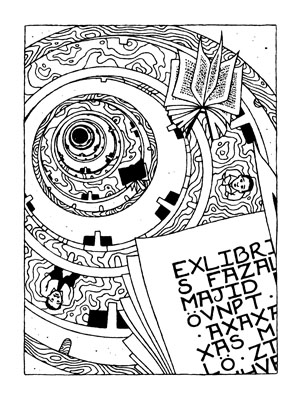
In Borges' story, the Aleph is a point in space that contains all other points. Anyone who gazes into it can see everything in the universe from every angle simultaneously, without distortion, overlapping, or confusion. The story traces the theme of infinity found in several of Borges' other works, such as "The Book of Sand".
Maze is another favorite theme of his.
Borges fractalizes the labyrinth, infinitely multiplies the interconnections between spaces — but makes all these spaces identical, cloned pieces of an infinite non-linear repetition, extending vertiginously into eternity, out in space and deep into the future, forever onwards.
I suspect this is obvious to the HN audience, but this work is nice little exposition on some concepts of Information Theory. I wonder if Claude Shannon had any thoughts on it.
There is a fun story based off this idea, A Short Stay in Hell by Steven Peck [0]. In the story the character dies and wakes up in a kind of hell that is basically a version of the library of Babel. There are other people there. You're allowed to leave if you can find the book that has your life story in it.
How would you tell the difference between a book that has your life story in it and a similar book with inaccuracies in all the details you don't remember?
The book qualifies this by giving everyone a perfect memory of every moment of their lives.
> I found I could recall every detail of my life; every event ever experienced I could remember with perfect clarity. I could remember every word on every page I'd ever read. Every conversation. Every tax form I'd ever filled out. I could reconstruct every second of every day I'd been alive from the moment of my birth until the day I finally shut my eyes at the end.
> This clarity of memory surprised me the first time I tried reviewing the past, but it was all there. (This was to be the greatest curse of Hell. Sometimes I would reply my entire life again and again for thousands of years. Remembering all the things I could have done differently, all the things... No. I won't go there now. I must tell this story).
> the middle-square method is a method of generating pseudorandom numbers
> The book The Broken Dice by Ivar Ekeland gives an extended account of how the method was invented by a Franciscan friar known only as Brother Edvin sometime between 1240 and 1250.[3] Supposedly, the manuscript is now lost, but Jorge Luis Borges sent Ekeland a copy that he made at the Vatican Library.
Can someone please help me? I'm trying to recall a post on HN within the past year that ended up introducing me to The Library of Babel. It was like a textual/visual blog post/article either in the same vein as The Library or direct text from it...or maybe the images were originally meant to illustrate it. It was weird. That's all I can remember.
Thank you, but no luck. I don't think the post had any explicit references. Could've sworn someone must've mentioned it in the comments because how else would I end up on the Library of Babel wikipedia page?
Any Fermi Problem-like answers to how large the library would be, based on how the number of permutations of the books and the size of each room? Is it an easy guess to say larger than the size of the universe?
If the sets of integers and reals is anything to go by, an infinitesimal portion of the books would include something that's actually legible, but perhaps the books could be sorted so those containing the most sensible arrangements of letters were kept nearby: don't bother looking at those noisy tomes of high entropy.
But perhaps the noise is just a language you haven’t recognized? Perhaps the noise contains True information when decoded using a scheme described in one of the other books?
O very true... you might start trying out one book as an XOR key to another. Of course, the result of decryption will already be sitting on the next shelf over :-)
What I was trying to say was, since there are an infinite number of real numbers between each pair of integers, there would be a similarly infinite number of garbage text between each pair of legible texts.
Even though there are an infinite number of integers, there are an even more infinite number of reals, rendering the proportion of (integers)/(reals) to be near 0.
In my Lovecraftian phase I imagined an infinite winding black pagoda with brail inscriptions on its walls. If you're very lucky you would wander up or down until you died of thirst reading nothing but nonsense. If you weren't you'd find the necronomicon or worse. Unlike the library the text would not be finite and there would be no limit to the eldritch horrors you could find within.
Nice find. That was written by Willard van Orman Quine, the noted logician/philosopher whose surname was adopted to refer to computer programs that are designed to output their own source code.
I like Borges, but this is one of his weakest stories. The mathematical point made is on the trivial side (and most readers who praise it interpret it as merely making a mathematical point). It is a bit stronger if read as an implicit critique of logocentrism or religious textualism, but still falls short of the best few of his other fictional works.
This story isn't really about mathematics. It's about the human response. It's about how we humans are pattern seeking creatures in a world of chaos that create patterns through our own process of seeking.


I used to joke that I was going to introduce a phone that could remember 10M 7-digit numbers: just enter the 7-digit index of the phone number you want to recall.