So much of the most comfortable housing stock in America is single-family "McMansion" type homes. The type of suburban detached house that likely the majority of middle-class American millennials grew up in.
For a young adult in the current economic climate, the only way you're living in one of these cushy homes is if you're living with your parents.
You can't rent one very easily, since they can't be divided up into multiple units or rented at all due to zoning and HOAs. Not to mention it's not typical to be a renter in these neighborhoods to begin with, so even finding a rental is nearly impossible in some areas.
Then of course, after the housing bubble crashed and the subsidies went away, a mortgage for one of these became a big challenge to achieve, and who has the savings sitting around for upkeep and emergency maintenance?
Boomer parents, and a handful of lucky gen-xers are pretty much the only people who could comfortably acquire and hold onto these houses, so it only makes sense that sticking to them like glue is the best strategy if you wanted one.
And there's also the fact that it's just not cool to live in the 'burbs, where you grew up, in the first place. The mental justification has to be "well I'm saving money at least". Saving money, means crashing with the parents. After all, it's "just temporary".
Those are at least my very subjective observations that might be overlooked in that study...
> For a young adult in the current economic climate, the only way you're living in one of these cushy homes is if you're living with your parents.
This is a very coastal/urban-centric view, IME. The large majority of my social circle growing up in suburban Dallas (a) still lives in suburban Dallas and (b) found a detached home before age 30 (if not 25). I moved away from the suburbs, and to a big coastal city, and so did almost "everyone I know" out here (with a lot of selection bias), but judging from that and housing prices in those crazy markets doesn't work for extrapolating to the country as a whole.
Of the ones still living at home, I don't know anyone thinking "it would be just as cool to have my own place, so might as well save money." The causality is reversed: "I'm broke, so might as well save as much money as possible, and my parents' place is big."
"Not cool" starts being a lot less relevant pretty quickly after getting out of college for most people, IME. Suburban houses are bigger than apartments. They're less noisy. They're more pet friendly. You have a garage for storage/workshopping/whatever. You have more space for starting a family. All those reasons still apply as much as they ever did, the big change from ten years ago to today is economic, not around coolness.
Keeping in mind that a large portion of these people live in areas outside of Dallas, with the average home price only several hundred grand above $150k[1].
In the greater Seattle area you'd be stressed to find a back alley condo for that cheap. My rent in the outskirts of Redmond for a 3 bedroom apartment is more than my mother's mortgage for her 5 bedroom house in Bellevue, which, despite being a 70 year old split-level home with low ceilings and a hill for a lot in a forgotten neighborhood without so much as one sidewalk, was appraised two years ago for over $750,000.
I can afford to live on my own, but hell if I can afford a reasonable down payment on a house within 25 miles of where I work.
Well, right, which is why the parent said it was a "very coastal/urban-centric view."
What he's describing about Dallas is true for the nearly 200 million Americans who live in the Midwest and the South. Cheap housing is the norm in the United States. I'm not bothered by people on the coasts complaining about housing costs, but you look foolish when you make generalizations about your generation that don't apply to the majority of the country.
For that matter, get an hour west of Boston and prices, while they may be higher than the national norm, aren't anywhere close to the Bay area stratosphere. So much of the discussion about housing prices here is about a very narrowly-defined set of urban areas--mostly on the coasts--plus the SV suburbs/exurbs.
It's even unclear how real the urbanization trend is as opposed to a preference for a small set of dense locations by college-educated people in a specific age range.
I have seen articles all over the place and comments all over this forum that suggest we all want to move into apartments in the city. I think a lot of it is propaganda by the real-estate industry as they are making ridiculous amounts of money by selling apartments. Governments also benefit as they can save money providing infrastructure.
I don't know about propaganda but, for whatever combination of cause and effect, urban living in a mostly narrow set of locales is more preferred than in the past by a demographic that is well-represented here. However, the pricing complaints are about San Francisco, not Detroit.
39% of the US population lives in a coastal state, that's not insignificant either. Most of those people have a problem with affordability, you can't just shrug the problem away.
There is more demand for housing in the coastal states. So the prices are higher. People should react to expensive, high-demand housing in the same way that they react to every other type of high-demand, expensive luxury good.
Which is to say:
If you can't afford to live in a coastal state, then what you need more than anything else is a U-Haul.
Those of us born in coastal states might have an issue with that. Affluence and gentrification destroy the character of interesting communities. Careless indifference deserves no place here.
It's not careless or indifferent to acknowledge that the demand exists. It is a fact of the world. A fact that, yes, I understand, you do not like. But I haven't seen a single proposal that does anything to realistically address it.
The demand is there and it's not going away. Whatever you're hoping for, it's too late.
Never say never. They just passed a law in California which makes it much harder for NIMBYs to prevent development. State-level laws can do a lot to curb NIMBYism, as the state government is concerned with having a healthy economy and doesn't care much about local efforts to fight change and development.
absolutely, just commented on something along these lines a few comments up. https://youtu.be/5GoAGuTIbVY?t=146 and another good commentary on a comparison of what percentage of income was spent on housing early in the 20th century vs later https://youtu.be/bbPYedkDU8Y?t=152
I was just listening to some Thomas Sowell on Uncommon Knowledge earlier who commented on the artificially inflated prices for these select areas: https://youtu.be/5GoAGuTIbVY?t=146
Well, maybe 1.5 the salary, but I bet total comp at Google in SF is way more than 1.5x best Ohio employers. But there is also California weather and NY culture that account for part of the cost of living premium. Don't think that has any value ? Great for you, you can live in Decatur. Ilinois.
Of course, but Google is an outlier in just about every sense. Most people in San Francisco don't earn the equivalent of Google's total comp.
Also, what's this nonsense about Decatur, Illinois? St. Louis and Cincinnati and Nashville and Pittsburgh and so on all have a bunch of pre-WWII, walkable, interesting neighborhoods, with little restaurants and bars and people putting on poetry readings and bands playing in basement clubs and jazz quartets playing at wine and cheese parties and concert halls that host national acts and major sports franchises and yuppies and hipsters and Python Meetups and comedy clubs and big pretty parks and coffee shops and whatever else you can think of.
No, they are emphatically not like San Francisco or NYC. But don't be silly. Millions of people live in those places. Did you really think they're all just skipping stones and waiting to die?
I'm quite glad I grew up here, because I think I'd be just the type of asshole who'd make jokes about Decatur, Illinois had I not. And you know what? I'd have been wrong.
Sure, they do have all those neighborhoods. The price differential reflects what people are willing to pay for one vs the other. The point about Decatur, Illinois is simply that Decatur Illinois lacks a lot of what SF has, which is why it's cheaper. It's a factual statement, not a value judgement
You'll get no argument from me here. But I think an erroneous value judgement is what's driving that demand. San Francisco is an incredible place. And a Ferrari is an incredible car. But lots of normal people would be better off realizing they can't afford the Ferrari and buying a Camry. It's not as bad as they think.
And to really strain this metaphor, people who have all their wealth tied up in a Ferrari would be a lot better off if they sold it and used the gains to live a comfortable life.
On good trips there, I can certainly understand the attractions of the Bay area (though I'm probably less sold on the city itself). However IMO way too many people, especially in tech circles, have convinced themselves that life isn't worth living if they can't live and work there whatever the other lifestyle tradeoffs. (Which leads to the corollary that someone needs to do something to make it possible for them to do so.)
As my friends who recently moved down here (Charlotte) from Brooklyn who worked in NYC tell me: still way too much, especially to have to deal with that traffic every day.
Rent in Brooklyn got them 12 acres 40 minutes away from Uptown Charlotte, and a house to boot.
I've lived in a bunch of US places, including rural Colorado and the Atlanta, Boston and DC metro areas, and I will say that Charlotte is a special case. People here complain about housing costs and traffic, and I just smile quietly.
But in the flyover states where housing is admittedly cheap compared to the coasts, so too are the wages.
"Cheap" housing only goes so far when your employment is 30 hours per week at the local Walmart for $9/hour. You're trying to pretend this is some "coastal" phenomenon, but you can't get there from here - you can't get the number of young people who have left the nest down from 60+% to just barely over 30% without it involving the entire country.
Young people in middle America can't afford to move out either.
For instance, in Ohio (as "flyover" as it gets :-)) the median household income is $45,749, and the median house sales price is $135,500, or about 3x median income.
In California the median household income is $67,458, and the median house sales price is $405,000, or about 6x median income.
So no, it is not actually true that the lower housing prices in flyover states are offset by lower incomes. Housing in California is proportionally twice as expensive as it is in Ohio.
Right. Households often have multiple incomes. That doesn't help the OP's point, though, since people in Ohio are more likely to live in a multi-income household than people in California.
If you look at per capita income instead of household, Ohio gives $135,500/$26,937 ~= 5, and California gives $405,000/$30,441 = 13 By that standard, California is 2.6 times more expensive instead of only 2.
I agree that it's a country-wide phenomenon. But everything else in your post is almost comically out of touch, which is to say that there are obviously other factors.
Because it's ignorant of basic facts. The median household income in the St. Louis metro area is $55k. It's $79k in the San Francisco metro, which is obviously quite a bit higher.
But you'd need to earn 159k per year in San Francisco to match the spending power of that $55k in St. Louis. And even that wouldn't be nearly enough to reach parity in home purchasing. Housing is 790% more expensive in San Francisco!
I get that it's fun to joke about flyover country, but the numbers are what they are. People simply are not struggling to move out of the house in St. Louis in the same way that they are in the Bay Area, for example.
Which is to say, once again, that there must be other factors at play.
Part of my point was to provide what feels like a more typical example for this audience. The parent made an anecdotal reference to imply he is an average HN user, to which I made a counterpoint with my own anecdote asserting I'm closer to an average user in terms of housing cost.
They're subjective but it's important to realize both scenarios and everything in between exist, and to acknowledge when you're only considering the extremities of that range.
That was my whole point. I may be a "typical" United States HN user paying thousands a month in rent, but "typical for HN" is a very small group, and "typical for millions and millions of other Americans" is something very different.
Fly-over country has many nice large homes for $200K with 1/4 acre or larger yards. And there are tech jobs, though obviously not as concentrated as the coasts. And the 15-30 minute commute is very typical. It all depends on priorities.
The perception today is that, sure, it's hard to make it on the coast, but there are no jobs and there's no culture in the Midwest, so that's out of the question.
What this is, more than anything else, is ignorant. I think I understand how it happened. The inner cores of the Midwestern cities that give large metros their names really have been gutted. They were literally ripped through by highways, intentionally segregated, their manufacturing base decimated.
They're crumbling.
And boy oh boy does this story have legs. It's sort of fun to flip through the destruction porn. Pictures of brick piles where houses once stood titillate.
So, it must sound as though entire regions are falling apart. But it's just not so.
If you were to do a quick search for information about St. Louis, MO, you'd learn that the city has a paltry median income of about $30k, a dwindling population of about 300k, and a pathetic land area of only 66 miles squared.
But the City of St. Louis refers to a very small part of a much larger region, an area myopically bound by voters who in 1876 couldn't imagine much happening in the farmlands beyond those lines.
The region today -- much of it on those old farmlands -- has 2.5 million people and a metro-wide median household income of around $55k.
This is the true picture of the region, though most descriptions of it are drawn from only its worst parts.
The fact is that, for many people, the opportunity in places like California lags far behind the increased cost of living. Lots and lots of regular folks would be far better off relocating to places they've long-ago dismissed without a serious look.
Yes, we have winters. And no ocean. But, yes, there's actually culture (of the kind generated everywhere that two and a half million humans live). And good housing. And, most important: you can actually afford it.
If someone is looking the broad area between the coasts, they see:
1. Crumbling ghettos (as you describe)
2. Crumbling non-ghetto rust-belt that's still not pretty
3. Rural areas beset by meth and herion.
4. Vast-scale suburbs with indeed little to no culture and fairly thin on jobs.
5. Areas like the coasts but costing close to the price of the coast -
But I'm sure there's good stuff between that.
Also, the City Of St. Louis is certainly the limit of the broad St. Louis ghetto, as the Ferguson events clearly shows. The metropolitan area is basically the 2nd or third most dangerous city in the US (behind Detroit and sometimes New Orleans).
The metropolitan area is basically the 2nd or third most dangerous city in the US (behind Detroit and sometimes New Orleans).
This is not only incorrect, it's perhaps the most notorious example of the problems caused by comparing cities at a level smaller than the MSA. The St. Louis MSA is, in fact, about middle of the pack on crime. See here:
The division between St. Louis City and St. Louis County creates a lot of issues for this region, but the fact that you could make your comment with such confidence demonstrates that the area's primary challenge is image marketing.
The problems actually go even deeper than this. It's pretty difficult to make reasonable comparisons using crime data, even when looking across entire regions.
To illustrate this, imagine one region where the baseline crime rate is not extreme, but above average all across the region. Now, think of another place where most of the region is pretty safe, but one pocket of the area has an extremely high rate.
These two regions might have identical crime rates. But which one would you rather live in?
This is why the FBI recommends against using its own numbers to make comparisons like the grandparent's:
"Each year when Crime in the United States is published, many entities—news media, tourism agencies, and other groups with an interest in crime in our Nation—use reported figures to compile rankings of cities and counties. These rankings, however, are merely a quick choice made by the data user; they provide no insight into the many variables that mold the crime in a particular town, city, county, state, region, or other jurisdiction. Consequently, these rankings lead to simplistic and/or incomplete analyses that often create misleading perceptions adversely affecting cities and counties, along with their residents."
Boy, no kidding! About 12 years ago I moved from the west coast to the midwest to a place I never thought I'd live. I can't believe the quality of life and work-life balance out here. My friends wondered if I'd have access to the Internet :) It's really perception more than anything else.
Texas, Illinois, Ohio, and Michigan account for 9 of the 25 best school districts in America, according to at least one ranking [1]. There are good and bad schools everywhere, and it's up to families to suss them out; living in the middle of the country does not necessarily mean living in an anti-intellectual backwater.
You can't possibly believe your own words. Am I to believe that you think every school in the Midwest teaches creationism? The ignorance and myopia in this thread is staggering.
Sorry, never heard of creationism being taught in schools around here. Although we do have a replica of Lucy in the towns science museum, and I do have a autographed copy of Dawkin's latest book when he came to talk last fall.
> "Not cool" starts being a lot less relevant pretty quickly after getting out of college for most people, IME. Suburban houses are bigger than apartments. They're less noisy. They're more pet friendly. You have a garage for storage/workshopping/whatever.
Amen! You get tired of living in basically a post-college dorm scene really quick, all the meanwhile paying 1000-2000 for the "luxury" when you can turn around and put that same money into 4x the space, and be actually building equity in the process.
The problem with the DFW Metroplex is that walkability is kinda garbage.
Also, the burbs (Grapevine, Colleyville, Arlington, Euless, Irving, etc.) are soulsucking tracts of aparments and housing subdivisions. Walking around is hard, biking difficult (getting murdered on large streets and highways), and the only non-chain stuff tends to be overly-face folksy town centers that people are moving towards (see Southlake, but even then it's a lot of big chains because of how much it costs to be there).
And that's before you even go into the shittiness of commuting around Dallas.
It varies. If you go back 30-40 years into the housing stock, prices are flat. Only the big McMansions have the higher price. When last I checked on the last house sold in the area ( in 2004 ) it had appreciated very little.
It's more than uncool. It means giving up a huge portion of your life to commute to work, to your kid's school, and to the grocery store. It's definitely not coolness that keeps me living in a neighborhood where I can walk to the grocery store and to work. It massively increases the hours of my life.
It's a lifestyle choice. Personally, I like restoring old cars, remodeling my home, building robots. I couldn't do any of these things without being already wealthy if I lived in a big city, within walking distance to the grocery store and work.
I gladly commute so I can come home to something more than an apartment or condo, because that is all that is available or affordable.
Priorities differ. Furthermore, not every job is in SOMA--or even in the Bay Area. Many tech jobs are in exurban areas an hour or more from the nearest metropolitan area. You can certainly choose not to work at one of those companies, but it limits one's options.
Which is fine. But, at least in the US, many of the even "urban area" tech jobs are not within a city's public transit system etc. Personally, I work for a tech company which is about an hour outside of the local major city and that's pretty typical of many of the major tech jobs in the area.
Victoria is wonderful if you can afford to pay a shocking amount of money for a condo/house or tolerate living in student-grade housing well into your thirties. Otherwise, Kelowna is a beautiful town with more reasonable cost of living, a good urban core, terrific weather, and easy access to some top-notch nature.
Nice, thanks for the info. I am also considering good school and educated community areas in Canada, I saw MoneySense report and it seems Ottawa is a good place (ah weather I know), it seems Kelowna (Saw it mentioned before also) suits the bill here.
What are tech jobs in Kelowna? I can't imagine there are many tech jobs there at all. Or at least any tech jobs there that pay more than 30% of a similar job in major US cities, let alone SV.
That long commute only happens when you live outside of the expensive coastal city, but insist on working there.
I can probably drive to all those places (work, school, grocery) faster than you can walk to them. Had I been willing to live on a street with cars passing by, I could have been within a few hundred feet of work+school or the grocery store. As it is, they are all within 3 miles without really any traffic. Getting to work is 3 minutes. Getting to groceries is about 7 minutes, and I can actually bring back enough stuff for a large family. School would be 1 or 2 minutes.
Oh, as a bonus, I never face the threat of personal crime.
For some people, spending most of your life in a polluted, noisy, shitty apartment is giving up more life than the commute to work. It is unfortunate that we have to make such terrible choices.
If you're talking about being able to claim mortgage interest on your taxes then that hasn't gone away yet. I don't know what other kinds of home owner subsidies exist.
I've never understood why people make such a big deal out of that deduction. It doesn't add up to very much in my experience - not enough to make it worth considering in one's decision about which house to buy, much less one's decision about whether one can afford to buy a house at all. If you're relying on the mortgage interest deduction to make homeownership affordable, you.... well... it's going to really hurt the first time an appliance breaks or you have to call the plumber or whatever. Better to keep renting.
> I've never understood why people make such a big deal out of that deduction.
It contributes to economic unfairness. Paying less taxes just because one owns a house is not optimal use of tax dollars when people who can't afford a house are doing pretty badly.
A homeowner pays less in housing costs (mortgages aren't subject to rent increases by a landlord) and pay less taxes than someone who rents who makes the same and they get to keep all the equity. It's incredibly unfair.
The historical reason for the subsidy is to increase home ownership. It's not really helping anymore.
That's the part I understand. What surprised me, when I bought a house, was that for all the talk about what a big deal this deduction was supposed to be, and how difficult it would supposedly be to eliminate it, the actual effect on my total housing cost was effectively negligible. They could roll it back tomorrow and I'd never notice.
I've owned three homes and never taken the mortgage interest deduction. The historical reason is based on 20% down mortgages for less-than-2x-annual-income housing. That's clearly not much the case any longer. Now it's expected by the NAR and the general real estate industrial complex.
I've never understood why people make such a big deal out of that deduction
The reason is that this, like nearly everything else in this thread, only applies to the coasts or for houses that would be considered quite expensive elsewhere.
The median home value in St. Louis, for example, is less than $150k. The standard deduction for a married couple filing jointly is $12,600. The math is pretty simple from there.
I think it's because many people confuse deductions with credits, to confused a deduction for a credit makes it seem like a huge amount than the fraction amount the deduction translates to with taxes due.
For most people middle class and higher it lowers the effective interest rate by a third or more. That's a much lower interest rate and changes the math a lot.
Hm. I guess it doesn't matter to me because I bought at a time when the interest rate was practically nothing anyway (my mortgage is at 3.5%). I can see how it would have been a big motivating factor for people in my parents' generation, who are of course the same general class of people who would have been trying to convince me that the mortgage interest deduction was a big deal.
I wonder if many project builders have tried promoting plans that make a larger house easier to compartmentalise either for separate living for teenage kids, or to sublet to someone else? e.g., separate entrance and main rooms, perhaps shared but lockable laundry, etc.
Others have pointed out, but I will emphasize, that this runs smack into the local politics of suburbia. Most people don't want to live next to a multi-unit house, and so:
1) the value of homes around a multi-unit house will decrease, causing enmity and dislike between neighbors, and
2) neighbors will respond by forming HOAs that restrict the number of units allowed in a house. My own HOA, for example, completely bans renting out my entire house, much less subdivided portions thereof.
Reading this makes me so glad I live in a part of the country where there are no HOAs and where multi-unit houses (2 and 3 unit freestanding) are typical. It's a great neighborhood, and the high density means I can live within walkind distance of way more friends than in the part of the city where I grew up.
Well, there's street parking, for one. In SF, for example, developers are not allowed to put as many parking spots as there are units. This is supposed to drive people to use mass transit, but more obviously increases demand for street parking. OTOH, single-family housing almost always has dedicated driveways/garages to eliminate this issue.
It's all about profit for the builder in relationship to municipalities and their zoning codes. Municipalities that were mostly formed around the time of the suburban building boom instituted very strict zoning and regulations around density, subdividing properties, adding in-law units etc.
Fast forward to today and in all but a few very progressive communities, the fear of changing these zoning laws negatively impacting property value has essentially frozen them in time. So in a lot of suburban areas you couldn't build separate living units on one single family lot, even if you wanted to. Or at least it would be quite costly.
For instance my brother-in-law is a planner in a suburban California city, discussed this once with him... apparently in his city you need to add 2 additional parking spaces for every extra housing unit added to your property. Want to make an in-law unit for grandma? 2 parking spots please. Don't have room for an extra driveway? No permit.
Basically unless new construction was zoned to be a higher-density area, for apartments or townhomes etc, for a developer it doesn't make much sense to build with extra units in mind. Especially if the builder has to put up a fight for permits or spend that much more money to meet code. In that case, it's more profitable to just be building condos.
Christopher Alexander talked about that in A Pattern Language, and the New Urbanist architects talk about/design for/build it quite often (the usual solution is the "carriage house" or "granny flat" but more generally the idea is to restrict zoning to address patterns of activity in public spaces, thus legalizing more variation in demographics and behaviors across time and short distances). It does not really fit into the mainstream (suburban) scheme of fastidious homogenization of uses and forms.
I think they don't because then you get into multi dwelling zoning and if the property was zoned for single-family homes it could get complicated (probably not by much).
In other countries it's common to live with your parents until you're married, or even a little bit past that. In America it's looked down upon. Nothing wrong with staying home, saving money (even if you pay rent to your parents, it's cheaper than living on your own). You can save money, pay for school, or not be forced to work a job by staying at home longer.
Yes, but if the current young generation of americans is poorer than the preceding generations (a conclusion I think is inescapable at this point), then it is worthwhile considering why.
The world is certainly richer than it was in the 80s. We are vastly more efficient at producing all sorts of goods. So, then, why is the current generation of Americans unable to afford what was available to the middle class previously?
I believe that the answers to this crucial question are obscure and are unlikely to be found in conventional economic and political analysis.
> Yes, but if the current young generation of americans is poorer than the preceding generations (a conclusion I think is inescapable at this point), then it is worthwhile considering why.
The answer is multifaceted, but part of the problem is that some of the major reasons are extremely politically inconvenient. For example, what are the economic consequences of women entering the workforce in large numbers in recent generations? Increased labor supply drives down wages per employee, then more two income families increase price inflation (especially real estate prices). Together they transfer most of the economic value of women working into the hands of employers and existing land owners, when the economic value of the domestic labor it displaced had previously gone primarily to the woman and her family. And people who remain single are extra screwed because they suffer the same wage and price consequences without the second income.
But for cultural and biological reasons when one spouse is a homemaker it will almost always be the wife rather than the husband, so policies that would increase the standard of living by reducing the number of two income families have consequences anathema to the left (fewer women working) and the right (less value captured by employers and land owners). So we don't talk about it.
> Increased labor supply drives down wages per employee
According to conventional economics, quite the opposite: it makes the economy bigger and creates more jobs.
(If growing the workforce increased unemployment, then bigger countries would have high unemployment and population growth would also increase unemployment).
don't forget upto 40% of her output goes to the government in taxes. so even the civil service / employees of the state (who don't care about left or right) prefer both working...
This is very true. We made the choice to have my wife stay home and raise our children rather than go back to work. We're fortunate to be able to do so, but when doing the math and calculating the after-tax income she's bring home, so much of that income would have gone straight to child-care that it was a no-brainier to have her be the caretaker in these early years of their development. The cost of childcare is a very real challenge for the United States.
Ditto here, though we hired a nanny the last 6 months before school-age since a good job opportunity came up for my wife. Now it seems he income just goes to pay taxes.
>I believe that the answers to this crucial question are obscure and are unlikely to be found in conventional economic and political analysis.
I'm astounded by this comment. Are you saying that the obvious answers of asset based inflation caused by our monetary policy does not majorly impact real estate in a way that hurts younger generations and the middle class?
I can't see how. It's basic math.
If assets rise in price and two people are leveraged into assets the same amount, who gets richer, the person with a 100k asset or the person with a 500k asset?
Oh, lovely. No, that's not it. Asset-based inflation is very much the better answer because that's how exponential things play out. Low interest rates stop (mild) inflation from bleeding off asset bubbles, so people do that because there's no risk.
To the extent that Baby Boomers foemented low interest rates and low inflation ( although that's arguable too - the 1980s were not exactly peak Boomer years - see the 1990s for that to really take shape ) you are correct, but it's really just collateral damage. When you make this much more money sitting on land for umpety years until its developed, that's the business culture you'll end up with.
Throw in the effect of 401k plans dragging everybody into the stock market and you get an even fuller picture.
A lot of Boomers are really boned. Like, poor. More than is commonly written about.
ObDisclosure: I am a cusp baby between the Boomers and GenX, early '60s model.
It is a generational wealth transfer. But when boomers die, they're generally leaving that wealth to millenials, aren't they? Except that the boomers also have a lot of debt.
That would depend very much on how the wealth is consumed I would guess. If it is used to finance vacations to Mexico and throw away imported consumer goods, that wealth will be lost. If it was used to build nice cities and finance great art, it would be preserved.
> The world is certainly richer than it was in the 80s
It's debatable. I was in my 20's in the 80's. I was able to buy a 3br/2ba, 1500sq ft. house when I was 26. I had my school loans paid off a couple of years after I graduated - that's not happening for 20-somethings now.
> I believe that the answers to this crucial question are obscure
I don't think they're so obscure. If we are wealthier now, then it's likely that the wealth is in much fewer hands than it was in the 80's and before. Income stagnation. Wealth accumulating in fewer and fewer hands. Back in the 1860's Marx told us this is what happens in Capitalist economies. While you may not agree with his prescription (and I certainly don't agree with most of it) his diagnosis was pretty much spot on.
>It's debatable. I was in my 20's in the 80's. I was able to buy a 3br/2ba, 1500sq ft. house when I was 26. I had my school loans paid off a couple of years after I graduated - that's not happening for 20-somethings now.
No, it's really not debatable the world is richer than in the 80s. Much of that wealth has been accumulating outside the US, though, particularly in India and China.
With interest rates as low as they are you could definitely get into a 1500 sq ft. house by age 26 today. You just can't do it in the places many 26 year olds want to live.
There's no way that 26-year-olds can afford a 1500sf house in those areas because the only jobs available are at Walmart. The places where 26-year-olds can get good-paying jobs are also places where the real estate is much more expensive.
>Where in the country can you not make $15/hr by age 26?
Any town where the only jobs are at Walmart and the feed-and-seed store. Walmart doesn't pay those kinds of wages in rural locations (or probably anywhere else, unless you're a manager).
> Much of that wealth has been accumulating outside the US, though, particularly in India and China.
But from a US perspective we seem to be poorer now.
> With interest rates as low as they are you could definitely get into a 1500 sq ft. house by age 26 today. You just can't do it in the places many 26 year olds want to live.
I bought that house in a place where 26-year-olds want to live (a West Coast city). Interest rate was 10%, but I was able to pay off the mortgage in 9 years. I don't think a lot of 26-year-olds are in that position these days. Too much student loan debt and houses much more expensive as compared to incomes.
We aren't poorer (well we might be a little bit because of the Great Recession), housing just costs a lot more than it used to.
Our parents just didn't get to buy a house for cheap. They also got all the increase in value. We have to buy an expensive house that probably won't increase in value all that much.
Why is housing more expensive? I'm not totally sure, but I suspect it's the effect of stretching suburbia to the limits. When my parents house was built it was the frontier between rural Illinois and the Chicago suburbs. Now it's considered a middle rung suburb. There are suburbs an hour further away from Chicago. But we've hit the limits on what a person can tolerate re:commutes. You just can't commute for over 2 hours each way.
We should be rezoning inner rung suburbs and cities for increased density housing.
Then again telecommuting and/or autonomous cars might destroy all the downsides to commuting.
Probably because land area is zero-sum and population is twice the size it was in the 60s.
Also rent-seeking, foreign investors buying houses with cash, etc.
It's a combination of factors.
> We should be rezoning inner rung suburbs and cities for increased density housing.
Agreed. Most of the suburbs are hideous, inefficient (most houses built before 1973 have marginal to no insulation) and in many places crumbling from age.
Coming from a country where education is free and renting (was) normal it sounds crazy to make so much debt. The 'crazy' is not meant offensive, more like interesting.
Think they will be rich... Wait until the health care and other end of life costs start to add up. Even here in the UK they can be high, if you end up spending time in a 'home' that can quickly eat through savings. So unless there are amazing full life health care and other insurance policies covering these guys then there is ever chance that all that money could go.
This. The entire point of the establishment convincing people to hand over large chunks of their labour for fiat currency is because they are giving you peanuts. You can't cash it in! All these houses "worth" $1MM - who is going to buy them? Demographics are shifting as the boomers die off.
Young Americans are living with their parents instead of saving money rather than living with their parents to save money.
What happens when they have children? Where will their adult children live? In their parents tiny 2 room apartments?
Basically, the full effects of the declining net income of adult Americans is being masked by people living off the accumulated wealth of their parents (both consuming their houses and getting hand-outs). Which implies that there's cliff that the American lifestyle will fall off at some point and then things will be ugly even in comparison to now.
The younger generation is simply not having children at the high rate of previous generations.
Anecodotally, most of my mid 30's friends have either 0 or 1 child, a few that got started earlier have two.
On the other hand, the millions of legal and illegal immigrants, especially from Latin America, are keeping the birth rate up. They do, in fact, many times live in much more crowded conditions. I have met a few Hispanic immigrants in my area as I speak Spanish, and in each case, they lived in single family homes with multiple families / generations.
I think three-generation households have been somewhat common throughout most of history, even in the USA (although admittedly probably not in the sort of high-rise apartment buildings where many people live now).
The US was the only major industrial nation not to be completely devastated in WWI and WWII. They/we benefitted from this enormously throughout the 20th century. It was only a matter of time before things normalized.
I don't think we have free trade (although I would certainly support it!). I think we probably are richer than we were pre-war. We're just not at the peak we were after the war when we had a monopoly on success.
We also profited greatly supplying the wars. We haven't had a "market" like that since then. The US was mostly its own customer during the cold war.
What other major industrial nation was not devastated during either World War? (I guess you can say "Canada" but I'm not sure how "major" or "industrial" they would have been in WWI).
My question is: the standard Ricardian argument for international free trade assumes that as trading partners become more productive, all trading partners benefit. Do you think this is the case? Certainly the original post does, as confirmed in his response.
If that is so, why would other countries becoming better at making things make us poorer?
It's caused by corruption in local governments. Not enough housing is being built; this means that prices rise until enough people are living with their parents or with enough roommates to cover the shortfall. The reason not enough housing is being built is because local governments are preventing it, using zoning. If the restrictions were loosened, rents would fall. If the restrictions were eliminated entirely, they'd fall precipitously.
Its a bit outdated, but the numbers have not radically changed[1] - around 10% of all housing is unoccupied in the US. Sure, its a huge place, and I can imagine few people want to live in Nowhere Nebraska, but that does not change the reality that we have some ~6x more unoccupied houses than homeless, and the vast majority of new construction is the same old unsustainable unaffordable suburban sprawl we have had run rampant with McMansions in this country for the past twenty years.
What we need is not the creation of new houses, but new cities, or the dramatic rebuilding of the old ones. We need high density urban environments with low cost of living built around foot and public transit, no cars, and with mixed use building again, without the zoning hell that currently cripples growth in almost every corner of the US today.
Actual, real-world people vote against high-density urban environments with their feet, and pretty much always have. It's just that in past ages it was only the rich who could afford a country home. That's changed, thanks largely to modern transportation making it possible to work in the city and live in the burbs.
This coffee's claim to fame is that the beans have been eaten (and then excreted) by a cat-like animal called a palm civet.
Now, does that high price mean that most people want to drink this coffee? Nope. Most people would avoid it at all costs. There is a small group of connoisseurs who enjoy this coffee. The price is high because, as small as that group might be, the (tiny) supply is insufficient to satisfy their demand at any lower price.
Similarly, there's a subset of people (mostly, though not exclusively, young, single, and childless) who actually enjoy living in dense urban environments, and will drive up the price accordingly. Those people are not the norm.
"We" is society at large. And half the point of this article is that "young Americans" cannot afford those country homes with long commutes, and thus still live with their parents.
For the current upcoming generation, they do not have the means to afford those homes either. If you want to house them independently they need denser Urban living since modern transportation in the form of personal automobiles is also incredibly expensive.
Society at large has decided that it likes suburbs and McMansions just fine. You don't get to make that decision for other people, just because you use the word "we".
'And half the point of this article is that "young Americans" cannot afford those country homes with long commutes'
Well, then, that's the problem needs to be solved, rather than patching it by forcing people back into the crowded urban environments that they so obviously do not want to live in.
'denser Urban living since modern transportation in the form of personal automobiles is also incredibly expensive.'
1) Why does it need to be dense and urban?
2) No, they aren't. In 1950 a median-priced new car cost about $1,500, somewhat more than half the median annual wage. Today you can get a new Ford Focus for about $17,000, which is... somewhat more than half the $32,140 median annual wage for those over 25.
Also, most families in 1950 had one car, period. Most families now have at least two. That doesn't tend to support your claim that cars have gotten more expensive.
'Society at large has decided that it likes suburbs and McMansions just fine.'
No, the people with the money and land have decided that they like suburbs. I am sure that if a millennial could buy a small patch of land and build a small house on it for cheap, they would.
This is the reason given for why housing costs are high in the bay area, but is not really the reason why housing costs are high, at least in general. Only a small percentage of people actually want to live in shitty apartments in polluted, concrete cities. You can make a million apartments and it is not going to reduce the price of houses where most people actually want to live.
Right. Labor = citizens. Citizens = votes. And as a society, we can decide to tax your productivity to provide for said citizens (Human being quality of life > profits).
I've never seen a more accurate sound (text?) bite for the challenges that today's labour market are facing.
These will only be exasperated further by the onset of automation and robotics in the coming generation(s).
I don't have a doubt that we could easily turn around the benefits of automation and robotics towards favouring the middle and working classes.
My concern though, is that the few that are currently gaining wealth from reduced labour costs in favour of productivity have a stronger grasp on where this wealth goes, than the majority outside of socialist strongholds like Scandinavia and some European states. And that trend will continue.
Surplus labor allows for the devaluing of labor. Japan doesn't have a surplus of labor (IMHO) due to lack of immigration and a quickly aging population.
Japan does have a labor surplus. That's why they have so many public sector make-work jobs doing things that could be automated or performed with fewer people.
Easy. It was harder and less acceptable to use international labor then, there were that many fewer college educated people, and that's 36 years behind the current level of automation technology.
>It was harder and less acceptable to use international labor then
This is very true. I know the big US car unions ended up screwing both the employees and employers, but have you ever wondered what would have happened in the 60's or 70's, had the line manager come over and told his assembly line team that they were going to not only be fired next month, but if they wanted a severance, they'd have to train their replacement recently imported from the third world?
I can guarantee you that there is a good chance this mgmt. team would probably end up dead or severely injured soon afterwards.
Today, the same circumstances elicit, at most, a few angry comments on some online media forum.
They also had a far less connected society where surveillance was /much/ less common and far more easily spotted.
I imagine the reasonable chance that someone snapping figured they could get away with it, particularly in a close knit group that routinely went fishing or hunting together and would say that's exactly where they were at the time something happened; was /much/ higher back then.
Also today everyone knows that someone else will just be hired to do the same thing. Today when some kind of correction does happen it'll either be approved from on high by those seeking to avoid an old-school revolution, or it will be a bloody zerg-rush.
This is a big thing that, oddly, a lot of folks in my cohort (~40s) are unwilling to admit.
You don't have to like unions to admit they benefited workers. In fact, the money spent on the destruction of unions points to it - why bother if they didn't help workers?
The post-WWII bargain, where productivity growth was split, is gone and not coming back. Whether there's a way to give workers a voice again or not is an interesting question.
Of course, if the class differential gets too big, there's always the pitchfork and torch route, which I don't think anyone (OK, most sane people) wants.
> It was harder and less acceptable to use international labor then
Yes, but we have been told that international free trade benefits us all. Do you disagree?
> there were that many fewer college educated people,
Yes, but we have been told that education is the key to our future, and a more educated workforce should be able to produce more and better goods for us all. Do you disagree?
> that's 36 years behind the current level of automation technology.
Yes, but automation was what dragged us out of the stone age and through the industrial revolution. It has, at times, apparently made us vastly richer. Do you disagree?
I don't say all this to be a dick (well, OK, kind of) and I agree to some extent with each of your points, but I think there is a larger issue at the root: debt.
> We have been told that international free trade benefits us all.
If you have 10 jobs paying people $10, and replace them with 50 jobs paying people $1, but keep the prices of the products the same; 10 people now don't have jobs, and 50 people each don't make enough money to buy any products. You've increased productivity 5x and cut costs in half but all of the gains go to shareholders.
> A more educated workforce should be able to produce more and better goods for us all.
Same as above.
> Automation...has, at times, apparently made us vastly richer.
Same as above.
> I think there is a larger issue at the root: debt.
It's the same issue. Debt is just another thing to rent to poor people.
burdensome and protectionism oriented business regulations blocks new entrants and means of doing business. When over a third of jobs require some form of certification, especially in lower paying jobs, it puts an unfair burden on employers and employees. When you can simply get government to regulate away your competition job growth is stifled.
it is always government. from sucking too much money out of the banking industry to make available for business needs to government trying to pick favorites in new industries and distorting the markets. from playing rate games, backing securities, to inducing lending risk by pressuring banks to lend to those they would prefer not too
Even the ACA damaged the ability of those to earn a living by putting in place that infamous twenty hour rule. That wasn't done to benefit working people, that was done to benefit certain types of employers but more it was done to distort unemployment numbers by artificially raising the number of people needed to do that same amount of work each week. This ain't much different than pleads to make college free, keep able bodied people off the job lines.
Sure many of the rich are getting richer but they only do so because those writing the laws are in constant election and reelection cycles. Where they try to write laws prevent you businesses and such putting money into politics but slip in rules that allow PACs to take 350k from one person; provided "wink wink" its not targeted to a specific politician.
tl;dr. Government is the source of the wage stagflation.
To me it seemed like the normal cyclic nature of economics. We had a bubble around 2006-2007, and when it was ready to crash / correct the governments around the worlds threw everything at keeping asset prices high (we have had "emergency" low interest rates here in Europe for ~8 years)now. Great if you are older / richer. Shit if you are under 40.
> (a conclusion I think is inescapable at this point)
It's not obvious to me. Possibly only because I'm uninformed, though, so feel free to point me at any relevant data.
There are a variety of trends which could be happening and which might explain this particular cohabitation-with-one's-parents phenomenon without having to mean that the current young generation has less wealth than its predecessors.
I think it's double-ended - if Mom and Dad bought a 4,000 sq ft monster with a three car garage, why not occupy some of it? I think simply calling it "poorer" is a different thing.
My uncles lived with their Mom until they got married. They are roughly Silent Generation or WWII. Its just The Way It Was. We had a massive housing boom; now it's over.
That's true, in Italy this is definitely the norm, but this kind of screwed up economy that only functions for the oligarchy has also been the norm in Italy for hundreds of years so there would seem to be a correlation between not having families and people being stuck under systems of oligarchy.
Your argument is just people making excuses. If our food quality went down or the quality of our air went down due to pollution, would you still be quoting "oh well it used to be so much worse in the 40's so don't complain" ???
This is a BAD sign. It is indicative of an economy that is not working for most Americans. Making excuses and disregarding these proxies for American quality of life does no one favors except for the 1%.
>In other countries it's common to live with your parents until you're married, or even a little bit past that.
You are also not allowed have sex in these countries. Sexual repression sucks ass. I would take poverty over sexual repression. As someone who has experienced this; it has had major psychological impact on my life that I feel the effect to this day. And I am not alone, millions of youth in my country experience this. Imagine what kind of society that breeds, imagine living in a sex segregated society.
I have been living in countries where it's perfectly normal to live with your parents until you are married, which are no different in terms of sexual freedom (of freedom in general) or quality of life than the US.
It sucks if it not the case with your country, but do not make it a general case.
Living at home while working at even a decent paying tech job is a great way to save tons of money or pay loans. Definitely something I've considered doing. Also works great with remote jobs.
Sure but of course most people who live with their parent do so because they can't afford to do otherwise regardless of the clever few who aim to save even more money.
I thought living with your parents in other countries was more of an aspect of a collectivist culture, versus a hyper-individualistic culture here in the US. I'm not arguing for or against either, my point being that it is simply countercultural and is probably not due to a culture shift but rather other external factors. Any culture experts care to comment?
In Romania, especially in its rural parts, it's customary to keep one of the offspring if not with the parents then at least somewhere close to parental home. Families encourage their kids to grow and develop themselves, and support them in doing so up to a certain point in time. Afterwards, they go in the other direction and "encourage" through all their available leverages retention inside the family, and this goes in various forms, from mild pleas for payback care up to heavy psychological pressure with nasty tricks and everything, that stops only when a decision was made by one of their children. The "lucky" one becomes their heir and caretaker and the others are released off the hook. If you're better with or off your parents depends on the times you're living in (be it Romania or other place), but clearly that's not something as simple as a cultural trait.
In Mexico it's more the case of not being able to afford living alone if you're not a college educated professional; also roommates are not a common thing in Mx as there is always a general lack of trust towards strangers
In France the idea of a young adult living with parents was so alien that it was enough to make a movie about it in the 90s. Now it's the reality for half the population.
If everyone is saving money prices will climb up and most of them will end up with nothing.
What should be done is that market should be encouraged to provide enough housing that young people can afford when they need it. Same way Ford did with cars.
Definitely ethnic variations. I've known plenty of people who are relatively new to the US and still hold a lot of their previous customs about the living arrangements of children and young adults.
My impression is that most Americans look at it and say "that's different", but don't look down on it.
there are ethic variations if not some that developed regionally. however a lot also deals with perceptions built up over time. Farm communities tend to see this for farms passing to the next generation.
The college industry is big money and they are incessant in their message that if you spend tens of thousands you will be a success. This implies that those who don't are not trying or worse.
You think there isn't, I think there is. And not just the US, western countries.
You will notice the important of the individual in these countries, getting out on your own, supporting yourself. being your own person, not what your parents want to be.
To be clear, that's always been the case. Looking historically, the brief period in which the working class enjoyed a modicum of wealth in the 20th century is an aberration, not a historical precedent.
Humans always starved, always died of infections, always were mass-murdered. Why is that even an acceptable reason?
All the XX century was about changing things that were considered constant. Have we given up?
History should lead us somewhere. Is this already lost on us?
I never said it was a good thing and I agree we should take steps to oppose rentiers. I'm just pointing out that the norm of easy homeownership is actually quite recent and unusual.
The norm of easy ownership of anything is quite recent. Any wealth was scarce. But now there's no reason why everybody won't have some place to live for them.
I wonder how the average amount of free space per dwelling has changed over the last 50 or so years...
Perhaps this trend could be explained to some extent by the fact(?) that mommy & daddy have a lot more space at home nowadays than daddy's parents did when he turned 18, making living with the parents more attractive to today's young adults than it was to prior generations.
Not at all suggesting this would be the only likely factor, of course.
Houses today are much bigger. This is one of those things that people often forget when comparing current economic markers or generations to the past. Our standard of living is simply much higher today. The average house had approximately 500 sqft per person in 1973 but had increased by roughly 65% by 2010.
That may be true, but that's not a good data set to use either way.
The graph only accounts for 45 million houses in the US, including only the houses owned by the young and the old. But that is a small fraction of US homes. (If those were all homes, the average household size would be 7 people.)
Those exact same houses from the 70s (even from the 50s, in fact) are selling for seven figures near me. That's about 20x the median household income in my city.
That's what blows me away about San Francisco. Not only are you paying 10x ($1.5M) what most people in the US pay for a house ($150K), you're getting a lot less house at the same time.
We're talking going from ~2000 sq. ft. to ~1100 sq. ft., old construction, no insulation, etc.
If you really wanted to make a comparison between equal houses, the difference is more like 20x ($3M for a similar house in the Bay Area).
If you're comparing NYC to St. Louis and desire a 60th floor apartment in a high rise, then the COL difference is infinity or mu or NAN or something. You simply can't make the comparison.
The same is true when comparing the average detached home in the Midwest to San Francisco. For most people, the answer to, "how much more would I have to make to buy the same house out there?" is "it doesn't matter, because you'll never make that much."
The article strongly refutes your assertion that "Our standard of living is simply much higher today."
Obviously the standard of living is in decline. An article such as this provides some evidence, as does the well known fact that the male median wage has been in decline since 1973.
I don't see any such refutation in the OP. And our standard of living is obviously far higher than at any time in the past. Even given wage (lack of) changes, the access to more and better medicines, having at our fingertips the entire artistic output of the history of the world, safer and longer-lasting cars, longer life expectancy, ubiquitous and free to nearly-free instantaneous communication, ubiquitous good sanitation, refrigeration, lower crime rates, lower pollution, and on and on.
I can't fathom how anyone can claim that virtually any American is better off than his counterpart from any time in the past. So let's do a thought experiment: can you pick a past time in USA history where you'd like to be transported, keeping everything else (such as your economic quintile) equal, where you'd be better off? Or forget about keeping things equal, would you rather go back a hundred years and be in John Rockefeller's shoes? There's a good argument to be made [1] that you're better off than he was.
I'd give up current times to go back to the 50s-70s where you could comfortably live on one income in the suburbs.
I don't much care for safer cars, longer life expectancy, instant world wide communications compared to the freedom of living a much better life during one of the most prosperous times in US history. Quality of life experiences feels like it was much better before the 21st century race to the bottom. What's the point of living "better" if you're going to be chained to a desk or job for 50-60 years, or constantly have to retrain decade after decade?
>I'd give up current times to go back to the 50s-70s where you could comfortably live on one income in the suburbs.
You can still do that if you're willing to make sacrifices. A colleague of mine gets by on one income - I don't know what he makes now, but he started at $35k about five years ago. And this is in the SF bay area.
When you do the math having both spouses working doesn't increase your standard of living very much because of taxes and child care.
>where you could comfortably live on one income in the suburbs.
Does anyone have statistics on how many "traditional" single-income households there are in the U.S.? I live with my wife and four kids (home schooled) in a fairly large house, with a single income under that is apparently under the starting salaries for newly minted software-engineering graduates in the big urban areas.
Not that I think white Americans deserve some extra-consideration but the recent decline in the life expectancy of white Americans [1], coupled with indeed further medical discoveries, seems like a demonstration that the effective decline in wages is able to outpace even these better medicines.
Most of the improvements are superficial, apart from medicine maybe.
- Housing
- Education
- Quality of jobs
- Career growth
- Job security
These are less accessible than 30-40 years ago, while surely you can enjoy the magic of Facebook on your shiny iPhone, which were admittedly unavailable then.
Medicine's not improved much either. Mostly access has improved for the underprivileged.
Robert Gordon makes the point in his book, The Rise and Fall of American Growth, that life expectancy improved twice as much from 1900 - 1950 as from 1950 - 2000.
lol this is complete propaganda. Whether you realize it or not.
> And our standard of living is obviously far higher than at any time in the past
Human health declined beginning with the agricultural era. I mean, you don't even have any knowledge of every time in the past, yet you are so confident in claiming our lives have never been better.
> the access to more and better medicines, having at our fingertips
You do realise that the extreme majority of illnesses experienced today are caused by the modern world and lifestyles? These medicines are designed to fix problems that didn't exist previously. The most commonly sold medicine is probably heart medication or something like that. These were things people did not experience 50,000 years ago, or even 500 years ago.
> safer and longer-lasting cars
Do you realise that most people just use cars to sit in traffic for hours going to a job they hate? You consider that a sign of how great things are?
> longer life expectancy
Well it is now declining, but quality over quantity. Sitting around at 90 years old watching tv isn't something I would count as life.
> ubiquitous and free to nearly-free instantaneous communication
social media and communication over the internet is a terrible replacement for real-life communication. Social media is actually really depressing. There are even recent studies that link time on social media with depression.
These forms of communication are usually just a sign of isolation.
> refrigeration
great for ice-cream
> lower pollution
lol? Climate change?
> I can't fathom how anyone can claim that virtually any American is better off than his counterpart from any time in the past
I can't even fathom how someone who hasn't lived in any time but now can make that statement. Literally any time in human history? How was it like, I don't know, 200,000 years ago? Tell us. You will mention lower life expectancy. That is mostly due to infant mortality rates. Many people lived until they were 70. They had actual lives, not sitting at a computer typing shit all day.
Everything you say is complete propaganda of a corrupt capitalist society and you don't even realise it.
> I can't even fathom how someone who hasn't lived in any time but now can make that statement. Literally any time in human history? How was it like, I don't know, 200,000 years ago? Tell us. You will mention lower life expectancy. That is mostly due to infant mortality rates. Many people lived until they were 70. They had actual lives, not sitting at a computer typing shit all day.
For an account of living in agricultural (pre-industrial) society, I wholeheartedly recommend "The Peasants" by W. Reymont - the Nobel prize winning, extremely realistic account of how life was in a small village in central Poland around year 1900. In short: everyone was working pretty hard, but only the peasants who owned land were living a decent life. The others (a majority) worked on farms owned by the village's "elite" and always feared about their future (not to mention they sometimes didn't even own homes so they slept in for example their master's stable, next to the piles of horse shit). On the other hand, the work was more varied that most jobs today and there wasn't that much to do in the winters so everyone rested then.
I would absolutely go back 100 years and live John Rockefeller's life. I certainly value a lot of the advancements we've made since then, but for me luxury means not having to work!
I don't know if there's any reasonable way you can actually measure "standard of living", since it arguably includes "happiness" which is difficult to quantify.
Except he worked hard a good part of his life--whether or not a lot of people here agree with his goals. (And worked quite hard on philanthropy as well.)
John D. Rockefeller also did live to a rather old age. Not everyone in that era was as fortunate.
Maybe you missed the sub-title, which is "For the first time since the 1880s, more young Americans are living with their parents than with a romantic partner."
"I can't fathom how anyone can claim"
I can't fathom that you mean this literally so I assume you offer this in the rhetorical sense. You may wish to consider "Don't Get Offended":
"One oft-underestimated threat to epistemic rationality is getting offended. While getting offended by something sometimes feels good and can help you assert moral superiority, in most cases it doesn't help you figure out what the world looks like. In fact, getting offended usually makes it harder to figure out what the world looks like, since it means you won't be evaluating evidence very well."
I am guessing that, in reality, you do have the power to fathom such a thing. If you need help, there are thousands of well-reasoned essays on the web, which make the point that you claim to have difficulty fathoming. Google will steer you to them.
Or you can play Devil's Advocate to your own mind, and make the case yourself, to yourself.
My point is that most of these metrics just use sticker prices. If you say something like wages have decreased in relation to housing and automotive prices, you can't ignore that houses are bigger today and automobiles are more reliable. If the median car price has stayed the same but your car now lasts you almost 100% longer [1], that is a stable sticker price but a 50% percent reduction is the yearly cost. If the median price of a house has increased by 75% [2] but the house is 50% bigger, the effective price increase is barely above inflation.
The problem with the argument that uneconomic factors have improved is not just that these are hard to measure but that a lot of folks have an interest in fudging the measurements.
Inflation adjusted wages have been quite stagnant while measures of inflation are rather dubious to say the least.
My old car is indeed a bit more reliable than my previous old car but both were reliable - I can't see that compensating for more or less everything costing more relative my relatively fixed income.
You seem like the type who is unlikely to change an opinion, so I'm not going to expend any more effort on this. However, for your own edification, you might want to stop and ask yourself whether this:
"If the median price of a house has increased by 75% but the house is 50% bigger, the effective price increase is barely above inflation."
can be reconciled to this:
"For the first time since the 1880s, more young Americans are living with their parents than with a romantic partner."
People are angry about the decline in the standard of living, and for most us, the justification for that anger is obvious.
>You seem like the type who is unlikely to change an opinion
There is no need to be rude. I posted twice in this conversation and linked to sources both times. I'm not sure how that gives the impression that I am being unreasonable.
>ask yourself whether this...can be reconciled to this...
It certainly can because they are measuring two separate things. Housing costs are up, but on a rate basis they are not as far up as most think. More Americans are living at home. The former is likely partially responsible for the latter, but it is unlikely that it is the only cause. As the article suggests, another cause is likely that younger people simply aren't living with romantic partners as much as the number of people living alone is also higher.
You really seem stuck on that one sentence from the article, but it doesn't say what you're trying to read into it. It does not say that standard of living has decreased. Heck, it doesn't even imply that. The only thing you can really get out of that text is that people's circumstances and priorities have changed. The change might be a decrease, but there's no need to read that into it.
Spot on. Every time I mention the high price of homes and how hard it is for non-boomers to enjoy such things as their own home, possibility of kids, family, stable jobs, there's never a shortage of defenders telling me that I'm out of line: they didn't live in a McMansion and get a new iPhone every year; younger folk have it easy and complain too much.
Well sorry, the exact same 1200 ft^2 brick home built in the 50s, that you bought for 2 year's salary (with a high school education) in the 70's, NOW costs 6 times my salary (or 12 times the median salary for the area).
The $600 iPhone which I absolutely need for any modern job (thanks to BYOD) isn't gonna make a dent in the cost of housing, health care, and college these days.
> The $600 iPhone which I absolutely need for any modern job (thanks to BYOD)
I agree with your overall point that things like housing, healthcare, and education are much more expensive today and are much more difficult to acquire, securely, on a median income. However, when you say things like "I absolutely need a $600 iPhone for any modern job", it comes across like out-of-touch whining. No, you do not need the latest iPhone for any modern job. You want the latest iPhone. You can get a very capable, brand new Android phone for around $100 bucks.
In the same way that client-facing bankers don't need to wear suits.
If part of your job is conveying status, bringing an Android to work conveys a completely different kind of status than an iPhone. It may not feel good, but that doesn't mean $600 for an iPhone, even when you can barely afford food/rent, is poorly spent.
If you're in a position where 1) your phone is out of your pocket and 2) you need to impress people, I'd be willing to bet you can afford the nicer phone or justify its cost to your management.
Functionally you don't need a smartphone to do most work. And that's coming from someone who works with the devices at a major telecom...
Oh, puhleeze, this is just straight up bullshit. A client-facing banker may need to wear a suit, but no one gives a shit if it's a Saville Row bespoke version. If it's so important for your job that you need an iPhone because an Android is somehow for the unwashed masses, you can afford it.
Live in SF bay area and save up $50k (One year if you could make $120k(?) and live with your parents?). Buy two $25k houses, one to live in, one to rent out for your living expenses. Semi-retire. ?
That's great for the small minority of people like you or me for whom that ("just make $120k. just go save $50k annually.") is a realistic achievable plan.
Everyone else who's not in this small minority still has a right to complain about coastal/urban housing prices.
Yeah, just to be clear, the question marks in the original were my attempt at saying I was unsure of how realistic the proposition was. Certainly hanging around HN, you could easily come to the conclusion that $120k is essentially a starting salary for software engineers in the Silicon Valley area (and how that's not enough, since the VCs are always taking the bulk of the value). But I don't have a feel for how "true" that is. My own personal story is that I live on a large plot of land in a large house, and support a wife and 4 kids on a significantly smaller income in fly-over country.
The census data linked does break it down by region (Northeast, Midwest, South, and West) and by city versus rural (Inside MSA and Outside MSA). It also lists both average and median. The exact rate of increase obviously varies depending on these facts, but the pattern is the same, American houses today are just bigger.
Actually looking at your data, it's the size of newly built houses. So definitely the houses themselves are getting bigger.
But with the occupants of all the houses, old and new, getting on average poorer, I'd be most interested in the average and median square footage that Americans live in and I don't think your data really gives data on that.
I would also add in the usable space (number of usable rooms). Many houses come with a formal dining room combined with a formal living room (often called the great room); they then have a family room that flows into the kitchen. Add in an oversized master bedroom, and you have quite a bit of square footage but not really anything you can do with it that you couldn't do with smaller houses.
This is an excellent point. Why is "living in mom and dad's basement" wrong and "living in <someone else's> basement" acceptable? Why do we need 2 people (mom and dad) taking up an entire 4k-6k sq ft "single family" dwelling sitting on 1/4-1/2 acre of land?
This country has a housing problem and this is the root of it.
Living in Mom and Dad's basement is fundamentally different than living with your peers. It's typically very socially limiting, and a sign of stagnating development.
I say this as someone who lived with his parents for two years during college, and would gladly pay the $12k/year it would have cost me to get those two years back, so maybe I'm biased, but nearly everyone I've talked to who's been living with their parents has had negative ramifications from it. Some romantic, some social development, some just general annoyance re: dealing with their parents quirks.
And I mean as a parent, my goal is helping my child develop into a fully autonomous adult. Fully autonomous does not mean 'depends on me for housing.'
I appreciate what you are saying here, but IMHO it's a relationship problem, not a housing one. Just as you would have gladly lived away from your parents, I gladly lived with mine (and did so in college).
My landlord doesn't think he has a right or obligation to control my behavior. If I'm not making too much noise or destroying the apartment I can do whatever I want. I will never have to ask permission to throw a party, never have to explain where I'm going when I leave, and never have to introduce my guests to him. I never even have to talk to him.
I very much prefer a simple "check-in-mailbox" relationship with the person who owns my dwelling. I actually like my parents, but I sure don't want them as landlords!
Agreed. I had a very nice childhood and I couldn't wait to get out of my parents place. There is something invigorating about being in complete control of your own life.
>Why do we need 2 people (mom and dad) taking up an entire 4k-6k sq ft "single family" dwelling sitting on 1/4-1/2 acre of land?
>This country has a housing problem and this is the root of it.
This country has practically unlimited space for housing. We do not have land short; much less a land shortage caused by people living in comfortable houses.
This is the result of our society screwing over the middle class and working people in general for many generations. It used to be the average joe could get a factory job after graduating highschool and be able to afford a modest home and start a family on a single person's income.
But now jobs pay badly and housing is expensive. And in the few places with high paying jobs, housing is so expensive that it makes up for it easily.
No, there's something different happening. Cheap housing is the norm in the Midwest (as has been covered elsewhere in this thread), yet kids there are still choosing to stay at home longer.
We have a dearth of skilled workers. Everyone has known that wages for unskilled labor would go down over time for decades. What people were predicting re: shifts in the labor market hasn't happened, and I do think that a large part of this has to do with culture (blue collar workers are looked down upon) and another part has to do with the U.S. not doing enough to encourage people to go into these fields. For instance, Germany's programs to train their unemployed population in skilled labor is ridiculously effective.
My wife, myself, and my baby are all moving back in with the parents in a few months time. They have a McMansion, so from a cost and space efficiency standpoint it makes great sense. Plus, free baby sitting.
It has always weirded me out how easily people discount the benefits of learning from their elders in the states. We feel lucky to give our daughter a lot of exposure to decades of life experience and wisdom.
I think there is more family dysfunction than other cultures. This is purely speculative, and based on my own experience. I could NOT live with my family. It would be non-stop fighting and absolute dysfunction.
This is always interesting to think about. In the US, living with parents after adult age seems to equate to enmeshment and codependency between parent and child. I think codependency is particularly definable in cultures like America's where individualism is valued. An Asian family doing the same thing may be seen as not-codependent due to a culture of not going against your family and collectivism rather than individualism. I would go insane living with my family or at least have a reduced sense of freedom, but I'm American so I've got the freedom and individualism values deeply embedded.
I believe other cultures have just as much of a sense of freedom and individualism, but the family dynamics are different in a way that parents themselves understand that freedom.
If you moved back with your parents, I assume the problems would be as much yours as theirs. As if they would expect to still be treating you as a child. I've seen that with all my American friends and relatives and that's the reason all of them hate being home: they cannot stand their parents treating them as kids. It's a really weird thing.
In other cultures I have experience with (South America), the kids' individualism and freedom grow as they grow, even if they're under the same roof. In other words, their identity comes from their own growth, not from being sent away. It's common for people to still live with their parents well into their 30s -- normally, until they get married, although it's common to just move your partner in. And when that happens, they normally share (and gradually take over) the costs and burden of living in the house.
That requires the parents to change the way that they interact with their children over time. That can be hard, especially if you never saw an example of it while growing up.
In a country where it's comparatively unusual to need to live with your parents for financial reasons, the set of people living with their parents is composed mostly of those who live with them for nonfinancial reasons, like codependency.
If everyone in the US was poorer and had to live with their parents, then it wouldn't be correlated with codependency at all, just "not being rich" - or "being normal". Certainly you'd rather be rich, but in this case it'd be normal to live with your parents and you wouldn't make assumptions about people over it.
I certainly hope I'm dead before we get to that point though...
I don't think people easily discount the benefits. I think it is a tough decision between an advantageous financial/child-rearing decision (in most cases) versus independence and decision-making power when you own a house and choose where you live.
I am definitely not discounting the benefits. I'd have a lot more money if I lived with my parents. Still, I plan to avoid it because of the toll on my psychological well-being...
Perhaps the peak romantic-cohabitation in the 1960s is the anomaly, and we're now retreating back towards something more sustainable. Consider that it is normal to live with parents in many other countries.
>>Consider that it is normal to live with parents in many other countries.
The normalness of living with parents correlates with the country's wealth per capita. Since most people in poorer countries cannot afford to own houses, they end up sharing houses their families own. Over time, the commonness of this occurrence becomes accepted as the norm.
It is NOT a good thing that the phenomenon is becoming common in America, because it indicates stagnating or declining wealth levels among the middle class.
It is cultural. In countries like India, Japan, China where collectivism is valued over individualism, it is acceptable to live with one's parents. In fact, even celebrities with a lot of wealth live with their parents.
Does collectivism correlate with a country's wealth per capita? Maybe it does!
In Germany there have actually been serious discussions (both amongst social democrats and conservatives) about "multi-generation living" as a model to improve the well-being of families with children and the elderly.
The rationale goes that grandparents can look after the children while the parents are out earning money and in turn the parents can eventually take care of the aging grandparents as long as they don't need intensive care.
The argument being that this arrangement was historically the norm and worked out favourably for everyone compared to the modern "everyone for themselves" model where overworked parents neglect their children and the elderly can't age in grace because nobody has the time to look after them.
I'm not saying whether this argument is valid or realistic, but "let's rethink best practices" certainly isn't as exotic as you may think, even if this proposal seemingly runs counter to the individualism that is presently the cultural norm.
EDIT: The model projects in Germany also aren't cases of economic desperation either. These are middle-class families who think doing this is beneficial for their children. Maybe one should point out that "living together" in this case doesn't mean the same thing as "sharing an apartment" -- it's more of a "close neighbour" thing. So you could argue it's a bit hypocritical.
The proposals about multi-generation living are worth considering, but they can't be used as an excuse to bone the younger generation and call it "the norm". And that's what I observe happening.
I don't think this arrangement was "historically the norm" for city dwellers. There, you had either nuclear families, or singles, or wealthy families complete with servants and maids.
In countryside, where you live is not important as long as you have land to grow food on and there's no drought.
But surely everybody in your family have their own idea what city they want to live in. It's sufficiently hard to negotiate this with your partner in nuclear family! Good look doing it with all those grandparents.
> The proposals about multi-generation living are worth considering, but they can't be used as an excuse to bone the younger generation and call it "the norm". And that's what I observe happening.
What does bone the younger generation even mean and how does that manifest?
See my comments elsewhere in this thread. I have one and soon two older children living with us and the circumstances are in that comment. There are no excuses used in my house.
I don't see society saying kids need to live with their parents or saying they don't. I see individual families with circumstances that make the multi-generational living arrangements advantageous or even necessary. However it is not all positive. There are pluses and minuses.
Singles always arrived in cities from countryside, where they formed families, and they could only have multi-gen families after a few generations. By then they had money for maids.
If you've taken a wrong (or even just unsustainable) direction, returning from that direction is progress, not regress. Not every undoing of a previous trend is heading back toward subsistence farming.
Is there any reason to think that the romantic cohabitation trend of the 1960s might be unsustainable? Given how many people still dream of till-death-do-us-part, yes.
This isn't necessarily a bad thing -- the last sentence brings this up: "What all of these shifting dynamics mean for the future of housing, families, and work has yet to fully emerge."
Just look at other developed countries where living with parents is normal. Could this just be the US lifestyle evolving? It looks like a pretty regular trend over the last ~50 years.
The number one elephant in the room is that the cost of living is increasing while most salaries are not.
It was supposed to be the other way around but urbanization seems to be a major factor for why that doesn't happen mostly because of the increasing value of real-estate that comes with urbanization.
Not the first time this happened. Check out "Progress and Poverty: An Inquiry into the Cause of Industrial Depressions and of Increase of Want with Increase of Wealth: The Remedy" (https://en.wikipedia.org/wiki/Progress_and_Poverty), the book that kicked off the Progressive Era.
There are interesting possibilities if you can compromise on the city. For example, take Worcester MA (2nd largest city in New England, still close to the high-tech areas). In Worcester you can buy a "triple-decker" (three three-bedroom apartments) for $400K or less. Rent is ~$1100 / unit, so this can easily pay for the mortgage.
yep. but if you have the leftover income and time to invest and maintain rental property, you also have the leftover income and time to research and invest in stock market. or study for a professional degree with higher salary, or seduce and mary a rich heiress, etc... all those will get you more money in the end.
I'm not being dismissive though, I agree with you. In a handful of affluent metros, directing some of your disposal income in the rental market is just a non-starter. In the majority of the country, you at least have that option.
It's been a long time since uni and my first company but at that time (90s) it was definitely not normal in my circles to live with your parents. You were considered rather 'sad' if you did. But that's only perception/peer pressure; there are reasons to live with your parents (financial is one). However another thing is that I know almost no one who could live with their parents; that is not about liking or not liking, but more about that you seriously want your own space when you get to a certain age and my parents would be driving me bonkers and vice versa.
>> It's been a long time since uni and my first company but at that time (90s) it was definitely not normal in my circles to live with your parents (financial mostly I guess).
I don't have any numbers to back it up, but my experience (I think we're of a similar age) was that this was true mainly for "white people with an English speaking background".
Most of my friends with an ethnic background did not have any stigmas related to living with their parents prior to marriage. This includes people who might otherwise be considered white but whose parents spoke a different language at home (Italian, Greek, Portuguese), etc. Granted, I live in Canada - there seems to be much less pressure for immigrants to assimilate vs in the US.
That might be very true; this was in the Netherlands in a 'prestigious' math/cs major; there were no (0) people with an ethnic background there. Come to think of it, we had no people with ethnic backgrounds in the electronics minor I did either.
I live in Spain now and it's normal here to stay with your parents until, what is in US tv shows referred to as, far beyond serial killer age.
The headline is one specific framing of the research. The more obvious takeaway for me is that "married or cohabitating in own household" has dropped significantly while living with parents, living alone/single parents/roommates, living with other relatives/group living situations have all gone up. (The study doesn't seem to break out just living alone.)
So I'm not sure the degree to which I'm inclined to read this study as "young people moving in with parents" so much as "young people not moving in with partners."
I think that in the future we will look back at current US living customs as a fad. The nuclear family will pass away and living in a big household with an extended family will be more common. I don't think that's necessarily a bad thing.
I don't think you can call it a fad because that implies that it's a purely social phenomenon, but in reality it appears to be tightly intertwined with economic factors. In particular, it seems to be mostly financial issues that are encouraging the shift in the US towards multi-generational households.
Considering I've never see a family with more than 2 people that wasn't dysfunctional in some way, this doesn't sound like a great thing to me.
I'd rather see a society where polyamory became normal, so people could put together their own families by choice, rather than having it forced on them by genetics. There's very few of my family members that I could stand living with.
Since the percentage of people living alone hasn't changed for the same period, it seems there is a direct shift from Spouse -> back to Parents, or not making the step from Parents->Spouse. The percentages seem to exactly cancel each other. I 'm not sure if there is an economic argument to make here. It seems like a shift away from long-term commitments and relationships. Or that relationships cost too much.
I'm looking at the original research [1] and it looks as if the percentage of people living alone or as single parents has increased significantly (like 3-5x). Which doesn't invalidate your point.
The headline here should be that married or cohabitating has dropped and all the other categories have increased.
I think this is due to economics for sure, but also I think this generation, of which I'm barely part of by the age range, has much less balls and guts than the recent previous generations.
Yes the quality of life is better, but now we have generation that just wants to coast along and ride off the successes of parents and forefathers/mothers. "I don't care if I have a shitty job and live in my parents basement, I have a smart phone and a car my parents gave me. I won't fight for better wages a better world, or my country because I'll miss watching survivor tonight. Hopefully someone gets elected to fix everything because I am too busy on facebook to vote and refuse to fight to have a life I want and can respect since it brings up uncomfortable feelings and takes effort."
I know I'm generalizing, but I'm disgusted in general with the lack of effort and spirit people in my generation seem to be putting into doing something about changing this shit. Let's just go back to our comfort cave at mom's and chill instead of giving a fuck.
I photographed students just prior to going into their senior year of high school for the last 10 years, and I don't feel it's getting any better. In this area there were two trends that stood out sharply:
1. A rise in the number of grandparents raising the kids rather than their own parents.
2. A decrease in the number of students that had any kind of plans or ambitions for post-high school life.
Private student loans are often cosigned by older family members. It doesn't make sense to take risks when defaulting on your student loans puts your parent's housing at risk.
Your comment places you likely in your early 30s, meaning you probably entered the job market before the recession when there were more jobs. If you went to college, you went before the next 7-10 years of continued tuition increases.
The realities of the economics facing young people today aren't so simple as your comment suggests. Most of those young people are living at home to be frugal. And no young person worries about missing a show, its all streaming anyways.
How would you expect this to be quantified? Just curious, I'm not planning to go researching for you. I admit it was a rant, and I'm allowed to have one from time to time.
I think their point was that making such a sweeping negative generalization against a generation (that has been utterly screwed by the fiscal and political policies of the generation before them) by attributing it to laziness and entitlement is the sort of "rant" that really warrants backing it up with some actual facts.
One thing which jumps out to me is that "other living arrangement" was higher back at the turn of the 20th century. Does anyone have any insight into why it was so high then but has declined since?
The reason this surprises me is that college attendance (and, thus, living in dorms) was much lower then. What were these other living arrangements that so many people were living in?
If I had to guess, boarding houses / rented rooms. If you look at census records for my neighborhood from a 100 years ago, nearly every household had non-family boarders.
Per the original research, other includes living with relatives other than parents (but not "roommates") or group quarters (including dorm or prison). I expect that the former of those used to be higher than today.
ADDED: Maybe boarding houses. Not sure how those are counted.
The size of my apartment, which houses one person, is a tiny fraction of the size of the house I grew up in, which housed 3 people. Living on my own is dramatically less wasteful than even 6 or 7 people living in that big house.
So it depends on the spaces in question. Urban living is typically compact and economical. Suburban living is expansive, what with the yards, cars and multi-mile trips to the store.
Presumably if you're living with your partner, you're paying 50% of the rent. I assume most people living with their parents are not paying any rent. At least in high-rent areas like the Bay Area, that's a significant savings in the order of $1000-1500/mo. Not to mention saving on parking, utilities, etc. Plus depending on the family there's likely additional time and cost savings with cooking and household items. Who knows, maybe some people even have their family or house-cleaner to do their laundry.
On the coasts this isn't true since long time home owners (like parents) have been in their houses for decades and are insulated from the crazy property value increases. If you are a 30-year old in San Francisco, the difference between living with your parents and paying 1/3 of the mortgage in a house they've owned for 20 years and living with a partner and paying 1/2 the rent of a new apartment would literally be somewhere on the order of $1,500/month.
IME: Apartments are expensive, and they have shitty features. Crappy sinks, bad laundry services, poor noise insulation, etc.
For many people, the options are: leave my parents large house, with nice amenities, and pay a lot of money to live in a crappy, small apartment for more money.
Grow as a fully functional individual with life skills and the ability to function independently or have decisions made for me and deal with bringing my friends, romantic partners, etc. around to meet my parents?
You're right, that's a very easy choice, but I think we reached different conclusions.
You have to consider: your parents' house almost by definition of them being parents, has excess space outside of your parents' needs. Why? Because you had to live there as a kid, potentially with your siblings.
So that's pretty much free housing if you live there. Of course there's an opportunity cost to giving you that space, but it's rarely actually priced. i.e. if you didn't live with your parents, they'd rarely rent out the room to some stranger. So it can virtually always be seen as free housing.
Compared to that, an entire extra apartment for you and your partner, is not free.
Then you figure in some extra factors, like rent control keeping your parents' contract prices way below what you'd have to pay. (my parents have a bigger house, same city, nicer neighbourhood, and pay half of what I pay for my studio). Or conversely, if they bought, their mortgage payments by now are probably low or non-existent, and property taxes are much lower than the would-be rent.
And finally if you look at things like having to buy new furniture vs parent-living, a more sober or less exotic lifestyle of parent-living, and all kinds of tiny economies of scale of living with more than 1 person (partner), plus the likelihood of getting heavily subsidised by your parents left and right when it comes to rent, groceries etc, and yes, for the child, living with his or her parents is generally much cheaper.
Somehow the only person I know that still lives with his parents is the brother of my girlfriend, he's 30.
Most people I know don't want to do this and leave early, between 18 and 21. And the rest left for university (or after if their parents lived where they studied)
I had a "single mom" and we we're rather poor. After she heard that I want to leave, which I told her 5 months before I actually left, she searched for a smaller home and got it after 2 months, so I had to live in the living room of the new home for 3 months.
When I was 21 some old teacher (>50 years) told me he was living in a shared flat with friends and not with his girlfriend and I was baffled. Now I'm 30 and still live in a shared flat with a friend.
The thing the article doesn't examine is how many single people live alone and are unable to partner even if they have above average income, we're seeing a shift into an asexual society made up of people only connected to their immediate family with no other connection to community or non-familial relationships.
If you're an only kid it's still 3 people splitting rent instead of 2.
If you have a large family and they're all pitching in, it could be even lower.
Deposits to move out, needing a bigger emergency fund, you have to go grocery shopping/chores all on your own instead of splitting them with others. Time is money. On top of all this, most people I know in the early 20's are shit at money management, so they can't save up.
Create a society that does it's best to drive housing prices up faster than wages and this is the necessary result. This and homelessness and the strangulation of nascent innovative cities like Portland (and Vancouver).
Of course no politician is going to advocate driving down housing prices because, in lieu of an adequate retirement system, vast swathes of the populace are entirely dependent on that housing Ponzi scheme for their old age. Its disruption is unthinkable to them. That and the inordinate influence of the mortgage industry.
So loudly blaming rent control and zoning is the prefect way to do absolutely nothing about the problem as neither of these have any but the most minimal impact on the situation. If you wanted to guarantee the next generation has it even harder, limiting the conversation to these essentially irrelevant points would be the perfect way.
Surely the horn of plenty constantly refills..
Would really be depressing if all we ever where is too late to a one time party. Here to clean up and to be looked down upon for not getting that high.
How long after the crash of 1929 were the reforms? Well, there was the Securities Act of 1933, the start of the SEC in 1934, the FDIC in 1933, and Glass-Steagall in 1933. So, most of it was four to five years after.
We are now eight years after 2008. What's happened? Not very much, from my view.
> people don't easily forget.
I think that 2008 wasn't nearly as bad as 1929, and people therefore forget much more easily.
Gordon Brown saved what was left of the world economy by bailing out RBS, Lloyds, and BoS, and forced the US to similarly bail out several of the US banks and auto manufacturers.
The people who were hit the hardest are still growing up, and many of them yet to reach voting age. I think change will come, but that will be after the death of the old guard (from age), and when this generation becomes the largest voting block.
So I am one of these statistics. I have an 18 year old that will graduate high school in June. She will take a gap year and live at home working for Americorps Vista help disadvantaged schools with STEM programs. She will then attend the Olin College of Engineering [0]
My oldest is 23 and graduated in May of 2015 from a 4 year liberal arts university. She is working part time in our local library system. She wants to be a librarian which requires a Master's of Library Science (MLS). So she will attend an online program at Florida State for an MLS next fall.
In the library system she works in, library associates are expected to give 2 to 5 years of part time work before they can go full time. The pay is okay, not great. None of her peers live on their own. At 20 to 24 hours a week they just can't pay for a place of their own (renting or buying). Full time work comes with a MLS.
We think the library system is taking advantage of minimal benefits for part timers and are taking advantage of these youths. But the passion of people that want to work in libraries have them working part time and making the sacrifice of living at home.
My daughter pays minimal rent to us, her auto insurance, gas, and medical co-pays. She saves everything else and when she starts graduate school her savings will start to evaporate.
We have a few friends that have children living at home. The reasons are varied. One is because of some mental health challenges. Some for living at home and attending a local college full time to save money on room and board. Some because they work part time and go to school like our child.
Her mom and I are 100% comfortable with this. We have some pseudo empty nester rules in place to help us have more freedom from our children and the same for them. However we still try to eat dinner together most nights. This is the together time that binds us as a family.
Ten years ago I would not have imagined this situation but it is what it is.
For the record we live in a coastal state in the US (Virginia) but in the center of the state (Richmond).
I blame the baby-boomers and their "It is all mine attitude". The baby-boomers have systematically dismantled all of the social advances since WWI. This is yet another indictment of their greed.
I'd like to see some sources for that, and less unsubstantiated inflamatory rhetoric. Trump is giving us more than enough of that.
Also, baby-boomers didn't happen until after WWII, and there are a lot more social services [welfare, social security, medicare, Obamacare, more trust in banks thanks to FDIC] and regarding social advances, women are freer, the civil rights movement happened, the sexual revolution happened, and homosexuality is socially accepted [I, personally, don't think the latter two are positive developments, but I mention them because I am in the minority]. You have baby-boomers to thank for a lot of that. Social advances since WWI? Yep, lots! "Dismantled" is hardly the word to use for the 20th century.
All of the social advances happened despite the Babyboomers, and largely because of the 'Greatest Generation.' The Babyboomers have engaged in a systematic reduction in taxes since the 1980's when they took over the economy, and therefore government's abilties to fund things like education. The babyboomers had free and lowcost education across most western countries, yet now most young people now graduating from university now leave with crippling levels of (student) debt.
Our infrastructure is crumbling, our young are getting poorer and poorer education and we are told we can not afford these public services as tax receipts go down. The babyboomers have been at the wheel for the last 30 years, and they have left us a mess to clean up from their greed.
The babyboomers dismantled the banking regulation in the USA and the UK which directly lead to the banking crash of 2008. They have also left us with a massively destabilised geo politics, and these weird problems with Islamic fundamentalism. The babyboomers exported all of our manufacturing jobs to China, so they could buy cheap goods from Walmart.
The babyboomers did not start running things until the 1980's, and they are definitely not responsible for very many social services, but I would agree that they did help facilitate a more tolerant view of minorities, and that is something to be commended, but that doesn't negate the their overarching negative impact on just about every other social program: housing, education, healthcare, immigration, out-of-work benefits, disability benefits. All of these have been massively cutback over "their" tenure, so they could cut taxes for themselves, during their most productive and prosperous years, so they can continue live their extravagant lifestyles.
The babyboomers are a disgrace to what their parents and grandparents did and stood for.
Obamacare is a positive development in the USA, but there have been massive (public) healthcare cuts (in relative terms) in every other country with a modern economy.
Reading the article what's striking is that while living with parents has now surpassed it's 1880 level of 30%, it has otherwise remained mostly stable, peaking at 35% in 1940. The big change is in the the decline in married/cohabiting households, which as nearly halved since 1960 (from 62% to 32%)
A couple buying a house during our current period of declining wages is hard enough. Doing it yourself is even more difficult, especially without a college degree or other marketable skills.
A lot of people are seeing this as a problem. I think there are many positives to it.
1. Over years American cities have built their specialties. It is much easier for children to find job in same field as their parents and settle in the same city as their parents.
2. More Americans now own housing makes sense to stay with parents.
3. Millennials have invested more in education and other things than spending money on rent.
Very likely these millennials would end up saving more and form the backbone of american middle class over next 20 years.
I'm planning on this happening to me right now. Basically, I'm not ruling out the possibility of my kids living with us until they are about 25. Too many things are working against them. College is too expensive, housing will be insane, and there is really no chance of their first jobs to be enough to pay for anything other than rent.
I can't even rule out them getting married and still having to live with us.
But how does this compare to in other countries? I suspect the percentage is significantly higher in Europe (especially smaller countries like the UK), and higher still in parts of Asia like Japan. If this is so common in the US (where cheap housing is apparently the norm), it makes you wonder how it compares in other places where space is more limited...
> In 2014, 28% of young men were living with a spouse or partner in their own home, while 35% were living in the home of their parent(s). Young women, meanwhile, are actually still more likely to be living with a spouse or partner (35 percent) than they are to be living with their parents (29 percent).
Can someone please explain to me how this works -- if there is an approx equal number of women and men, then at least (35%-28%) = 7% of women are living with a spouse or partner who is NOT a man. If we account for gay couples, assuming there are the same number of female and male gay couples (and in reality there are more gay men couples than lesbian couples), then this difference is still 7% (or greater). So 7% of women are living with a partner who is not a man nor a woman?
I would hazard to guess that a couple that consists of younger woman to older man(that is older than 34, which the research seems to cut off) is more common than the otherwise.
I'm not sure what to say about this other than it doesn't bode well. I really wonder what American society will look like in 50 years at this rate. People living with their parents until their 30s, a sky-high divorce rate, high rents, massive student loan debts, these are not signs of a healthy society, and as someone else pointed out, it isn't good for the birthrate either. We better get to work on extending lifespans to mitigate this I guess.
Well at this stage in the game, it seems like everyone right now who owns a house is someone who owned a house 30 years ago, i.e. the only way anyone from my generation gets a house is to inherit it from my parents when they pass on. Fortunately, my parents fully intend to do that.
There's a rise, however, in the number of seniors who reverse-mortgage their house and sign away the title to it in exchange for a monthly income until they die. If that continues, I imagine the banks and private companies will own all houses in about 50 years, because the previous generation decided to further screw their offspring in the name of having a slightly cushier final days.
i.e. the only way anyone from my generation gets a house is to inherit it from my parents when they pass on
This statement can only be made with a straight face by someone who has never been off the coasts. There are 65 million people in the midwest and another 119 million in the South. A majority of those are in areas where cheap housing is the norm.
I live in the Midwest, and I am likely to inherit my first home. Housing is cheap relative to the coasts, but pay is lower, and student loans aren't based on my wages.
Yes, salaries are lower. But they aren't 8-10 times lower. A 1000 ft^2 bungalow that costs a million dollars in Palo Alto can be had for around a hundred grand here.
And, no, it won't be in a place that's as nice as Palo Alto, but it will be in a perfectly reasonable working-class neighborhood. It's up to you to decide if that tradeoff is worth it.
One way to clarify your own thoughts on this is to imagine the reverse. If you were from St. Louis and somebody gave you a million dollars, would you spend every penny of it to buy a house in Palo Alto?
That's a bad comparison, because Palo Alto is not representative of housing prices in American metro areas, it's an exception.
A better comparison would be someplace like northern New Jersey, or any such suburb, where you can be an hour away from a big city and you can get a house for ~$350k or so. Then you can enjoy having decent access to the big city, and also having lots of nice amenities very close by, enjoying a much prettier environment (there's a reason it's called "the garden state"), and there's better-paying jobs than anything you'll find in the midwest.
If I were stuck in STL for some odd reason and someone gave me $1M, I would not stay in STL, I'd move to someplace where houses cost $300-500k most likely.
I'm not impressed by snark about being "stuck in STL for some odd reason." You shouldn't be either. It's not particularly clever.
But, to further the point, the same would obviously apply to houses in higher price ranges. $500k can buy a house in the Midwest that could fairly be described as luxurious.
>I'm not impressed by snark about being "stuck in STL for some odd reason." You shouldn't be either. It's not particularly clever.
It wasn't meant to be "clever". Maybe you think it's a great place, but if you're offended that not everyone thinks STL is some great place to live, that's your problem. STL does not have a reputation as a nice place to live. Proof: Ferguson. And Midwest weather is generally very bad (temperature extremes, tornados, etc.). And the crime rate there is known to be very high. If I was forced to live in some Midwest city, STL is probably the last place I'd choose. There's plenty of other Midwest cities that have boring but safe reputations.
Yes, $500k can buy a luxurious house in the Midwest, but the salaries there are much lower so you're not going to be able to afford that house there anyway.
I'm not offended. I'm well aware of the perception and reputation of places like St. Louis. You're absolutely right about perception. What I'm arguing is that the perception is erroneous and based on a very limited understanding of what's really going on in the Rust Belt.
The fact that you think "Proof: Ferguson" is a complete thought demonstrates this beyond doubt.
But you're definitely right about the weather. It sucks.
Edit: Just one thing I wanted to point out, not so much for you, but for anyone else reading this. Saying that, "And the crime rate there is known to be very high" about St. Louis is equivalent to suggesting that the South Bay isn't safe because the crime rate is very high in Oakland.
The only difference is that nobody measures the safety of the South Bay against Oakland. But in St. Louis, the whole region is referred to as "St. Louis" even though only the inner core -- St. Louis City -- is included in those crime stats.
You're right about one thing: that's a huge perception problem. The crime rate is "known" to be high here due to ignorance about how the region draws its political borders (which affects how crime stats are collected) and wildly mistaken impressions about Ferguson.
But, I guess as long as you "know" it to be true, it's not worth trying to better understand it.
Walmart or any other nationwide retailer isn't going to give you lower prices on TVs or clothes or groceries because you're in a low cost-of-living area. It all costs the same, nationwide. Same goes for anything online. ISP/telecom costs are not any lower in the midwest. Gasoline is not significantly cheaper. Cars cost the same no matter where you buy them. What else is left? I suppose you can get away with paying someone less to mow your lawn there, but that's about it.
The retail employees in the bay area get paid more because they have to pay for the insane rent just like you have to. This obviously results in higher prices for goods purchased in brick and mortar stores.
I grew up in the Midwest, and among my peers I grew up with (born in 1980), home ownership is the norm. This is particularly true for those with children.
I was born in the same year and this is true for me, too. I'm considered crazy because I still choose to rent. Again: I am considered a weirdo for not owning in my thirties. That is a normal sentiment among the working and middle classes in the Midwest.
I don't think people on the coasts really understand this. My girlfriend moved here from Boston by way of NYC. She still can't believe the apartment we rent Downtown. In her mind this is an apartment for people much wealthier than we are.
Thank you! There is a bit of coastal bubble going on in this conversation.
I made $50K per year when I graduated and bought a house about a year later. $170K for a new house in a nice neighborhood. The total house payment was sub $1000. That's typical when you get out of the big cities on the coast.
The vast majority of my peers actually do NOT make $50k - and we are all on the East coast, where a house would cost you ~$300k minimum for something that wouldn't require extensive repairs.
Sometimes people need a good kick up their arse to be able to see outside of their bubble.
Yes, homes in the interior of the continent are more affordable. But in my experience, none of the inland cities have a tech-job market robust enough to warrant buying a house with a mortgage, except maybe Chicago. And I wouldn't want to live there again, because of the corruption.
So you can easily afford to buy a house, but when you have to move for a new job 3 years later, your equity may just be eaten up by closing costs and market fluctuations, and you might as well have been renting the whole time.
There's just nowhere in the US where I feel like I might still be in the same spot 10 years from now. And even if I did inherit a house from my parents, I'd just have to sell it, because their city--my hometown--is absolute crap for tech jobs.
Totally disagree with this: the tech-job market is pretty damn robust in Denver/Boulder, Minneapolis, and St. Louis, to name three that I have some personal experience with. Not to mention Austin, Dallas, Kansas City, etc.
SF, NYC, and Boston aren't the only places you can get a job.
And conversely, the price of housing has doubled in most of those markets over the last few years (at least Denver, Austin, and DFW - the ones I have direct knowledge of)
It might be cheaper than NYC, SF, & Boston - but we're not pulling down 200k+ Salaries for Sr. Engineers here either, its all relative.
I am a programmer in St. Louis. I won't pretend that it's anywhere near the market that larger cities on the coasts are, but there are plenty of jobs to go around.
It used to be the case that all of those jobs were at MEGACORP, but that's no longer true. You can find just about whatever you're looking for.
I'm not allowed to look for jobs in St. Louis, due to a non-negotiable spouse veto. It's something about dating someone from there once, and being a Cubs fan.
>>There's just nowhere in the US where I feel like I might still be in the same spot 10 years from now.
Yet, funnily enough, the justification one hears frequently for enduring the housing premium of the Bay Area is the number of nearby jobs that make it easy to switch employers every 18 months or so.
Hmmm, you need some how-to-manage-living-and-jobs instruction. Wow. Here you go:
Step 1 is to get a job. There are jobs all over the country. The concentration may be highest in the tech hot spots, but most of the jobs are elsewhere. Pick some place like Melbourne, FL. Pick a job that has long-term potential.
Step 2 is to fly out there and look at rentals. Pick one. Move.
Step 3 is to start looking for a home, casually at first. You want to learn about neighborhoods and traffic jams. Meanwhile, see how you like your new job. If the job doesn't work out, go back to step 1. If you need more time to figure out the local housing situation, rent for another year. Also, if you own a house in a different part of the country, get it sold.
Step 4 is you buy the house. Move.
Hopefully you can work there for decades. I've done a decade already. When things start to go sour, go back to step 1.
Sometimes you may lose on the "closing costs and market fluctuations", but remember that it's no big deal when the houses are cheap.
You are likely being downvoted because this seems very condescending and patronizing.
There are several statements that elide over critical details. You could literally write entire books on these topics:
  - Pick a job that has long-term potential.
  - If you own a house ... get it sold.
  - When things go sour, go back to step 1.
  - It's no big deal when the houses are cheap.
Jobs with "long-term potential" went into decline decades ago. I have already held more positions than both of my parents, combined, over their entire careers, from graduation to retirement. My sister can say the same. Our spouses can, too. Everybody I know is an "at will" employee, and every last one of us is afraid of sudden unemployment.
Remember 2008? I do. There's nothing quite like dropping $50k as a down payment and then being unable to sell when you really need to, because your note-holder won't even consider taking a little haircut with a short sale--which you would have to do, because all your equity is gone.
Step 1 is BS. How many articles pop up on HN about how broken tech hiring is? I would literally rather help my current boss bury a dead hooker in the woods (for the paying customer, of course) than deal with more whiteboard interviews and homework assignments and sudden ceasing of all communication.
When houses are cheap, usually rent is, too. But even where houses are "cheap", they are often still an over-unity multiple of the local median income, and require a lot of long-term debt to purchase. For most people in the US, a house is the most expensive thing they will ever even aspire to owning.
Exactly. And when your career is so unstable (as you said, we're all afraid of sudden unemployment) that you might be looking for a new job at any time, and that could mean having to move because the area doesn't have the density of tech jobs that the Bay Area has, that means that it's a really bad idea to take out a mortgage on a house. At least with renting, you're only stuck paying rent for the rest of the lease, or if you stay long enough to make it to month-to-month status (or you negotiate something in between, like my current renewed lease where there's a 90-day notice on either side), then you're not out too much money in case you have to make a sudden move.
On top of all that, in the current era of women having their own professional jobs, that makes it even harder to settle down and have a family, since one of you losing a job means you have to move someplace, and that screws up the other's career. That means there's really a big disincentive to even date seriously and get married, because everyone's constantly moving around from city to city. I'm somewhat newly divorced and most of the professional women I see on Tinder/OKC in the metro area I live near (DC) have a string of characters in their profile indicating all the places they've lived: Boston, Philly, NYC, Seattle, etc. It's gotten to be a cliché. One woman I briefly dated complained that every time she made a new friend in the city, she (the female friend) moved away.
You're near DC. That isn't cheap, but OK, not horrible. So... would you like a stable job? The DC area has stable jobs.
Could you get a security clearance? There are many government agencies near you.
Can you do low-level stuff like assembly? If so, my employer might want you. It's been 11 years, with growth, and we've never laid off a technical person.
Having worked for both private companies and government contractors, I'd recommend against taking a job with the latter, unless it pays at least $15k more per year than you could expect from the former. That's about how much I value having to deal with ridiculous nonsense on an almost daily basis.
Sadly, the Beltway Barons can easily afford the differential. The least you can do is demand that they pay it.
True, but they're still privately-owned corporations. Working at one is not like working for the government: you don't get the job security and other perks that government workers get.
However, working there isn't like working at a company in the commercial sector either. You have to get a clearance, you might work with classified information, you'll frequently work with government workers, you might work at government facilities even. And you'll be exposed to a lot of nonsense, as you said, because it is government work, even though you're paid differently.
Basically, being a contractor has two big differences from being a government worker: you generally get paid more, but you don't have the job security and can be furloughed at any time (without pay) if there's a government shutdown or if the contract you're working under ends. (Government workers get furloughed too when Congress doesn't pass a budget, but they usually get back pay after it's over.) The big advantage with government work (government or contractor) seems to be that you can be a worse-than-mediocre worker and still have a job with decent security.
I have heard this about job security with contractors. I have seen the opposite.
It's been 11 years. During furlough stuff, most of our contracts were exempted due to high national importance. For the few people on contracts that had to stop, we found other work for them to do. It would be nuts to lose a good employee to a competitor because of a work stoppage.
I guess you'd say I don't switch much: I'm on my 3rd professional job. For the first I was just starting out, so no sense buying a place, and within a week I could tell that the second place had little long-term potential. That's 3 in 16 years, with 11 years for the only one where buying looked sensible.
2008 would've been bad if you had to sell. I still think you ought to have been able to cover the loss in most places. There were places around here that dropped by 70%, which is horrid. You ought to be able to cover a large portion of that, and certainly anything outside 2008. That year was special.
I guess I don't see the complaint about tech hiring. Except for the time sink and the fact that you might really really need a job, it's kind of fun. You get flown out somewhere, see the place, and talk about nerdy stuff. What is not to like?
Being in tech, you're probably 2x the local median income. If you can tolerate a normal house, the situation isn't bad. You could be looking at 2x your income. You can get that paid off in less than 5 years.
It seems like 5 years is a possibility, if I turned my family into a Dickens novel.
I just found out this week that my current employer is being sold. Again. That's 6 times in 16 years, and 4 of those times resulted in layoffs for me and my least-connected co-workers. 2 of those layoffs resulted in changing cities, mostly due to the need to keep paying the mortgage or risk losing all the equity. That's a grand total of 12 different corporate overlords over 16 years, for 7 different jobs. Not one of them lasted more than 3 years, even for the few I wanted to stick with until retirement.
So I'll be dusting off the resume again, just in case. I just can't wait to immerse myself in the sheer idiocy that is the tech hiring ordeal once again.~ And this time, I'm even older and less "culturally fitting" than all the previous rounds.
The two times I bought houses during that time burned me badly. I lost all the equity anyway, even after keeping up the payments while trying to sell, and paying rent in a different city. Tyler Durden might have a better opinion of the credit/banking industry than I do.
I'm only bitter and pessimistic because the real world is an awful place that doesn't care whether I live or die, so long as the checks continue to clear. There are few people on this planet that can take a $100k kick in the teeth and laugh it off. We're not ruined, no, but I don't exactly appreciate the setback to the college and retirement funds, either.
Screw their offspring? By what law of nature did the property and wealth of a person's parents become an entitlement to said person? How did it come to pass that parents are sacrificial lambs to their children? What, if any, responsibility does a child have to go and make their own lives and happiness in your view?
If parents decided to reverse-mortgage, sell, or otherwise not bequeath their hard earned property to their children they are acting completely within their moral rights. It doesn't matter if the parents hold on so they can continue to buy food or so they can cruise the world: it's their stuff. The child is not "screwed" out of anything because their parent's property was never rightfully the child's in the first place. If the parents decide to be generous and give their kids the house, car, bank accounts, etc.... lucky kid.
The only case when this above is not true is when the child is not yet an adult or was born with defects which impair proper functioning as an adult.
I agree that inheritance shouldn't be a natural right. I don't really expect to receive anything from my parents.
However, things like rampant anti-development attitudes are an untenable example of screwing their offspring. The older generation already owns houses, so they love opposing any new development without regard for the fact that it's making home ownership impossible for all but the wealthiest or luckiest of my generation.
> so they love opposing any new development without regard for the fact that it's making home ownership impossible for all but the wealthiest or luckiest of my generation.
I doubt very much that the effect it has on price of existing real estate and how it limits the market is something that the decision to oppose growth is made "withour regard for".
What the fuck is the point of life if not to leave your descendants better off than you? What a depressingly narcissistic brand of individualism.
Moreover, if you refuse to help your descendants and expect them to "pull themselves up by their bootstraps" like you did because (ultimately) "it builds character," you shouldn't be surprised when they get their asses handed to them in life by the multigenerationally wealthy that were playing the game from the start.
Property rights are laws of man not laws of nature. The law of nature is that the strong take from the weak. To the extent property rights and other enacted laws create a permanent underclass of people who feel they were born into a raw deal then mismatched generational expectations will be the least of our problems. Expect serious turbulence in the decades to come. As Milton Friedman wisely said "the Earth belongs to the living".
I have a physician relative who told me how bad he felt about elderly people who die alone and afraid, and whose children are somewhat disinterested when they pass.
But then he pointed out that these same parents kick their kids out of the house at 18 without much compassion.
I guess parents do have the right to do what they like with their wealth and to force their kids out to fend for themselves, but they need to accept the consequences.
As my mother-in-law lay in her deathbed, she actively tried to get her kids to fight over what little remained in her estate after she had already squandered most of what her husband had saved before he died.
One of her last statements to my spouse was, "They're in cahoots against you."
Presumably the parents themselves have inherited themselves.
I think the most appropriate way to approach an inheritance is that your job as the inheritor is to be a custodian.
Sure, you can absolutely blow the money on scratch-tickets or throw it into the wind but I don't consider that to necessarily be very moral or ethical.
This is a terrible attitude to have if you care about the long-term viability of your family.
My parents have inherited a little bit of money - it'd be a fortune where I grew up, although you couldn't buy a house in SF with it - but that money isn't really theirs, just like it won't be mine when they are gone. It's the slowly, painfully built fortune of the entire lineage, going back to before 1900, and it's something to be carefully grown and protected. If any generation blows it, there goes the cushion that we've worked for decades to climb out of subsistence farming to the middle class.
This happens because the Fed is content to expand the money supply by directly giving money to Ray Dalio instead of Ray Smith.
I just don't get how the central banks think they can spur inflation with prolonged periods of 0 or negative interest rates. Have you seen what's in the CPI basket? It ain't stuff HF managers are gonna buy more of if they make $50MM instead of $10MM a year.
This is simply the result of class-warfare, and the rich are winning. Nobody wants to hear it though. Every time I rail against the supranational oligarchical bankers on hn I get downvoted into oblivion, and almost always without any response or discussion.
My estimation is that the oligarchs have already exploited the third world as much as they can, and now the only place left to exploit is to turn inwards an cannibalize their own populace. This is primarily happening in the banking center countries, Germany, USA, and the UK.
Personally, I have been expecting a crash that is used to push a globalist currency move, my guess with cybercrime as the scapegoat.
Globalism is the enemy. I am so tired of hearing about how globalism is just here to stay and Americans are just going to have to get used to a lower standard of living. It's just a talking point for collectivists who want to push the global government model, but I think that a return to protectionism is what is called for. Tax imports, subsidize exports, lower or abolish income taxes, reduce corporate tax rate but make less loopholes so they actually have to pay something. Do not misconstrue protectionism for isolationism, which is a common but false retort.
Inflation is much higher than measured, because they have figured out how to manipulate the numbers. The same with wages... and unemployment,.. and all the other things we supposedly use to measure the macro-economy.
We need to stop speaking of the branches of the evil and get to the root, and I am convinced that the central banks are the root that is rotting this country. The fiat, fractional reserve system is farcicle enough, but decoupling it from gold and turning it into the petrodollar has forced us into realpolitik geostrategic moves that are going to do nothing but bite us in the ass.
Andrew Jackson may have been a son of bitch, but he was right in how he attacked the banks.
"It is maintained by some that the bank is a means of executing the constitutional power “to coin money and regulate the value thereof.” Congress have established a mint to coin money and passed laws to regulate the value thereof. The money so coined, with its value so regulated, and such foreign coins as Congress may adopt are the only currency known to the Constitution. But if they have other power to regulate the currency, it was conferred to be exercised by themselves, and not to be transferred to a corporation. If the bank be established for that purpose, with a charter unalterable without its consent, Congress have parted with their power for a term of years, during which the Constitution is a dead letter. It is neither necessary nor proper to transfer its legislative power to such a bank, and therefore unconstitutional."
In other words, congress should abolish the sneakily passed Aldrich bill... cough Federal Reserve Bill, and reclaim it's constitutional authority to regulate money. (Please note, I do understand that too drastic a change away from a fiat fractional reserve system would cause too much instability, which is why I think at first the structure should be maintained, but instead of an unaccountable board of governors and open market committee, it would be congress. The real danger is that congress is bought and paid for, so we need a simultaneous movement to kick out all the incumbents.)
United States seems to be following Italy's way. As US is much bigger transition takes more time and tolerances for inequalities are higher but trend is obvious.
In case of doubt check if these are growing:
Regional inequality,
Wealth inequality,
Bureaucracy,
Tax system complexity,
Corruption,
Importance of social networks in business,
Education inequality,
Youth unemployment,
Living with parents longer
Did I miss the point where Trump offered something that looks like a vaguely plausible solution to the problem that in recent periods of aggregate growth, that growth has largely been captured at the top end of the income distribution?
He has promised to bring manufacturing jobs back by ending "free trade" (i.e. imposing tariffs on the countries that have been imposing tariffs on our exports for decades) and punishing American manufacturers that move factories abroad, significantly lowering taxes for lower income brackets (including no taxes for the nearly 50% of the population in his lowest bracket), and encouraging domestic investment by reducing corporate tax rates to extremely competitive rates while imposing a repatriation fee on offshore corporate accounts and ending the tax exemption on corporate income earned abroad. The "automation is going to put 99.9% of humans out of a job" dystopian futurist crowd may see this as punting the ball down the field, but I'd much rather pump some wealth back into our lower classes today and wait until everyone else is contemplating post-scarcity economics, than commit economic suicide while China snickers.
He doesn't announce plans to fix things, he just says how bad something is, says something insulting about whoever tried to fix it before, then says that if he gets elected he'll somehow magically take care of it because he's the kinda guy who "fixes things", or something.
Although, there have been frequent instances where he claims to have a plan for something, but doesn't want to say what his plan is because he doesn't want to give anything away to his enemies. It would be kind of endearing if it was someone asking a little kid how he's going to prank someone, not so much when it's a grown man responding to questions about the potential use of nuclear weapons.
I think parrot is the word you're looking for. Had you read the article you'd have seen this is a trend that started in the 60s and started accelerating in the late 90s.


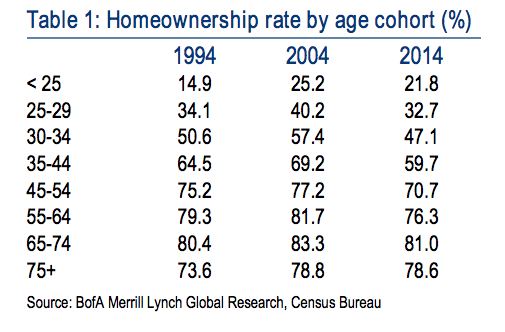


For a young adult in the current economic climate, the only way you're living in one of these cushy homes is if you're living with your parents.
You can't rent one very easily, since they can't be divided up into multiple units or rented at all due to zoning and HOAs. Not to mention it's not typical to be a renter in these neighborhoods to begin with, so even finding a rental is nearly impossible in some areas.
Then of course, after the housing bubble crashed and the subsidies went away, a mortgage for one of these became a big challenge to achieve, and who has the savings sitting around for upkeep and emergency maintenance?
Boomer parents, and a handful of lucky gen-xers are pretty much the only people who could comfortably acquire and hold onto these houses, so it only makes sense that sticking to them like glue is the best strategy if you wanted one.
And there's also the fact that it's just not cool to live in the 'burbs, where you grew up, in the first place. The mental justification has to be "well I'm saving money at least". Saving money, means crashing with the parents. After all, it's "just temporary".
Those are at least my very subjective observations that might be overlooked in that study...