I have a special place in my heart for Winamp's classic UI (Winamp 2). In my opinion, it was the most intuitive interface for a music player. it had a playlist, equalizer, plugins, all of which were condensable to a fraction of it's full size. Of course, now there are a number of similar players that have the same capabilities, but shit, Winamp 2.x was where it started. Even today, it blows todays iTunes interface way out of the water.
An absolute yes to this! That's why my install of Audacious uses a Winamp 2.x skin--it just makes sense. The rectangles, the beautiful alignment of playing data, equalizer, and playlist... It can never be eclipsed.
This has inspired me to figure a way to get my Wine'd Foobar2K to look like Winamp 2. There's probably a helpful article on that somewhere.
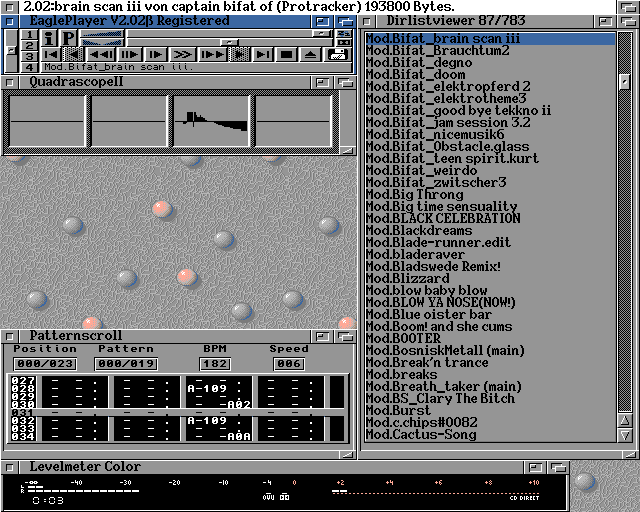
Plugins? Check. Highly configurable? Check. Showing and hiding the playlist in a movable window at the click of a button? Plenty of visualization and information windows, all open at the same time if you want? Check. Early 90s? Check! :) Though I won't claim Eagleplayer and Delitracker invented that stuff, they were just the first audio players I used a lot.
It's really a pity Deliplayer for Windows isn't developed anymore... it could have gone places I'm sure.
I still use XMMS, which has a very similar UI. Because I love it. (I tried Audacious but it was slower and had unicode character problems, and similar problems with XMMS2)
I don't know about the entirety of Unicode characters, but I've been using Audacious since version ~3.1 in 2011 (now 3.4.3) and it's never had any problems displaying Japanese and Korean characters--if you're not using the Winamp 2 theme with bitmapped fonts.



I have a special place in my heart for Winamp's classic UI (Winamp 2). In my opinion, it was the most intuitive interface for a music player. it had a playlist, equalizer, plugins, all of which were condensable to a fraction of it's full size. Of course, now there are a number of similar players that have the same capabilities, but shit, Winamp 2.x was where it started. Even today, it blows todays iTunes interface way out of the water.