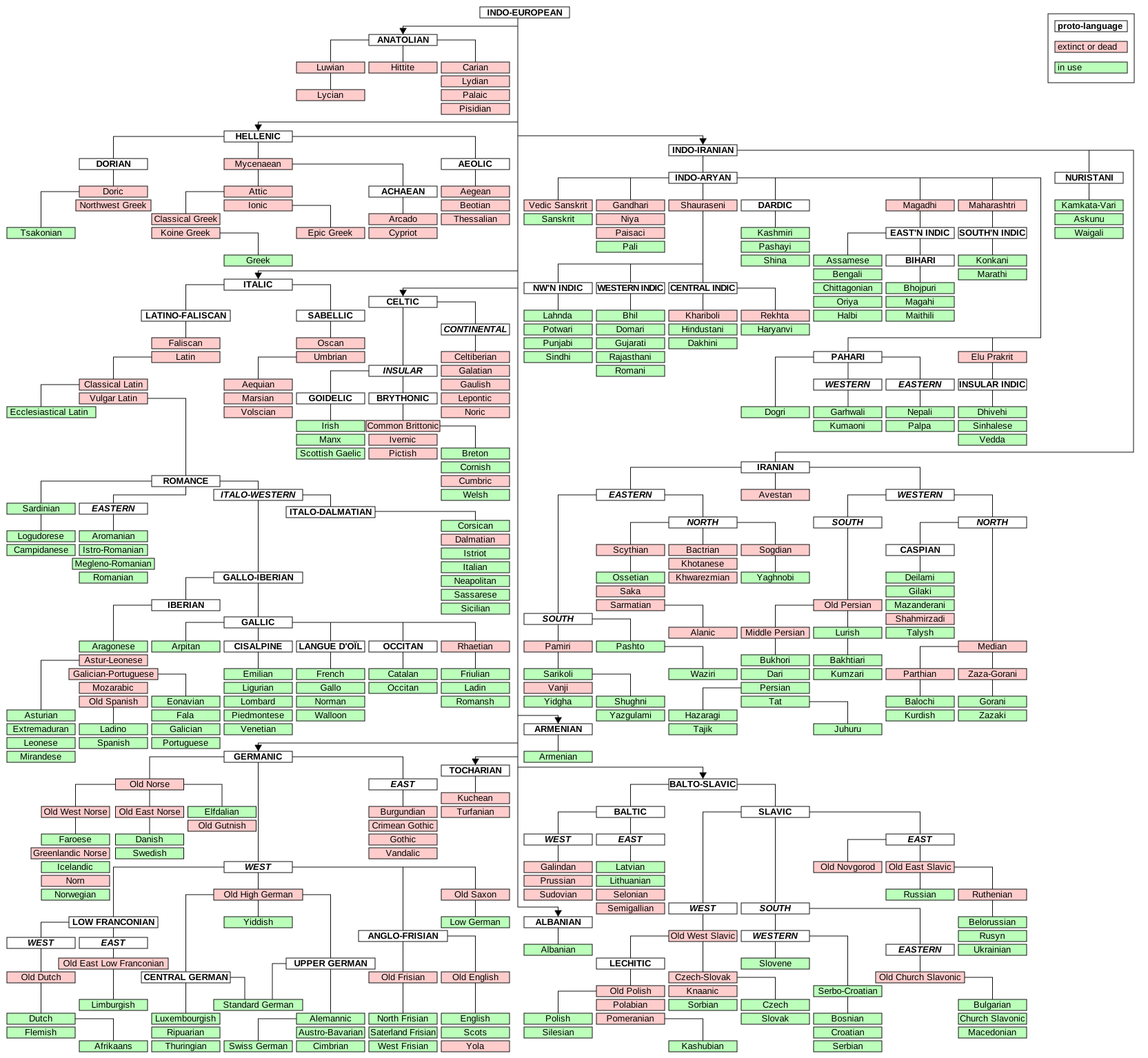
Aside from English, they're all closely related languages (Hindi, Marathi, Gujarati). I wouldn't really expect knowing related languages to give the same payoff as say knowing languages from different groups or families of languages.
I wouldn't group them like that, English/German/Dutch are Germanic languages, while French/Italian/Latin are Romance. Japanese also a bit removed from Mandarin/Cantonese. But, yes, I would argue that knowing unrelated languages broadens ones perspective far more than knowing similar ones.
There are subdivisions like Germanic and Romance in the language family which do seem sufficiently far apart. However, there are quite a few subdivisions that seem very closely related.
I wonder if there is a way to draw entirely new subdivisions based on benefits of knowing languages from each subdivision.
Also, intuitively, what you say about knowing unrelated languages makes sense. I am curious however, if you had some deeper insight or knowledge into why (if true) this might be?
Just because a language borrows significant amounts of vocabulary from a language, it doesn't mean that it's related to that language. Take, for instance, English. Neither the fact that English has borrowed significant amounts of vocabulary from the various Romance languages (French, Spanish, Italian, Portuguese, &c.) nor that Norman French had a large effect on the language's orthography and phonology make it a Romance language: English, in spite the many, many outside influences upon it, is still solidly a Germanic language. About the only odd thing about English is its lack of V2 word order, and there are still _plenty_ of vestiges of it.
The same goes for the influence of Chinese on Japanese, only more so: Chinese and Japanese aren't remotely related.
As far as Japanese being an isolate, please keep in mind that the Ryukyuan languages are practically dead and all the other Japonic language are long since dead. There's some _very_ scant evidence that it might be part of the hypothetical Altaic group of languages, but the evidence is weak at best, and only marginally more plausible than the Nostratic hypothesis.