This has very little to do with national moods/prejudices and much more to do with boring/atypical industries vs. hot consumer ones. ONO got no attention largely because it's "boring" to a mass audience. There are plenty of examples of this domestically, e.g.
+ Child focused ecommerce company Zulily filed a $2.6B IPO, but got very little attention.
I'd also note that there are blinders even within the startup community. I've submitted plenty of stories about under-the-radar startups that die on the vine because the companies are more focused on execution that cultivating a PR rep that would earn media and upvotes.
+ Nearly a quarter of the top 20 projects on Kickstarter are board games—can you remember the last story you read about one? A couple have raised more than Oculus Rift or Formlabs, but get no attention because they're "boring," while these hardware cos earn magazine covers and lavish praise.
+ Mailchimp is easily a $100MM+ in revenue company that was bootstrapped, but they're rarely profiled.
The reality is the tech news reported by most of the big names is just the most "exciting" tip of the iceberg. There are plenty of worthy stories that just won't generate page views and hence don't get the attention they "deserve," if coverage was apportioned by success measured in dollars or reach rather than pageviews.
I think that Martin is refering to the attention that the wasup adquisition had here in Spain and how little is getting in the spanish media, a Spanish start up that's selling for that amount.
It's easy to blame media "blindness" and inattention -- here, apparently both in Spain and on the wider Web -- but to me it just boils down to the economics of attention. If the author is right and "nobody cares" then the lack of press is pretty explainable.
In today's ad-driven world, journalists are tacitly rewarded (at the very least) for Web traffic. As such, the coveted beats are the ones that drive guaranteed interest -- Apple being the traffic gorilla when I was a staff writer. The stuff closest to consumers (porcelain) on the whole drive more interest than infrastructure (plumbing).
Starting out in the Valley I got beats like Seagate and storage (after getting the assignment, another editor joked that it was "borage"). I remember envying the consumer electronics writers for their traffic, but was always more of a pluming guy myself.
I completly agree with this: When Tuenti (the Facebook of Spain) was sold it was very very covered in the press (in Spain and in all Europe) although it was “only” a 70MM adquisition, as you say, is not how big is the sucesss or how much money is done, is how boring or how popular the startup is what makes how much cover the news get.
nice comment- how do you stay apprised of these in light of the media bias towards the "sexy", are there any websites, youtube channels or blogs that are good for this kind of information? thanks!
Europeans arent as unreflectingly captialistic and "frontier"sy. Americans have always seen success in business as an crowning achievement. Europeans have traditionally found this kind of pre-occupation with monetary success somewhat crass or trivial.
> Europeans don’t realize that if a company that went from nothing to connecting 7 million homes is not celebrated...
That's total BS. You dont need a culture of fanatical adoration of business success for their to be successful businesses.
> if a company ... is not celebrated ... we will not get young Europeans on the right track
It really worrisome how these people have to go around reminding everyone how amazing they are. I think our children will do just fine without being propagandised by self-aggrandizing money-chasers.
Bullshit. What is crass is the perspective that Americans are unreflectingly capitalistic and pre-occupied with monetary success.
Most business owners I know started their business because they saw a need for something and they wanted to deliver what was needed. Financial success is important because it allows their organization to continue functioning but it's hardly the top motivator for business owners I've spoken with.
I will concede that there are a fair percentage of businesses that are unreflectingly capitalistic and pre-occupied with monetary success. However, to paint an entire nation with a broad stroke is ignorance at it's worst. It would be the same as saying "The Brits have terrible teeth" or "The French smell." It may be true for a percentage of people but is no way to address a body of people.
You have this thing called "The American Dream" and you have an entire cultural history tied to self-motivation, entrepreneurship and "pushing the frontier"...
Clearly every single american isnt subject to the same cultural pre-occupations, that's absurd.
But there are only certain cultural phenomena possible in one place or another. A right-wing party in the UK could not even begin to use any of the ideas or rhetoric of the republican party - they'd be widespread revulsion. We dont sing our national anthem in the UK, we dont "pleg" anything, we dont consider our country "Exceptional" (hence American Exceptionalism). There hasnt been the suggestion that our prime minister is impotent for not interfering in Ukraine, at least, nothing like the inferiority-complex about Obama's lack of big-dickery.
The idea that the west is culturally homogenous is "Bullshit". As compared to anywhere in europe, americans are vastly more market-oriented, mistrustful of government, approving of business success, etc.
It is simply the case, insofar as I can see, that "business" isnt really a dream of any kind in europe. People dont grow up wanting to run/own/be in business in anyway, we dont really have an "explorer"/inventor dreams either.
A considerable amount has been written by the european experience of america and an almost ubquitious theme in the accounts is "the feeling of unlimited possibility", an ostentatiousness and pre-occupation with wealth, etc.
> A considerable amount has been written by the european experience of america and an almost ubquitious theme in the accounts is "the feeling of unlimited possibility", an ostentatiousness and pre-occupation with wealth, etc.
You say "etc." there like those two things are related in some way and a reader could figure out how to extrapolate. Surely the feeling of unlimited possibility does not entail ostentatiousness and preoccupation with wealth? They're just two things that you ascribe to Americans without much argument.
The "American Dream" is an idea about the distribution of money in a society, not about money itself. If it were just about money, lottery winners would be considered realizations of the American Dream. If it were even about success in business, CEOs of Fortune 500 companies would be heroes in American society. (From political debates to popular media, they're decidedly not.) If there were some government policy by which all Americans could be made filthy rich (ignoring the intrinsic impossibility of that), I don't think anyone would consider that a realization of the American Dream either. The dream assumes that money is a central value in society, of course, but maybe that's because things like inner peace, being a good person, and deeper notions of happiness haven't historically been explicitly constrained in so many human societies the way the ability to accumulate money has.
Out of curiosity: if Americans are prototypically self-motivated and desire to make money, push the frontier, explore, and invent, and that Europeans don't (as a culture) dream of those things, do Europeans have widely shared dreams? What are they?
> Out of curiosity: if Americans are prototypically self-motivated and desire to make money, push the frontier, explore, and invent, and that Europeans don't (as a culture) dream of those things, do Europeans have widely shared dreams? What are they?
There aren't any. "Europeans as a culture" simply does not exist. It's just a bunch of very different countries with very different cultures that decided to make a union.
The only difference I've found that holds between the USA and the whole of Europe[0] is that our price-labels all list the price after taxes. I found that quite weird. But they all get to have some unique quirks, so otherwise your culture is very recognizable in the sense that it might as well be another EU country :P
[0] someone is bound to correct me on this, I haven't been to all of the EU countries.
"The American Dream", self-motivation, entrepreneurship and "pushing the frontier" are all good things IMHO.
However, they aren't the same as "unreflectingly capitalistic" and "pre-occupied with monetary success".
I'm not going to address the rest of your America bashing because the response requires a nuanced answer that I don't have the time to write today. I'll leave that to others.
> However, they aren't the same as "unreflectingly capitalistic" and "pre-occupied with monetary success".
They have become inextricably linked. Maybe early in the 19th C. you'd be right. After the rise of american industry and maufacture and its corresponding propaganda (edison, etc.) AND after the cold war, "capitalism", "democracy", "patriotism" all became intertwined. Such that today The American Dream is almost purely capitalist and pragmatic.
The American Dream has, to my eyes, for a long time been directed towards individuals - it is their dream. A person achieves their dream. Once, perhaps, The American Dream was a dream for Americans - a common enterprise, with common goals, something achieved for everyone or no one, etc.
The author of this article did not explain why ONO was part of a common enterpise, which its activity was making all our lives better and helping us achieve our ideals. He said,
"built originally by Eugenio Galdon and mostly by my friend Richard Alden between 2001 and 2011, is in the process of being sold to Vodafone for around $9.5bn, and nobody cares."
If that's doesnt read hollow and pathetic to you I dont know what could. It's complete mythologising of two people "building" a company, it's display of hurt feeling over the fact that $10bn doesnt impress people enough, its utter pre-occupation with self-aggrandizement and money.
The rhetoric in this article is almost suffocating its message and very few can tell - because this rhetoric has become the language in which we phrase our dreams today.
The extent to which you have littered your own biases throughout this thread, and then expected everyone to regard them as the true interpretation, is absurd and childish.
If that's doesnt read hollow and pathetic to you I dont know what could. It's complete mythologising of two people "building" a company, it's display of hurt feeling over the fact that $10bn doesnt impress people enough, its utter pre-occupation with self-aggrandizement and money.
For example, this. I'm amazed you can't find one positive interpretation to agree with. The $10bn price tag is a reflection of the company's commercial success -- a reflection of the hard work, smart decisions, luck, timing and scale involved in that success. To an American it's obvious that two people didn't personally build the company, but it's also respectable that they undertook a massive risk to create opportunities for others to join in their effort and partake in the rewards.
The fact that you can only arrive at an extremely cynical interpretation really says more about you, and goes a long way to confirm the assertion of the article.
We'll I've commented three times thus far to direct replies.. I wouldnt say that was "littering".
> To an American it's obvious that two people didn't personally build the company
Yes, but it's also obvious who gets the credit (, and who doesnt).
> I'm amazed you can't find one positive interpretation to agree with
Sorry I dont find the acquistion of wealth anything to celebrate in itself and that's the point of the article.. so no, obviously i dont think there's a positive interpretation here and it isnt "cynicsm": it's reading it without buying into its assumptions.
> But we should not blame Americans for this. Americans do the right thing, they recognize and celebrate success. The blame is exclusively with Europeans who are still uncomfortable and envious with big exits
Yes Americans do the right thing and "celebrate success", they try not to tax "job creators" and make sure "hard working risk takers" get the "credit they deserve". Ideological, all of it.
I don't think it's a two way link. That a pre-occupation with monetary success implies self motivation and entrepreneurship doesn't mean that the reverse is also true.
Also I think it's OK that the American Dream is about individual economic mobility. But I don't think it's about the individual, rather it's about the idea that any individual can achieve their dream. Or perhaps that there aren't a set of people who can and others who cannot.
Whether or not American politics have been faithful to the American Dream is a separate discussion.
[quote]"The American Dream", self-motivation, entrepreneurship and "pushing the frontier" are all good things IMHO.[/quote]
Everything in moderation. Here in the US, however, moderation has no place. It's all or nothing mentality, like a fricking casino bet. Fair compensation for effort is dead when everybody is taking risks for maximum rewards and training their work-force to pander the lowest common denominator... the hard sell. Everywhere I go retail workers are badgering me to upsell, banks & home improvement chains are the worst, IMO. That's what happens when there are 100's of candidates for every job opening and all the competition has been killed off by the oligops. Everywhere you go in the US, if it's a large enough customer base, it's oligops all the way down.
The most generous American employers barely meet the minimum legal requirements in Europe. Americans tolerate conditions of employment that would be utterly unthinkable to most western Europeans.
EU workers are entitled to a minimum of four weeks paid holiday. The EU requires 20 weeks of paid maternity leave, mandates a maximum working week of 48 hours for most employees and enshrines a great deal of protection against unfair dismissal. Those pan-EU minimums are exceeded in most member states.
A very large proportion of European companies, especially French and German businesses, regard the wellbeing of their employees as a primary aim, not a cost of doing business. Planning is done in the long-term, with the creation of stable and sustainable jobs being a primary objective. Silicon valley 'perks' like subsidised canteens and employer-sponsored social clubs are the norm for semi-skilled manual workers in many EU countries.
That's before we even address things like generous welfare benefits, state healthcare and other policies that are as normal in the EU as they are unthinkable in the US. The Democratic party would be considered centre-right in most European countries. A left wing in the European sense simply does not exist in the US. 20 seats in the French Senate are held by communists - not socialists (they hold 128 seats), but bona fide Internationale-singing, red flag flying communists.
If you think that Americans aren't unusually capitalistic, you really need to travel more.
> The most generous American employers barely meet the minimum legal requirements in Europe. Americans tolerate conditions of employment that would be utterly unthinkable to most western Europeans.
Yea, googlers live like shit. Oh and work visas for Europe aren't in huge demand and don't run out early every single time. Also, we don't have dramatically more immigrants from Europe than visa-versa. OH OH and italy, spain, and greece don't have a huge unemployment problem - all those riots are celebratory of that fact.
>Bullshit. What is crass is the perspective that Americans are unreflectingly capitalistic and pre-occupied with monetary success. Most business owners I know started their business because they saw a need for something and they wanted to deliver what was needed.
Well, most of the business people I know of, only see a need in areas that they thing are profitable. How many try to actual affect people's lives in substancial ways, instead of building the next Instagram (and now WhatsApp)?
>Financial success is important because it allows their organization to continue functioning
Preoccupation with financial success (that idea of continuous enlargment) is what has killed a lot of companies from functioning. They had good product X, people loved, it sold in droves, and then some BS managers just have to expand to field Y, and ruin all the qualities that made X and the company good in the first place.
>I will concede that there are a fair percentage of businesses that are unreflectingly capitalistic and pre-occupied with monetary success. However, to paint an entire nation with a broad stroke is ignorance at it's worst.
Well, that's how generalisations work -- and they are a valuable compass, it's not all prejudice. It doesn't take everybody being pre-occupied with monetary success to call a nation as "pre-occupied with monetary success". It just takes a more-than-usual number of such people, or a culture more open to it. If in a country X there are 1% preoccupied with such things and in country Y there are 10%, then the general sentiment that Y nation is far more preoccupied with such things is valid.
> Well, most of the business people I know of, only see a need in areas that they thing are profitable
Yes and people only live in areas where they have a way to get food, air and water. A business can't function without profits. Naturally, a business owner will spend their energy on addressing needs through a model that can sustain itself.
Others may choose to go the non-profit route and try to sustain themselves through grants/subsidies/benefactors/etc. There are 1.5 million non-profits in the US [1].
One way or another, the organization has to sustain itself.
>Yes and people only live in areas where they have a way to get food, air and water. A business can't function without profits.
Well, tons of musicians, writers, painters etc don't give up if they have to function without profits. In fact lots of them keep at their craft, without ever achieving much monetary success, and they produce stuff.
A person making a web service could do just as much, if he really wanted to "fill a need and change the world". At least he/she could go at it for a reasonable income, without aiming for bucketloads of money. And yet, lots of people here sneer at "lifestyle businesses".
> Most business owners I know started their business because they saw a need for something and they wanted to deliver what was needed. Financial success is important because it allows their organization to continue functioning but it's hardly the top motivator for business owners I've spoken with.
I disagree. Capitalism is used in political rhetoric in the US, more than it is in (mainland) Europe.
I don't think that this statement can be compared with "terrible teeth" or "French smell", because those things are globally seen as bad, while having a strong pride of financial success is neither in Europe nor in the US seen as bad per se. I think financial success is simply used as a universal measure of success in the US, because capitalism as a philosophical, social and political thing had it's strongest development in the US and UK.
Another thing that added to this is Marx criticism. Now, I don't talk about political communism, but the criticisms that liberals and capitalists tend to agree with, while the broad society (by that I mean people who simply never studied economy or philosophy), but know that communism emerged from this criticism of capitalism don't want to be associated with it. The meaning of socialism and communism vary a lot depending on the country you live in. That is because in the US it sometimes nearly synonymous to "enemy dictatorship", these the term the term might in Europe be used for a totalitarian system, but also as the resistance to such a thing, as in Nazi-Germany. It might be about not making everything about money, but also many other things. Every country in Europe has another history. In some you can make a communist party that even company owners would vote, while in others nobody would vote for such a party.
I think it's also not fair to make such statements about the whole US, but depending on the society you live in success always means financial success. If you live in London, maybe in a banking district this is surely more true than if you live in another part of the city or somewhere else.
With the US it is really hard, especially for Europeans the US can be a hard way to look at, because it is considered one country and since you can only hear a certain amount about it, even if you are very interested into the country. The chance that you for example hear Ron Paul saying that someone who dies because he cannot afford a surgery can be proud of supporting his country or something like that is more likely than many other things.
For many people especially in big cities, no matter where on the planet capitalism, liberalism and democracy bind together and others see socialism, liberalism and democracy as one thing, while others see that as impossible.
This was really political, but the way these terms relate can also change how you define success. But that's not all, cause there are different reasons for wanting to be financially successful. If you live in the US it might be that you just want your children to be able to go to college. So even if this is the only reason you might for someone from Europe, where you can study cheaply or even for free, look really focused on monetary success.
The difference between the states and cities in the US should really be considered in making such comments, but when people talk about another country they tend to talk about the political elite of a country and in the US it appears to be focused on financial success and parties that reject such rhetoric aren't usually considered. As a European you often don't even know that there are other parties that people are able to vote for.
Basically the reasons are about nonces. That's why Europeans think US people are super capitalist and US people tend to think Europeans are super socialist. None of these statements is true, even if I strongly agree that US people seem to take more pride in having companies making money, just like other countries take pride in making great wine or whatever.
Often such things look kinda like a religion to outsiders. You know, like capitalism where the market is your god and everyone tries to please it, but you cannot really control it and it is hard to see what the outcome is and the capitalists are like "You should not try to control it, because it knows best", basically like "Don't try to play god" and no matter who you are you are, capitalist, socialist, communist, republican or democrat, everyone thinks when your party finally wins everything will be amazing, people will finally see the truth and everyone will be living together nicely. Socialists think everyone will share everything and capitalists that everyone will be rich and only pay for good companies and it will all somehow work out, with only minor bad happenings.
I don't think it's that way and that people might be better off not caring about things like other people's definition of success, especially not when it's a generalization, but also not of individuals, because it is incredibly easy to be wrong about it. I think we should try to not lose trust that humans, as social (in biological terms), as long as they are sane generally tend to measure success also from a social perspective (see various foundations), even if they of course also are able to forget about it. And of course power corrupts that sanity, be it power through money or power through a political position. I guess that's why democracies are neither perfect nor evil.
> Europeans love success stories as much as Americans, but we're too American-focused to notice our own success stories.
this.
Plus, to be fair, I have never heard of ONO, mostly cos no matter how much of a single European market we are, we are not a single European language, so we are not a single European news feed.
Yeah, I think in Denmark the media mainly notices American and Danish business, and not as much those from rest of Europe, unless they do something that really impacts people. People definitely care about what Danish businesses are doing. It's true that monetary success isn't the only measure people care about, e.g. Copenhagen Suborbitals, a nonprofit, gets a ton of startup-like tech press. But people also care about monetary success of Danish businesses. If ONO were a Danish company, it'd be on front pages of newspapers. But it's a Spanish telephone company nobody's heard of, so people aren't really interested.
I think part of the WhatsApp news wasn't only the location but the "lightweight" aspect. There was a lot of, "wow a company sold for $16b just by making a phone app?!" By contrast people aren't surprised that classic capital-intensive, "heavyweight" infrastructure companies like telcos can be worth billions. Plus, nobody cares about infrastructure unless it's their own infrastructure. DONG Energy recently sold a minority stake to Goldman Sachs for $2 billion, which made huge news in Denmark, but did anyone else read about it?
When Tuenti (the Facebook of Spain) was sold it was very very covered in the press (in Spain and in all Europe) although it was “only” a 70MM adquisition, is not how big is the sucesss or how much money is done, is how boring or how popular the startup is what makes how much cover the news get.
Are you implying that the sort of people who assume the degree of risk required to build a financially-successful business (specifically of the "home-run" magnitude implied by a multi-billion-dollar acquisition, IPO, etc) are merely "self-aggrandizing money-chasers?"
Companies of that scale sometimes have the ability to improve society. There's also the potential for abuse.
But if a culture's general attitude toward aspiring to construct such a business entails disdain and mistrust, it hardly seems illogical to consider the possibility that cultural pressures are turning people away from the desire to do something entrepreneurial.
And that, I think, is the point that the author was attempting to make.
> Are you implying that the sort of people who assume the degree .... are merely "self-aggrandizing money-chasers?"
Yes. That's very often the mentality, however you'd like to dress it up.
There's a distinction between small-businesses that arent pre-occupied with growth and "success" and those which are. Sure, if you have your own bakery/etc. then you're probably doing that because youre interested in the craft of baking. The fact that you own the company is kinda incidental to your passion for a craft.
I'm saying that these kind of people who build up multi-million/billion-dollar companies are basically interchangable money managers. You can take a telecoms business-genuis and put him in insurance, or manufacture, or anywhere: and people routinely do! Because the "skill" at that level is merely business as such.
All I got from this article is "people should aspire to be successful in business", which I think is kinda stupid and dangerous. People should be passionate about, eg., giving people healthcare, creating amazing art or music, writing the best novels, finding out how the world works...
that we have businesses and that they make money is something which is meant to facilitate our dreams not become them.
Capitalism abstractly is not meant as an end in itself, but almost everywhere we look today it has become one. Growth, expansion, money, "success" for its own sake - not for the sake of beauty/truth/skill/knowledge/love/etc.
First, thanks for your refreshing perspective. I agree that the focus on wealth and growth isn't going to help us create interesting things as a society. However I do think there's a craft to building a business that can stand along side the craft of baking or the pursuit of art.
The idea of great risk for great reward is a myth. The risk that the founder of Facebook assumed for example was close to nil, because he didn't have any job or money to start with. He risked the precious time that he would otherwise use to party at some Harvard fraternity. Similarly for so many other tech founders. They just happened to do well something that they liked at the right time. There are many small business that represent a much bigger risk for their owners, in terms of financial investment and loss of income.
It's only a myth if you're examining the situation from a singular angle -- that of monetary risk.
There's a great deal of risk and uncertainty involved in foregoing the completion of a degree, a potentially-salaried position at a stable firm, and so forth in favor of starting a company that is statistically unlikely to succeed.
Risk is relative. For a broke college student to quit school, move across the country, have no (or little) income, all for an idea that they have no clue will work is a huge risk. In the same vein, someone quitting their job after having already committed to car payments, house payments, and alimony is also a huge risk.
You're disproving your own point. In the same paragraph, you say "The idea of great risk is a myth" and "There are many small business that represent a much bigger risk for their owners". Think about it.
The idea that I'm talking about is that the reward from a company is proportional to the risk taken. My example shows that small companies can sometimes impose a greater risk to their founders than the risk taken by the founders of Facebook or Google.
And? What is your point then? Would you be upset if the gold mine you discovered took 100' of digging before it yielded even an ounce, but your neighbor picked a spot where he only needed to dig 10' to get a pound of it?
The fact that the risk wasn't called in, so to speak -- that the worst case scenarios did not come to pass -- in no way diminishes what was risked. Beside, you have cherry-picked two cases where it is quite easy to construct a plausible a sounding (and factually false) "no risk" argument. HN routinely features entrepreneurship efforts where much was gained and much was won. Your main gripe appears to be that the risk-reward maxim is not describing a literal, linear relationship.
Next up, the sun doesn't always set in the west! (provided certain map orientations, times of the year and fluctuations in magnetic north)
Agreed. Having a lot of money doesn't make you a special person. If you're rich and want to be celebrated, you should probably do something worthy of it rather than making money. Similarly, just because a company was sold for billions of dollars doesn't mean it has any importance - just remember the tech bubble.
If you primarily rely on sources of information in English (of which I'm guilty, too) then obviously you will be mostly getting information from the Anglosphere dominated by the US because it's, oh you know, richest and most powerful country in the history of the world.
This is not some "Americans cover their successes" thing. It's that they matter more. There is an underlying economic reality in which we are lagging far behind them. Not Africa-far but still far.
This effect even gets reinforced by the European journalists: a German speaking journalist will read German and English sources. A Spanish journalist will read Spanish and English sources, etc. Having the "lingua franca" is a huge asset for the Anglosphere. It not only affects the flow of news, it also leads to cultural dominance (everyone watches Hollywood movies, but European movies are primarily shown in their home countries, same goes for music). I would say that average Jean in many European countries knows more about the Anglosaxon legal system than their own one - just because they get exposed to TV shows about US lawyers all the time. The French try to fight that influence - but I think resistance is futile. Instead, the Europeans should try to find angles to inject their own views into the English news & culture stream. This leads to one large globalized, multi-cultural soup of values - but that's better than an Anglosaxon dominated soup of values. The times where each country could have their own soup are over.
Indeed. I'm often amazed at the kind of American news reported by the Portuguese media and think "Why aren't we getting these news about European countries?". At the same time, I'm part of the problem: I know more about American politics than German politics, even though the latter affects me a lot more.
Does any of those countries come close to the GDP of, say, Alabama ($160bn)? Sure, comparing the value of organic wine form Rome to a car from Detroit is not straight-forward but technological progress and compound interest generally ensure that powers of today absolutely dwarf those of even a hundred years ago, not to mention a thousand years ago, or two.
The ancient empires had troubles feeding their populations at times. Today, most Americans are overweight.
The gross world product is about 72 trillion dollars. Alabama's share of that is 0.2%. In order to 'come close to Alabama', a historical power would have to be close to 0.2% of the world's GDP at the time. And I don't think any of the ones in that list went that low.
0,2% of the world's GDP in 2012 is a good measure for a comparison of Alabama to other modern countries in 2012, not a comparison of Alamaba 2012 to Rome 12 AD.
That's like saying that the last person on Forbes 500 is not really rich because they barely have 0.05% ($3 billion / $6 trillion) of the group's net worth.
Wealth is a relative measure, not an absolute one.
"That's like saying that the last person (blah)"
No, because relative to other people, they have more stuff. The proportion they have of the group's net worth is significant greater than almost all other members, who have generally have five or more orders of magnitude less wealth (0.0000005% and less).
The reason why you're having trouble converting from countries to individuals is because there's currently only 200 countries, but 7 billion individuals. That's why the individual's percentage looks lower.
Also, your comparison makes absolutely no allowance for inflation. GDP rises for everyone over time simply due to inflation. Your shekel could purchase more in the time of Herod than it could in the time of Netanyahu. Zimbabwe's GDP went through the roof in recent years in their own dollars; but it didn't as a comparison to the rest of the world's output.
GDP is a modern concept made to measure today's economy. But if you talk about power US is the most powerful country but not dominant (see Syria and Crimea).
The British empire at his peak held one fifth of the worlds population. The Roman empire conquered everything was worth conquering and he was providing free food and gigantic games to his poor citizens. If you consider modern Europe his GDP is very similar to the US, although his political situation is more fragmented.
So back to the OP in each era the economic conditions improved, and there was a place where this improvements was more evident, a country who was richer and more powerful than the others. US is one of these nations but it's not something exceptional in history as the OP suggested.
None of those pre-modern great powers could compete either economically or militarily with the modern United States.
Of course, they might have been relatively more powerful in relation to their contemporaries, but that hardly implies anything relevant about the modern era.
well it's pretty obvious that a gun is more efective than an arrow.
US is the most powerful country now, but it isn't dominant (see Syria, Crimea, etc..) and it not as dominant as the British Empire or the Roman Empire was at their time
the OP is talking about nowadays US, so no Rockefeller, Ford and friends.
As it's difficult to compare richness through history I was focusing on relative power. Can someone challenge US now? yes: Russia, China, Europe. Some past empires didn't have any counterpart because they were too powerful for anyone.
China or Europe can challenge America? The Chinese can barely float a carrier and have only a few nukes. Europe depends of the USA for most of its defense. Russia counts, since this is the nuclear age with MAD and all, but it hardly counts if it's suicide.
Economically, china is still not into high income yet, while Russia is stuck in a natural resources trap with lots of corruption. Europe is quite fine though.
So many disagree with this proposition because it does not convey the meaning you apparently intend. "Most powerful" might conceivably be a relative measure, but there's no way that "richest" is. Most nations of Europe (probably not Moldova, Slovenia, and a few others), on both a total and per capita basis, consume much more than anyone on that list. In a military contest most modern European nations would by more concerned about veterinary care for the enemy's horses, than the military outcome.
Next time you intend to make a relative statement, use the word "relative". Of course, that was not what the post to which you responded was discussing, so your post would have been more obviously beside the point.
> Most nations of Europe (probably not Moldova, Slovenia, and a few others), on both a total and per capita basis, consume much more than anyone on that list.
Be careful with Europeans, they get pissed off easily. Slovenia has a GDP (PPP) per capita of $28,195. While that's half of the US it is actually a lot, they're definitely not subsistence farmers in Mali. You cannot really compare it with Moldova - $4,182. First world versus close to third world :)
Point taken, but I already knew Slovenia > Moldova because hockey. I only qualified Slovenia because my statement was "total and per capita", rather than "per capita" only. It was probably still unnecessary, since even though they have a small population most historical empires did as well.
as technology improves and time pass seems obvious that mankind is richer and have better military than the past. You can probably say that nowadays Slovenia could win against 1600 Spanish empire, so the only comparison that is reasonable a relative comparison, that's why I didn't specify.
I agree that it wasn't the main point of the post i was replying to but I found that point just smug and incorrect, backed-up with cultural bias rather than historical fact.
EDIT: sorry, I wasn't clear enough, my comparison was mostly in the "most powerful" part rather than "richest"
Of course it's relative. Power is about asserting your will, and inherent in that is having someone to assert it over. Saying that a modern country could beat a historical one in a war is silly.
It is interesting to note that in the 60 years that the US has been the ascendent world power, they've withdrawn from all sizeable wars with objectives unmet. If you're using actual active warfare as the yardstick, then the US is not powerful at all on comparison to historical powers. If you're using sensible measurements of power, then of course the US is powerful, most of it from projection of force and cultural/soft power.
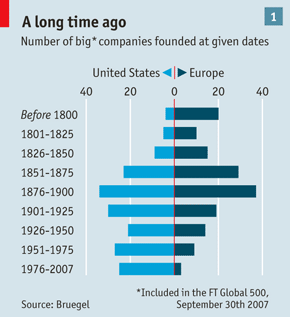
Well, you have to put that image into context. The US hasn't been devastated by 2 world wars. I'd say that the graph proves it - the first moment where the US was massively ahead was 1900-1925. Want to bet that 90% of the European companies from that period are pre-1914?
What is more worrying is 1976-2007 -> does that mean that things are ossified already? That there's no room for smaller companies to grow? I'd blame European conservatism for this together with US multinationals.
Per-capita is way more important, a rich man doesn't need more than one toothbrush and it's detrimental for a country when other men can't afford a single one.
The question is "which country is the richest and most powerful". If we use the per capita statistics, Luxembourg is. That doesn't sound quite right, does it? If we look at the totals instead, the top ranks are USA, China, Japan and Germany. If you ask me, that seems more like what we're looking for.
Who is this "we" are you talking about? USA spends most of its income in military which is as dystopian as it gets, plus it haves 5.1 trillions in debt, while there are countries with no debt at all.
We are talking about foreign policy? I just found out, I would have swear we were talking about economical influence on international tech news coverage.
You begin with a valid point, that many English speaking technology blogs are US based, and therefore have a (valid) US bias.
That said, the idea that the coverage of US based acquisitions are inherently more important than elsewhere worldwide is utter nonsense.
As other comments point out, many, many large nontechnical acquisitions get very little coverage outside their respective channels. There are a handful of tech companies who have become media darlings and/or are considered within the community to be thought leaders or industry shapers, who make headlines with every move.
But the OP makes a great point, in that when some successful founders reach at least sudo celebrity status (eg: Jack Dorsey), and can be used as examples they can be magnets that encourage the next generation of entrepreneurs.
A couple of weeks ago Actavis bought Forest Labs for $25b. A few days earlier Comcast bought Time Warner Cable for $42.5b. And before that Beam offered $16b for Suntory.
Huge deals that affect entire markets (and industries) happen all the time, but unless you follow that specific market you don't get to hear about them. The fact is ONO is a mobile operator in a small local market (from a global industry reference frame), and wholly outside of the tech-news-but-really-only-"startups"-and-only-SaaS-startups-at-that microscope that most of the tech press spend time looking through.
Google buys Spanish Ono for $9.5bn to start Google Fiber throughout Europe
Vodafone won't be rolling out ultra fast fiber networks. They'll be putting everything through a cost-benefit exercise to maximise profits. Essentially just a fish being eaten by a bigger fish.
The mainstream don't care about telco markets and it's not major news in telco terms. A 10bn acquisition is a third tier telco M&A deal.
Think about it this way in 2012 "mobile networks revenues were larger than all revenue combined from mobile phone sales, PCs, online ads, books, recorded music, watches, Apple, Amazon, Google & Facebook."
ONO really was an startup? I don't think that any startup, in the HN sense(garage startup), has the financial strength to become overnight a cable company.
Anyway, I haven't heard about this "guy", Eugenio Galdon, and it seems that he was the chief advisor of Calvo Sotelo, former president of Spain.
So, in my opinion, this is hardly news. This is a typical story of spanish success, where a "well connected" person, with the financial help of big investors, takes advantage of regulatory and (foreign) technological changes.
Panoramio, idealista... even Inditex are real spanish startups, much better examples of entrepeneurship.
Commercially speaking, media has one goal - procuring eyeballs. Just because eyeballs aren't fixated on a particular story doesn't make it sad, it just means it's not a compelling story.
So why is WhatsApp a compelling story?
1. Broke conventions - company only had 55 employees and valued at $19b. This isn't normal for us. A telecommunication company selling for $9.5b makes sense.
2. Story of triumph - the founder of WhatsApp was "from a small village in Ukraine". You can't get any more American than this my friends.
You see, America is quite possibly the greatest marketing engine in the world. This is what separates itself from the rest of the world. We are engrained story tellers, not because of some magical gene inherited, but rather because we know good stories sell well.
People in general don't care about telco acquisitions unless there's a major strategic consequence. The example the author gives “Google buys Spanish Ono for $9.5bn to start Google Fiber throughout Europe” would have huge consequences for everyone from consumers to device manufacturers to content providers throughout Europe. Normal telco consolidation is rarely anything other than the slow march of monopoly.
A 16 year old cable company is barely a startup, and highly unrelatable to the startup community at large. The same story about a US company wouldn't get coverage here unless there was a major strategic element. Kudos to the founders and funders, but it's not a particularly inspirational story for other entrepreneurs. The kinds of companies that get the most coverage here are very young and generally have a global reach. A regional company (which most telcos are) in say New England wouldn't get much coverage in the pacific northwest. This isn't a regional or even a cultural issue, just a significance issue.
At the core of the problem is that the European market is not homogenous, so building a big company is way harder.
* There's a significant overhead in expanding across borders because of different laws, language, culture, etc. That could even mean having to hire lawyers and business developers for every country.
* The pool of potential employees is smaller. Perhaps there's someone that would be a perfect fit for your startup, but he lives in a neigbouring country, so he's less likely to apply / want the job.
* For the above reasons, the investments are way lower, because startups have lower probability of becoming big.
Do you think it's possible to fix or mitigate this problem? What can the EU do to make operating across borders as easy as possible?
And E-Plus the third biggest German carrier gets sold to Telefonica for $11.8 billion.
Did anybody hear about that?
Telcos wanna deny it but it's close to a commodity.
This is mostly money shifting around. When was the last time they introduced a game changer?
Google Fiber is something else, it's simply 50 times faster than the average Internet connection.
I mean, most people around here would prefer telecos to just be dumb pipes, with the most want innovation being faster speeds. Regardless, some developments I can remember recently:
Sure, nothing that changes their core value proposition, but plenty of products that indicate a willingness to "innovate". Things like the home boosters stand out particularly to me; the vast majority of their customers will never need such a device, but for those who do, it will be invaluable.
I'm Spanish, more or less watch the Spanish media (around 3-4 times per week during lunchtime, usually I don't check most news) and I wasn't aware. So not even our media cares.
I understand it should be bigger news, but I don't understand why should anyone be celebrating. Other than the ones who are making a killing out of this deal, of course.
The Spanish telecom market is not a competitive market, it's enormously rigged and regulated. Success in this market doesn't come from innovation or better business practices, but as a result from politics and power struggles. This is probably true for any other telecom market nowadays.
Also, who in his right mind would consider ONO a startup these days?
There isn't a specific one, or at least not one I'm aware of (I guess that's enough for me). Of course, a sale of a Spanish company for 9.5 b€ is big enough that normal outlets should at least mention it.
That is really true. Facebook buys Instagram for 1B$ and everyone know. Google buys Nest and everyone start to discuss about "Internet of things", but no one cares about ONO.
Facebook's purchase of Instagram was big news because a lot of people thought of Instagram as an app that lets people post cheesy filtered selfies, and it seemed surprising that that was worth a billion dollars. Google buying Nest has a somewhat similar hook, in the sense that you can tell a story around "WTF is this company doing and why do Google think it's worth so much." Vodafone buying ONO is one telecommunications company buying another telecommunications company; it's not obvious why it would be interesting to anyone outside of the telecommunications industry.
Facebook, Instagram, Google, and Nest are all well-known in communities focused around Internet technology companies. I suspect that this acquisition is well-known and well-discussed in communities focused around telecommunication companies.
Well the big difference between those two stories (Google buys ONO and Vodafone buys ONO) is that one would imply change (for the consumer - for founders both is of course a big change) and the other doesn't. Who cares if the corporate overlord at ONO is called Richard Alden (ONO "founder" in Varsavsky's eyes) or Vittorio Colao (Vodafone CEO)?
I wonder what is the point of caring? If I was a founder a multi-billion exit under the radar sounds like a dream come true.
Celebrating success as the author puts it is merely a symptom of meritocracy and individual responsibility. Of course, it comes with its own issues (less of a social safety net and income disparity).
I won't call an MSO/Cable company news as boring. Why the American industry creates so much attention is due to the dominance of American Technology Sector and American media firms. The MSO sector has lot of potential for innovation with the rising sectors such as Home Automation, Gigabit fiber or to sum it up (Internet of Things). When it comes to technology, even Nokia the most respected handset brand of the pre-smartphone age, was acquired by Microsoft, an American firm. Unless Europe gets more flexible with its tech industry (like encouraging Kickstarter/Ycombinator type firms) they would never gather the focus like the US.
If I'm not mistaken ONO wasn't a public company so I'm wondering why should basically anyone care except the parties involved?
Reading about big acquisitions of non-public companies (or public companies whose shares you don't own yourself) can sometimes be nice entertainment, but I fail to see the significance of the lack of news coverage as assumed by the OP.
I've been a ONO customer for more than ten years now. Honestly their internet service is the best around. Vodafone buying Ono isn't something for us customers to celebrate, because I'm sure the service will get worse. Mark my words.


+ Child focused ecommerce company Zulily filed a $2.6B IPO, but got very little attention.
https://news.ycombinator.com/item?id=6740927
I'd also note that there are blinders even within the startup community. I've submitted plenty of stories about under-the-radar startups that die on the vine because the companies are more focused on execution that cultivating a PR rep that would earn media and upvotes.
+ Wayfair, a bootstrapped ecommerce company raised $165MM in its "Series A" and barely got a notice here on HN: https://news.ycombinator.com/item?id=3625381
+ Here's another example of HN blindness: https://news.ycombinator.com/item?id=3625381
+ Nearly a quarter of the top 20 projects on Kickstarter are board games—can you remember the last story you read about one? A couple have raised more than Oculus Rift or Formlabs, but get no attention because they're "boring," while these hardware cos earn magazine covers and lavish praise.
+ Mailchimp is easily a $100MM+ in revenue company that was bootstrapped, but they're rarely profiled.
The reality is the tech news reported by most of the big names is just the most "exciting" tip of the iceberg. There are plenty of worthy stories that just won't generate page views and hence don't get the attention they "deserve," if coverage was apportioned by success measured in dollars or reach rather than pageviews.