Weird how SQL Server and its Azure variants gets no mention. It dominates in certain sectors. DBEngines ranks it third most popular overall https://db-engines.com/en/ranking
Are people choosing SQL Server independently of the Microsoft ecosystem? My understating is that you typically use it because you’re forced to choose a MS product.
Us it, though? I worked with it tangentially and found it deficient compared to Postgres. Why pay for a product that's worse than the best free product? In the old days there was a question of who to pay for support that was easier to answer for proprietary DBs, but with cloud services that answer is "you already pay your cloud provider".
I wish Microsoft paid more attention to T-SQL though. It’s an atrociously primitive language in some ways. There is no “record” or “struct” type of any kind, table-valued functions are not composable, an error in one line may throw an exception or just continue execution to the next line depending on whether TRY..CATCH exists at some higher level… to name just a few grievances of many I accumulated over the years.
It can work well performance-wise and security-wise, but programming it can be quite a pain, and I feel that’s unnecessarily so, considering what resources Microsoft has at their disposal.
Their query optimizer is incredible. Unfortunately that lets people get away with truly horrifying queries or views nested a dozen layers deep until it falls over.
It is of course true... it is well known that SQL Server scales to department level, but Oracle scales to company level. This is true inside Microsoft and Oracle as well. Inside Microsoft, they have a bug database per division but Oracle has a single database for the entire company. Ask people who work at those companies.
You don't believe that web visitors are directly querying SQL Server, right? I can believe they are storing their employee database in SQL Server... they have hundreds of employees.
do some research and then come back here… coming with shit like “you don’t believe they are querying sql server directly” is childish and unprofessional.
How much is out of the box or simple easy to access configuration not magic incantations either you need expensive courses to know or be battle hardened with years of experience is the question really
SRE who deals with some .Net stuff that uses MSSQL but is converting to MySQL. so I feel somewhat qualified to talk about MSSQL. TL;DR: Nothing interesting going on.
There is nothing to talk about here. It's boring database engine that powers boring business applications. It's pretty efficient and can scale vertically pretty well. With state of modern hardware, that vertical limit is high enough most people won't encounter it.
It's also going the way of Windows Server which is to say, it's being sold but not a ton of work is being done on it. Companies that are still invested in it are likely because they don't care about cost ultimately or cost of switching is too high to greenlight the switch.
Anyone who does care about cost like my current company has switched to OSS solutions like PostGres/MySQL/$RandomNoSQLOSSOption. My company switched away when turned into SaaS business and those MSSQL server costs ate into bottom line.
I'll probably come across as a shill here, but there is a lot going on with SQL Server, all included in your license (Standard Edition has limitations on scaling).
Some of these things are merely passable, some are great, but it's all included. The key takeaway is that SQL Server is a full data platform, not just an RDBMS.
- RDBMS: very solid, competitive in features
- In-memory OLTP: (really a marketing name for a whole raft of algorithmic and architectural optimization) can support throughput that is an order of magnitude higher
- OLAP: Columnstore index in RDBMS, can support pure DW style workload or OLAP on transactional data for near-real-time analytics
- OLAP: SSAS: two different best-in-class OLAP engines: Multidimensional and Tabular for high-concurrency low-latency reporting/analytics query workloads
- SSIS: passable only, but tightly integrated ETL tool; admittedly in maintenance mode
- SSRS: dependable paginated / pixel-perfect reporting tool; similar to other offerings in this space
- Native replication / HA / DR (one of the only things actually gated behind Enterprise)
- Data virtualization: PolyBase
If you're just looking for a standard RDBMS, then there's little to justify the price tag for SQL Server. If you want to get value for money, you take advantage of the tight integration of many features.
There is value for having these things just work out of the box. How much value is up to you and your use cases.
Yes, it has a ton going on but most of companies I've found using it are using primarily as RDBMS and thus MySQL/Postgres could replace it. Other stuff it did could be replaced by tools more geared towards specific function and most of time, at much lower cost.
Licensing isn't cheap. For anyone wondering, before discount, it's 876/yr per core for Standard and 3288/yr per core for Enterprise. Also note that Standard is limited to 24 cores and 128GB of RAM, if you want to unlock more of that, you must move to Enterprise.
My point was just that there’s a lot going on there, and value for those who want more than an RDBMS. I have no disagreement that the RDBMS on its own is not worth paying for for most, and especially not for any techish organizations.
I’d also note that most orgs and use cases probably don’t need more than 24 cores and 128GB RAM.
I think for an organization that wants a near-trivial out of the box experience with RDBMS, reporting, and analytics, Standard Edition is not a bad deal. Especially for the many organizations that are already using Microsoft as their identity provider and productivity suite.
Microsoft is a decent deal if you go 100% in on Microsoft, but it's important to budget for additional support because actually using microsoft products has quite the learning curve.
> It's boring database engine that powers boring business applications
I'm taking that as a positive thing... it's boring and does its job with little fanfare. That's pretty much what I want out of a RDBMS. So long as it is "fast-enough" with enough features for the applications that use it, that seems like a good place for an RDBMS to be.
One could still argue about Windows and licensing fees, but from a technical point of view, for business customers, boring isn't necessarily a bad thing.
There’s other boring databases that also reliably fill that job, and they also cost far less.
It can also be a bit of a pain outside the C# ecosystem, whereas every language ever has nice postgres drivers that don’t require us to download arms setup ODBC. It runs on Linux as of a few years ago, but I also wouldn’t be surprised if many people didn’t realise that.
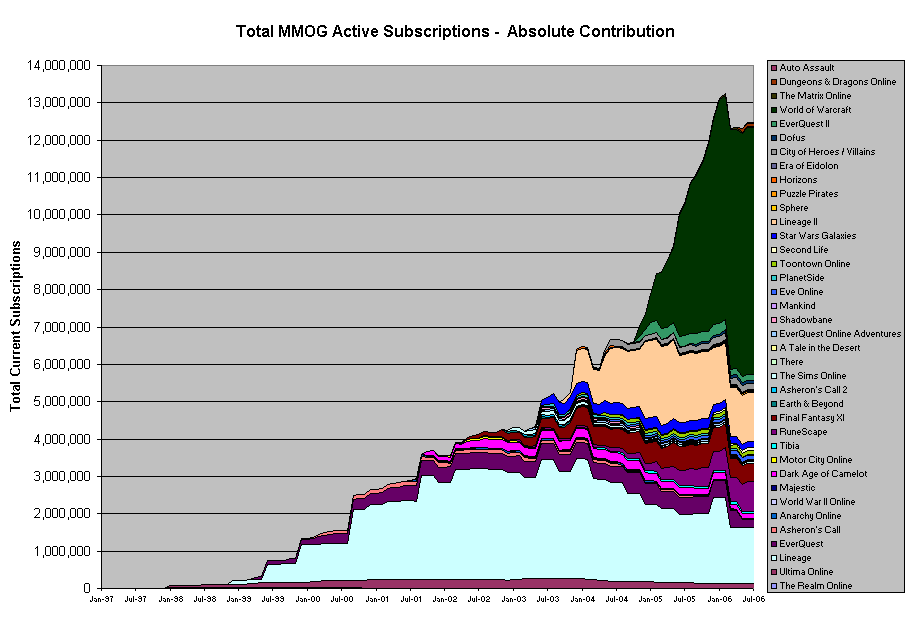
Looking at some subscription charts I was able to quickly find now I see I made a mistake. I was thinking of Lineage 2 using mssql, while it was Lineage (1) that was the major one. I do not know anything about its backend and it would be hard to assume considering how much older it is.
I was a big proponent of MSSQL. It is still a good product but I see Microsoft constantly fumbling with new OLAP tools. It is a shame but it seems Microsoft is abandoning MSSQL.
I have used a lot of RDBMS vs NoSQL solutions and I love SQL Server. I have used and written services consuming/reporting/processing thousands of transactions per second and billions of euro per year.
The profiling abilities of SQL Server Management Studio (SSMS) and its query execution insights, the overall performance and scalability, T-SQL support, in-memory OLTP, and temporal tables - I just love SQL Server.
I'm not sure if it's just that I learned SQL Server better in college than MySQL, Mongo or Postgres but it's just been an amazing UX dev experience throughout the years.
Granted, there's some sticky things in SQL Server, like backups/restores aren't as simple as I'd like, things like distributed transactions aren't straightforward, and obviously the additional licensing cost is a burden particularly for newer/smaller projects, but the juice is worth the squeeze IMHO.
Lots of people deliberately avoid Microsoft technologies and their whole ecosystem. There's of course interesting stuff happening there, but not enough for those outside the ecosystem to care.
It's more a cultural thing than anything else. HN for example largely leans away from MS. It's quite interesting how little overlap there is between the two worlds sometimes.
Speaking as one of those people, it's just not my thing, so it's not on my radar at all. There's enough stuff happening outside MS to keep me busy forever.