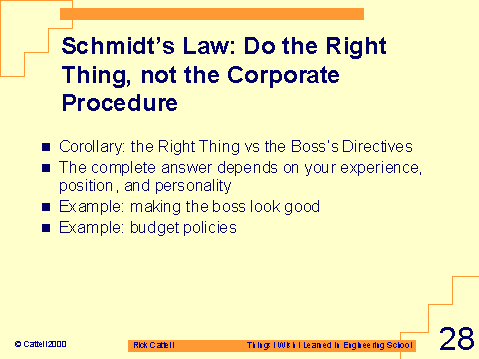
Amusing off-hand remark in a merely 12 year old presentation:
  > Rule 1: Almost all organizations try to do too many things
  > Examples: SGI, NeXT, Apple
  > Lesson: Make sure the company management can make the hard calls
While I agree with most of your points, I think that you've mistaken engineering school with soft skills/personal management course that you can attend on weekends or order on DVD for $19.99.
To be honest, I never actually believed anyone can learn these things by being told how it works (in contrary to engineering, BTW). Making a mistake is an important part of the process. Otherwise you will get a two-week lasting hype "I will change my life and be more mature from now on" and then you are back to normal. There has to be some feedback and positive feedback is simply not fast enough.
You can't take the "I wish they had taught me X in school" genre too literally. Often what it really means is "it's too bad X can't really be taught in school, but must be learned through experience", "it's too bad that the typical school contains very few people who understand X well enough to teach it", and/or "it's too bad that, when they told me X in school over and over again, I was so young and inexperienced and lacking in context that I didn't really grasp the importance of what they were saying".
What it doesn't really mean is "they should simply start a one-semester course in X and then all the new grads will be much smarter".
Why do we phrase our essays in this manner? Optimism. Optimism and marketing, which often go well together, like chocolate and peanut butter. "Ten things that you could learn from me today instead of spending ten years learning them the hard way" is a good sales pitch. "Ten things that you will spend five minutes reading, but will not truly understand, and then you'll still have to spend ten years learning them the hard way, but at least when you learn them you will already know the words for them" is not as good. ;)
Don't get too good at what you don't like doing. Work will gravitate to the most competent people
As an enterprise dev, I'm always weary of being pigeonholed. I've witnessed it on many occasions yet I don't think I've ever seen the idea expressed so succinctly.
Edit: except the second link he provides doesn't seem to refer properly anymore and the first link has a very long load time, if it loads at all -- an HN-type slashdot effect?
What do folks think of Rule 42 (slide 18)? "Being first is more important than being best." Specifically in light of recent discussions about Instagram and 'being first' [1]
My feeling is that this rule is often true, but also mostly useless. Because of why it's true: post-facto rationalization. Every product ever made is the first to do something - though sometimes we are forced to make up new words to describe just what that something is - and if that product is a wild success it will turn out that that something was the important thing to be first in.
I'm fairly sure that the first iPhone camera shipped out of the box with the ability to snap a photo and then email it to a list of your friends. I'm sure that there was a way to post an iPhone photo to Facebook. But in the next five years when two dozen Instagram clones get founded, flail, and die, we will be told that they failed because Instagram was the "first" to "really" get mobile photo sharing. Where "really get" is defined circularly: We know that Instagram was the first to have it, because no earlier company managed to become Instagram.
Similarly: The IBM PC was not among the first PCs to hit the market, the iPhone was not the first smartphone with a touch screen, Facebook was not the first social network, Dropbox was not the first way to sync files between computers, Amazon was neither the first online retailer nor the first online retailer of books:
More classic examples: Singer didn't build the first sewing machine, neither Swan nor Edison built the first electric light bulb, Henry Ford was far from the first automobile manufacturer (but he was "first" in several other things, which are now known to have been vitally important, because they formed the basis of… the very successful Ford Motor Company!)
One could probably rephrase the rule to make it more useful. (Perhaps a variation on the classic "nobody ever got fired for buying the industry standard"?) But it's surprisingly hard. The subject resists glib generalization. I'd just pay more attention to the other rules. ;)
That's kind of what I was wondering. That being 'first' is largely irrelevant since, if you make it, you were 'first' to get it 'right' (terms which are rationalised after the event). Hence, I'd consider them of limited use outside of hypothesis testing.
Like he said. If you are going to be second, you have to bring something really great to the table, something that itself has value, and replaces the value of the thing you are leaving. To use an example: Sean Parker said Facebook should never have won, considering MySpace's network effect at its height. Facebook was great: it had its own value, but it still had to replace MySpace's massive network effect. Luckily, due to MySpace's lack of innovation at that time, its own value plummeted, making it easier for Facebook to rise up above it.
That's what I would say. Being first is good, because you can capture the market, hence making it difficult for users to switch.
Problem is you only have a limited time to learn. How do you prioritise the curriculum? How long do you spend at uni before going into the real world?
I have learned more in the real world but probably because my teachers lacked inspiration...
While I agree that these business skills are VERY necessary in life (sometimes unfoutrunately so), you can learn them up to certain degree during school. You need a good teacher with relevant exerience in these skills, he / she will give you the basics and some anecdotes. when finally are in a position you need these skills, then you have the necessary basis to built upon.
And that really is something you hardly learn at university, no matter which major you have.
As having gone to engineering school, I agree with you.
But the main issue is that most technical courses are given by people with a strong foothold in academia (and a lack of knowledge of "the outside world")
Good teachers go a long way, you have to be aware of the issues to realize they're happening once in the "real world".
You have to know the technical aspecsts, but if you restrict yourself to that, you'll spend your life in Dilbert's world unable to change things. And when it's your turn to lead, you'll do exactly the same as your boss did.
This list is very important, and the most amazing thing is how many people don't know 10% of it, even in companies!