For me one of the most compelling data points wasn't even a parenting reference. It was https://www.amazon.com/Millionaire-Next-Door-Surprising-Amer.... First published in the mid-1990s, the chapters on the children of millionaires found that the more support millionaires gave to their children, the worse that those children turned out. Armed with that theory, I've always doubted the wisdom of extreme helicopter parenting that has become popular since.
One important thing that the NPR story completely glosses over is the component of race and class that permeates this issue. It’s not an accident that the prototypical mom of the “free range kid” movement is white and lives in a relatively wealthy neighborhood like the one mentioned in the story.
Poor black and brown women are disproportionately targeted by child welfare authorities starting literally from birth. https://www.ncbi.nlm.nih.gov/pmc/articles/PMC7372952/ This makes it particularly important that we actually change the laws around what constitutes neglect or endangerment, not just create a culture shift.
This happens everywhere, it doesn't have to do with race. I have a family member who has children in very posh and upscale neighborhood in a suburban area of NoVa. She has had neighbors call child welfare several times for her 10 year old skateboarding around town, or playing at a playground unattended with friends (literally a block away from their home). I get the vibe that alot of older residents don't want children running around because they value peace and quiet, so they call the cops/DCF when they see kids hanging w/o adults.
Sociology departments in America are captured by the current moral fashion (identity politics). If it were me, I'd think twice before believing the research that you linked to.
If it is moral fashion to acknowledge and measure the obvious racial and economic discrimination in America then that’s a fashion which is morally good.
That is assuming that the moral fashion is actually doing that. Unfortunately, the moral fashion is more about starting with a predefined set of conclusions, then working backwards to justify those conclusions. I don't think we need to sell out our integrity to achieve a better society, or make false equivalence between liberal social justice and critical social justice, of which the latter is the current moral fashion.
It is actively harmful if they're measuring the wrong things and in the wrong way to come to an exact predefined conclusion instead of the one that is actually maximally good for children.
Hard not to when antisocial policies are intentionally used to disadvantage minorities after the 60s.
We might agree they're focused on a symptom, not a disease, but conservative policy objectives are definitely causing disparities that now even poor white people are finally feeling.
Conservatives shut down public pools in reaction to integration and then proceeded to shut down socialism.
All too frequently laws in the US are completely out of step with the culture. For instance despite broad support for many reforms (abortion rights, term limits in Congress, marijuana legalization) nothing happens just because the culture has evolved.
I’m not a parent so I don’t know what I’m talking about.
However, I have a lot of friends with children and some of their takes are completely irrational to me.
“Let the kids WALK three blocks to school? Not anymore, things aren’t like what we grew up with. It’s scary out there!”
Exactly. Violent crime, etc has been on a general and significant downward trend since we were kids (80s and 90s). It’s not what we grew up with - it’s significantly safer. The media drives a tremendous amount of anxiety and it’s extremely detrimental to parents, kids, and society overall.
It used to be “sex sells” (still does) but more and more it’s “fear sells”.
"Let the kids WALK three blocks to school? Not anymore, things aren’t like what we grew up with."
One truth in this regard: people will straight up call the cops, or worse, CPS, on unattended children. In their perception that things are scary, people manifest their fear and become villains with "good intentions."
And, to the hilarious dead response to my first comment, I'm just gonna repeat this back to you: "You're one of billions of ultimately meaningless voices."
>One truth in this regard: people will straight up call the cops, or worse, CPS, on unattended children
And there will never be any meaningful consequences leveled against those people, empowering bad actors far beyond any meaningful social sanction they could ever have generated by themselves.
Making sure concern trolls and the hysterical can't fuck up a working community is something poorer societies (SE Asia, Continental Europe) inherently do better than richer ones (UK, US), mainly because the former simply can't afford to indulge it.
The book wasn't a compilation of independent research papers. It was produced out of a compilation of interviews done to better understand millionaires.
Support was defined by the wealthy parent providing financial support, whether through a stipend, gifts, or whatever. It turned out that, despite the best of intentions, such support almost inevitably wound up with destructive emotional dynamics.
What’s an example? I thought the family safety net was a bigger factor in children from wealthy families starting riskier ventures earlier in life and perhaps serially. I’ve never heard of a company starting like you describe so I assume it isn’t that common, but maybe people just don’t talk about it much? Or maybe you are just exaggerating the loan magnitude by quite a lot?
But presumably it is also possible that some children were smart and successful, so therefore the parents didn't feel the need to provide so much support.
Whereas others were perhaps struggling with everything so the parents gave much more support.
Everyday example: the parents of disabled people dedicate almost everything they've got to help their children, and often end up poor and with a poor quality of life themselves as a result.
Well, it comes a lot of from the good stuff that involved parenting does.
In other words, even taking kids to school in a car instead them walking (or at least on the bike, but their own feet still involved, therefore they are themselves 100% in control in going to school) is the support that is not the in the list of "support" but will be in the long run. I should mention, I do recognize the time constraints of current society.
Epigenetics suggests that unnecessary stressors in the current generation reduce biological fitness, which competes with struggle for the sake of struggle when its not necessary
hope someone finds the happy medium of allowing growth without unnecessary stress
The wars of the 20th century were pretty extreme outliers in terms of how many people in the societies were significantly affected by the wars. I believe that for most of human history post tribal era, most of the population wouldn’t have been nearly as affected by wars. You might have to pay taxes to someone else after it’s over.
Some centuries in Central Europe were full of war, wiping out 30% of the population in some countries (30yr war, for example). So there were definitely large populations affected by war previously.
What I've read of history shows it to have been full of wars with things like genocide and mass rape. We didn't even have a name for genocide until after WW 2 - it was just a standard thing that happened regularly.
And pillaging was just taken for granted as a standard solution to the problem of supplying an army in the field. It was much easier to take whatever the local peasants had and then move on than to have a good supply chain. The fact that the peasants often starved as a result was just one of the costs of war. Better them than us, and we have the weapons.
I feel like the problem though is that people don’t trust their community, and they don’t trust that the kids will be safe.
If the child’s playground is right next to a block of houses and shops with people walking around all day, it is much less likely that the child is taken away. Whether it’s actually safer, I’m not entirely sure, but it definitely feels safer to have your kid playing near a busy pedestrian area, compared to an abandoned playground down a quiet road at 4pm. And the feeling is what matters regardless.
And that is a big part, but also just the feeling of trusting your neighbors increases when you live in a walkable place and see your neighbors all the time. [0] That source isn’t maybe the most thorough, but it echoes my experience of moving to a quiet but walkable neighborhood in the Netherlands from the US. People really do trust their neighbors much more here, and I’ve changed in that regard too. Everyone is always offering to help each other out.
>You could create the most walkable neighbourhood in the world and not achieve much in this regard.
As always, giving into hysteria only leads to more hysteria.
The massive expansion of the rights of angry Karens to summon State guns on command that occurred somewhere in the 1980s is why the current homebuying generation doesn't care about "walkability" in the first place: the generations that grew up under those conditions have simply adapted with mansion-sized homes because if you don't have a private version of what used to be a third space free from Karen's prying eyes, you don't get a space at all.
It shouldn't be lost on anyone that the people who most want walkable neighborhoods "for the children" are also the people who are going to destroy those benefits once they see the results of the other things they vote for on the street outside "for the children's safety". So no, I see no reason to build things the way they want and agree that tendency towards isolation is mainly because by and large we remain rich enough to avoid addressing the elephant in the room.
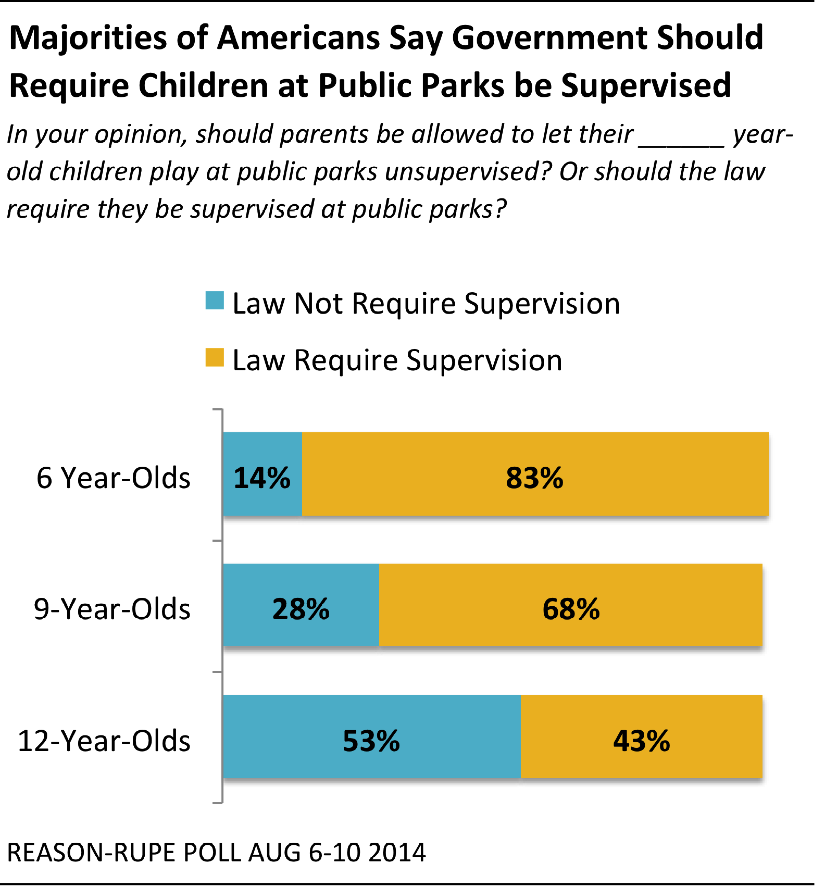
The way parents interpreted the poll is not "Given a hypothetical park somewhere in the world, should..."
But rather "Given the current state of parks in America, should..."
The parents are most likely right, it currently probably is unsafe for kids to be alone in public parks.
But that is not because american parents hold dogmatic beliefs about kid independence, they're just making a judgement call based on how unsafe parks currently are.
"Free" is probably the wrong word. They get to do that in places that have a strong social fabric. The diversity of America combined with a capitalism-induced culture of pitting people against each other makes that impossible in the US.
I think the idea here is that children need to have the opportunity to explore the wider world independently, not just a 50 metre circle around their home.
Playing in your yard isn't really "minimal supervision". You probably just didn't know how often your parents checked on you. And you would have known that your parent could just look outside and see you.
As a 8 or 9-year-old, could you go to a friends house, to the store, or to school without parental supervision?
Did you have safe bike lanes to do this? Was there safe public transportation? Sidewalks on busier streets? Safe crosswalks where the cars are supposed to stop by law - and are those laws enforced heavily to keep you safe? Could you play independently outside of your yard?
I live in the USA and we picked our neighborhood specifically because of these things.
My kid has been going to her friend’s houses by herself since she was 5. She goes down the block (sometimes a couple of blocks! Friends of friends) to her friend’s houses. I feel like we changed the culture in the neighborhood. Kids come out and go to our house and other houses all the time. It’s a good, safe neighborhood.
Of course it just takes a few people to screw this up. Some busybody lady who felt the need to tell us she was a foster mom (okay? Maybe trying to signal what a moral person and upstanding person she was?) called CPS on us saying we were “neglecting” our child which meant a visit to verify we were not abandoning our child on the street. She later lost her job and had to move away, let me tell you I was very sad to hear it. To avoid such spurious accusations, we got our daughter an Apple Watch with cellular service, which we generally use to call her when it gets dark out.
She’s eight now, and went to Walmart by herself earlier this year several times on her bike to buy a few things. I was very proud of her!
This is extremely important to us that she be able to have this autonomy. It’s definitely not the default, though. There are a half dozen or more kids that regularly dip in and out of our house. It’s sad that some parents absolutely don’t allow their children out of their sight. There are kids just next door my daughter basically never sees because they aren’t allowed to leave their houses, despite being the same age as my kid.
It does seem that women are by far the biggest offenders in this space. They're also the biggest consumers of murder/mystery and true crime podcasts & media.
I wonder if any studies have looked into why women are reacting like this more and more.
I'd like that sort of neighborhood as well, but other than sidewalks and perhaps a nearby park it seems difficult to gauge character like that until you live there. And there are lots of neighborhoods that have the objective basics (sidewalks, low crime, etc).
You know hindsight is 20/20, I may be puffing up how much “research” we did. There was a lady having a garage sale with some kids the day we looked at houses, my daughter now plays at that house almost every day, we drove around the neighborhood once or twice and saw kids playing outside, we knew the city was one of the safest around. It was the most expensive house we could “afford” (not really) at 30 after our first daughter had been born. The other candidate house was in an older neighborhood and we watched someone being arrested at the gas station down the street, which turned us off to the place.
It is still US suburbia, but as I said it’s an “if you build it, they will come” type situation and during the summertime we see kids (early tweens) with electric scooters or electric bikes going by themselves or with small groups of friends to the shops nearby (stuff being close enough to do this, although walking is maybe a little bit of a trek). Twenty years ago when it was built, this house wouldn’t have had all the accommodations nearby, as they’ve been built since.
I do think that us taking a principled stand on “we will not be bullied, and it is a goal for our kid to be able to be independent in the neighborhood” has helped. I know 100% the Indian girl down the street’s mother initially had a rule she couldn’t go play but she said “but mom, the girl down the street can go everywhere!” and now she’s out playing almost every day. All the kids have the “be home by dark” rule. It’s also astounding how diverse the neighborhood is, her friends are mostly first or second generation Americans with professional parents, from India, Argentina, Mexico, and Vietnam. It’s really great to see all the girls becoming good friends.
I grew up in a small town where everybody drove everywhere and bike lane did not exist, but as a kid we grew up biking on the roads or walking around. Our typical soccer pitch was a partly secluded street, and getting the ball stuck under a car was the norm.
Now in my home town there are zero kids on the street. Culture has shifted drastically.
Most places I've seen, yes in the US, have bike paths, and houses are typically in a separate area from main thoroughfares. Why wouldn't a kid bike to a friend's house, or a local park?
I live in a decently nice neighborhood in San Jose. Houses $2-3m. People constantly run the stop signs, they don't slow down at all, 30-40mph. I've only lived here one month and I already saw a car hit a pedestrian on a scooter at an intersection (and the guy just drove off).
That's not really a bike path, now is it? It's a painted lane on a road.
I've never been in a place where I had to take a "busy main road" to get around locally. Cross it sometimes, sure, which can be done at a light. This sort of highlights the problem. Over-protectiveness, by examining the worst that can happen, and the worst scenario.
I've been riding in a big west coast city for the better part of two decades, and I have definitely not been able to rely on dedicated bike paths (or even multimodal "trails") to get around. I mostly ride in the road, and often in the car lane rather than a paint-separated bike lane when I judge that the latter is unsafe (can happen for various reasons but mostly conflicts with cars turning right, pulling out, etc.).
Despite that, I've avoided bad accidents and generally felt pretty safe, but only because I survived long enough to develop an acute intuition for when drivers are about to do something stupid/illegal/dangerous. Previous and contemporaneous experience driving a car on the same streets was also very important. I would not trust these streets with my daughter's safety on a bike, and I honestly won't trust her to read the idiots' minds until she has some experience doing so from inside a heavy steel cage.
Riding within neighborhoods like the one I live in now is a different question, though some people do drive quite fast through here, and the size of the typical modern car makes clearances and sight-lines rather tight. I do see a lot of older kids out on their own walking, often to and from school, which I think is great.
I've been riding in a big west coast city for the better part of two decades, and I have definitely not been able to rely on dedicated bike paths (or even multimodal "trails") to get around.
Fair enough, but that's not what I said. I said locally, and neighbourhood. You elude to this later in your comment, but it seems unjust to reply, and refue my comment, while changing scope.
These are kids. They can bike locally to friends houses, or a corner store, or a non-central local strip mall, without hitting main roads.
Which you in fact agree with, later in your comment!
It doesn't need to be all or nothing, people. Biking in local neighbourhoods can be safe, and it can still be dicey on the main roads.
I think the problem with your model is that it conflates these two concepts, which may sometimes be appropriate but definitely isn't universal. For example, if you walk about 3/4 of a block east from my house you will hit a relatively busy arterial that is honestly one of the more dangerous roads I've ever ridden on, with broken sight lines due to parked cars (which also constitute a dooring hazard), lots of cars pulling in and out from side streets and parking spots, delivery drivers blocking the bike lane, a busy pedestrian crossing (again with very poor visibility), and cracked and rutted pavement. Just from their small stature alone, a child riding on this road would be in significantly more danger than an adult would, to say nothing of the skill and experience it takes to navigate so many simultaneous conflicts safely.
On the other hand, if you walk west from my house, you can go the better part of a mile through a quiet, shady neighborhood before hitting a main road.
Now what is "local" and what is "neighborhood"? Is the grocery store about a 3 minute walk east of my house not "local" just because to get there you have to at least cross this busy, relatively dangerous arterial? I don't think that makes sense. However, it's definitely not part of my neighborhood in the go ride around the neighborhood sense I understood as a child growing up in the suburbs. So in my view I am not changing the scope of the conversation, but rather trying to draw your attention to a distinction that may not exist in the locales you have experience with, but is important in some of those you don't.
Well this is why I stipulated only crossing busy main roads, and going to local, quiet strip malls, and otherwise being on side roads.
This added context to my statements about local, and neighbourhood, and all kids get directions such as "but don't do that!!", it's part of life as a kid. And frankly, an adult, though it be self prescribed.
Naturally each situation is different, but busy rodes have traffic lights, otherwise you might tell the youngster "never cross that road".
And that still leaves loads of low risk areas, which ypu yourself admit is viewed as local.
I see a lot of either/or in some topics, and local non-car travel seems to be a big one. People want to rail on about fewer cars, it's not safe, more bike paths needed etc etc. And I find that any conversation revolving around it being safe ... anywhere to bike, elicits these sort of absolutist responses.
"It's just not safe!!!!"
But the reality is, it is safe... just with conditionals, which I mentioned, and with instructions to child, and of course taking into account the specific child too.
And this is how to avoid helicopter parenting. You don't use a cell phone tracker, to make sure they obeyed, you don't follow them around, you give restrictions and work with that.
If your point is that biking locally is safe anywhere (excepting absurd scenarios) for children as long as they can be trusted to accurately internalize and unerringly obey a complex set of directives concerning which roads they are allowed to ride on, where and how to cross those they are not, and warnings of hazards they aren't experientially equipped to intuitively understand, then sure, I agree with you.
However, in practice, I think you will find that there are very good reasons you see a lot of younger kids out walking by themselves in neighborhoods like mine, but very few on bikes (unattended). If it just came down to "helicopter parenting", you would not see the former either.
From where I sit, you're making my point. An exaggerated emphasis on the complexity of a few "don't do that" rules, and the concern that blind obedience won't be forthcoming, is the malformed cause of helicopter parenting.
Additionally, "kids are actually allowed outside" isn't really proof that taking away bikes isn't helicopter parenting.
Look, I can't imagine we're going to agree here:
* I believe a child is given great disservice, if they don't have the option of doing risky things and
* I believe a child a abused, their development twisted, if they don't break the rules occasionally, and do a risky thing... while considering how to do it in a least risky way!
Put another way, if you seek to cut off all possibility that a child can get in over their head, or do a risky thing, one is helicopter parenting.
What exactly do you think it is that I'm exaggerating? I've been polite here, but frankly—given your earlier assertion that "most places [you've] seen [...] have bike paths, and houses are typically in a separate area from main thoroughfares", I don't think you have any clue what you're talking about re: any neighborhood even vaguely resembling mine. Furthermore, your implicit assertion here that making any dangerous activity off limits for children of a certain age is helicopter parenting—abuse, in your words—is totally ridiculous.
Am I a helicopter parent because I refuse to allow my nine month old to crawl around in the street out front eating dog shit to learn how bad it tastes? Because I won't let my four year old help out in the kitchen by chopping zucchini with the extremely sharp chef's knife I barely trust myself with? Get a grip, man.
This sort of hyperbole is what is wrong with US political discourse.
When I say:
"But the reality is, it is safe... just with conditionals, which I mentioned, and with instructions to child, and of course taking into account the specific child too"
and you ignore this context, you're missing vital context, and your reply loses value.
And when I say:
"Put another way, if you seek to cut off all possibility that a child can get in over their head, or do a risky thing, one is helicopter parenting."
and transition "a risky thing" to mean "every possible risky thing conceivable", you are again ignoring context, for that is already mitigated by my statements about the individual child.
Part of the growth of a child, is to allow risk, so that as an adult, that human will be able to gauge risk. Helicopter parenting over-reduces risk, and results in weaker adults as a result.
Let's look at the bike example, with rules. And as I discussed, a child being told that it's OK to bike in their neighborhood, but "don't go on that busy street, although you may cross at a light!"
Now you have to trust that child, while I should not have to say it, for I already did, and therefore you should keep the context in mind, "and of course taking into account the specific child too".
For example, I have seen 8 year olds with more sense than 12 year olds.
But back to the example. Now what happens if child decides to ride that busy road? Well, on very rare occasions, a child might break the rules. But naturally, that same child would not want to get caught and punished.
So what would a child do? Well, it rarely, if ever would break that rule. And that child would be damned careful, because they didn't want to get caught doing something wrong!
One of the reasons for punishment, is not to instill blind obedience to rules, but instead to instill risk management as a concept to children.
But I'm sure you'll take this response to indicate I believe toddlers should by flying fighter jets, instead of 10 year olds biking to a friend's house, with rules. So why even discuss any more?
I recently had a few discussions with a person who strongly believes that large language models are already generally intelligent, and that a so-called ASI (Artificial SuperIntelligence, IIUC) is overwhelmingly likely to emerge within the next few years. These beliefs are founded in (imo) breathless, grandiose, generally unfounded readings of essentially every AI paper posted on the arXiv, but when others point out that said conclusions are not [yet] supported in practice (i.e. LLMs cannot yet replace the average software engineer), this person retorts that LLMs' performance on synthetic benchmarks is the only thing that matters, and that (e.g.) a practicing software engineer with decades of experience is utterly incapable of evaluating the merits of a particular LLM as a programming tool.
Long story short, I maneuvered this person into a rhetorical corner where they had no choice but to abdicate or say to my (virtual) face that a master carpenter is literally incapable of evaluating the practical merits, or lack thereof, of a particular hammer that they have held in their hands and used. That is when I decided to stop having substantive conversations with this person, because there is no arguing with such an absurd depth of self-serving epistemic nihilism. I was satisfied with simply proving that it was there, to myself and others in the conversation.
---
> "But the reality is, it is safe... just with conditionals, which I mentioned, and with instructions to child, and of course taking into account the specific child too"
You are offering broad, utterly worthless generalities with a side of BS hand-wringing about politics (which this is not). I am offering concrete scenarios and questions, because each child is real and they live in real physical environments and any injury or death they sustain in the course of a dangerous activity is real.
So I ask you again: is it appropriate for me to let my nine month old crawl around in the street? Why or why not? Is it appropriate for me to let my four year old use the sharpest chef's knife in the drawer? Why or why not? I would like you to commit to answers here, to establish a baseline, so that I know you are not so steeped in self-serving epistemic nihilism that you would tell me to my face that a carpenter cannot say if a hammer is a good hammer or a bad hammer just to salve your own wounded ego.
Once you've provided those answers, let's try a less obvious (I hope!) scenario. First, at (approximately) what age would you say that a child living in a sleepy subdivision with wide streets, long sightlines, and minimal traffic should be allowed to tool around on a bike in the street and visit her neighborhood friends living within a handful of blocks? Now, having answered that, how would you answer it for an identical child living in a high-rise condo in downtown LA?
Are they the same age? Is your answer simply "as soon as they are able to ride a bike", taking judgment entirely out of the equation? Or will you admit that all things are not equal?
And finally, assuming you do admit that parental judgment has a role in keeping children safe, what exactly is it that makes you believe you are more fit to judge the cycling safety landscape of my neighborhood, in my city where I have been cycling for almost two decades, than me? Without even knowing what neighborhood in what city we're talking about, no less!
I look forward to reading your answers to these questions. If you cannot answer them I will have to assume you are participating in bad faith, and this will be my last reply in this thread.
My street is fine. But it’s a quarter mile long, and the road it connects to is nearly impassable for pedestrians or bikes. The road is narrow, curvy with steep 5-20 ft high wooded or fenced hills on either side. It has no shoulder. It’s technically a 35mph road, but cars can come around the bend at 35-50 mph at any time and you have nowhere to go. You just have to trust that they will see you and not hit you.
Never seen a bike path in any neighborhood in the part of the US I live in. I'm sure they exist somewhere, but they are definitely not common. The are bike paths in downtown areas, but not in the suburbs.
Statistically speaking, roads are quickly becoming more and more unsafe for drivers, let alone pedestrians and bikers. Cars are much larger than they were in 90s, people are driving more recklessly than ever and enforcement of traffic laws is at an all time minimum.
A lot of the people espousing the whole free range parenting stuff never actually walk around and understand what the pedestrian experience is like. If they did, they'd be strongly advocating for better road design and pedestrian paths. But you rarely see the two groups intersect.
When I was little (20 years ago), I left the house in the morning and came back in the evening. My parents didn't really care what I did. It was the same for all the children in our small village.
We played in the forest, created tree homes, tunnels and much more. It was an incredible time which I'm certain helped me a lot in my development.
Granted, I was growing up on a farm in Germany. There wasn't much traffic or other "dangers".
Sometimes people get so tangled up in half-baked theories and rationalizations that they need to be reminded that water is wet. It should be common sense that lack of autonomy will mess kids up, but some people just don't get it. A refusal to tolerate any risk or uncertainty ironically ends up doing more damage than whatever it is they fear.
Parents shuffling around kids from activity to activity in their minivans is the bane of present day kids. The problem is that cities are so car centric. A good way of alleviating some of it is to do at least 3 hours of independent self play a day.
I blame Otis Toole[1], who confessed (and later recanted) to the kidnapping and murder of Adam Walsh. The hysteria Adam's father was able to create in the United States is astounding. I grew up before that happened, and yet, when it was my turn as a parent, I was still freaked out the first time my child wanted to walk home from a friends house, 2 blocks away about 10 years ago.
When I was a kid, we were told to go outside and play until the street lights came on.
Yeah, this discussion thread so far accounts how sensationalist media covered true crime cases. Child abductions, serial killers, Satanic panic led to cultural shifts where suddenly the 'burbs aren't safe anymore and stranger danger was amplified and everywhere.
I remember a massive shift in my parents behavior (along with friends parents) after that movie aired. Previously normal things like letting your kids play in the toy section of Sears while parents shopped elsewhere quickly ended.
It's on a different topic. ie. That if people speak up for themselves, or they want to address unfairness or inequality in their society, it's because their parents hugged them when they cried as babies, instead of ignoring them, or whatever you're supposed to do to "toughen them up" (ie. turn them into terrified adults, washed up in middle age, who see any new youth movement as a life-threatening trend that must be stopped).
My parents had several children, and they always say that they noticed behavioral differences even in the first baby months. In other words, some behavioral traits or impulses are more due to nature, not nurtured by their parents. Some babies cry more, some less, some eat more, some less, even if you approach them equally.
> In "The German Mother and Her First Child", Haarer wrote, “It is best if the child is in his own room, where he can be left alone.” If the child starts to cry, it is best to ignore him: “Whatever you do, do not pick the child up from his bed, carry him around, cradle him, stroke him, hold him on your lap, or even nurse him.”
A bit late to the party but I knew I've read this earlier on Hacker News but I couldn't find it earlier. This paper (with slightly different styling) is linked at the bottom of the article 'Play deprivation is a major cause of the teen mental health crisis' [0] discussed here [1] a few months ago.
I don't understand this. We were free-to-play, but it was not unstructured. Quite the opposite, you had to be somewhere on time, in a heirarchy or school structure and there were teacher imposed rules.
I miss that heirarchy more than I'd care to admit. The endless cycles of milking the good while it's good, is an offensive and time wasting replacement for what used to be a well-timed culture.
It is deeply humorous to see fear of traffic and crime listed as a valid reason to keep kids inside. When you list fear of data leaks as a valid reason for privacy from surveillance, people discount you. So much emotional picking and choosing lately.
Parentalism is destroying the West, make no mistake, "security" is a massively overrated parasite, sucking the life out of it's inhabitants. Get off my back.
Typically, unstructured play is defined as playing without predefined rules or adult guidance, like playing on a playground or drawing pictures. The child is left to their own devices.
Structured play has predefined rules; for example, playing Monopoly, role-playing, or cooking with an adult's help.
Although you had to follow rules in a school setting, it wouldn't necessarily make your play structured, since you always have to follow those rules anyway; it's not like playing Monopoly, where the playing itself is governed by additional rules, and everyone takes turns, and follows a set structure.
Can we just all agree it's the people and ideology we don't like messing everything up here? As long as we don't get more specific we can find some common ground.
Robert Putnam discusses the decline of unions leading to disconnections in the workplace in Bowling Alone, chapter 5. Though certainly, the alienation between workers accompanies other forms of atomization in American society, and is more of yet another effect than a cause.
Wait. Does this pass for science in these fields, psychology and medicine? They summarize various statistics from prior papers as if they are trends across space and time (hello sample bias, are there papers that contradict their claims they are omitting because it doesn't fit their thesis?) and then make broad conclusions based on anecdotal evidence and sweeping theories.
This should barely pass as a "kids these days" like-and-share from your grandpa on Facebook that has a bunch of comments from Cheryl about how true it is. Which is tragic, because it's something anyone who spends time with children can figure out... that independence makes for a happy child. But to be published in a journal I thought the point was to find rigorous evidence for such things, not muddy the waters further with vague specious claims.
> Does this pass for science in these fields, psychology and medicine? They summarize various statistics from prior papers as if they are trends across space and time (hello sample bias, are there papers that contradict their claims they are omitting because it doesn't fit their thesis?) and then make broad conclusions based on anecdotal evidence and sweeping theories.
I feel that if you've never heard of a meta-study then you must not be very deep into science at all - like, even undergraduates know what a meta-study is.
In the real Foundation books, which the TV series barely resembles, this was part of the galactic empire's decline. With so many studies done, over tens of thousands of years, on millions of planets, each with hundreds of millions of people, there was an immense load of prior work. And meta-analysis was where all research ended up.
Just read a bunch of papers, summarize them, and write a new paper. Scientific research had devolved to the point, that no one knew how to do new research.
Despite Asimov's opinion on the matter, it seems that in reality the meta-analysis is a useful tool for understanding the de facto scientific consensus on some topic beyond the scope of a single paper/study.
I think the original naive critique is valid though. What if the consensus is wrong? But of course, it's better than one random study, unless you particularly trust that researcher and none of the others.
Still not sure where he mentions it in the series, but I wonder if it's Asimov making up a far futuristic galactic version of Scholasticism, with its focus on reinterpreting existing works, for his far future version of The Decline and Fall of the Roman Empire.
Without disputing that Asimov might have brought up such a concept somewhere in the series, it certainly is not a prime factor mentioned in the first novel.
"Good. Add to this the known probability of Imperial assassination, viceregal revolt, the contemporary recurrence of periods of economic depression, the declining rate of planetary explorations, the..."
[...]
Gaal said, "As Trantor becomes more specialized, it becomes more vulnerable, less able to defend itself. Further, as it becomes more and more the administrative center of Empire, it becomes a greater prize. As the Imperial succession becomes more and more uncertain, and the feuds among the great families more rampant, social responsibility disappears."
Without disputing that Asimov might have brought up such a concept somewhere in the series, it certainly is not a prime factor mentioned in the first novel.
Quoting part of the novel, does not mean other parts do not eapouse other things.
One "decline theme" was that the overall culture of the empire was in decline. And part of that, was attributed to stagnation, which exhibited as a lack of scientific change, and advancement. There were other ways this was exhibited, such as how spacers didn't even understand how their ships worked, because they didn't need to. They had been so static for thousands of years, with no change in their drive systems, that rote repair guides were all that were required.
And that there were few experts left who even understood the drives.
Amusingly, with all the changes, the TV series got this right. The Foundation shows immediate, groundbreaking scientific advancement in many areas, the Empire immediately falls behind technologically, a mere generation after the empire withdraws from their section of the galaxy.
And with a mere handful of specialists in each branch of science, at that!
And in the TV series, again a good parallel to the books, one of the primary characters' planets has reverted to barbarism, rejecting science, demonizing those who dare learn!
Culture was a primary reason for the fall of the Empire. Stagnation.
As I mention in the other comment, I wonder if the regurgitation of research idea was Asimov's take on far future galactic dark ages Scholasticism. Which would fit the theme of stagnation, sure.
He's refering to the episode near the beginning with Lord Dorwin.
"Then why rely on him? Why not go to Arcturus and study the remains for yourself?"
Lord Dorwin raised his eyebrows and took a pinch of snuff hurriedly. "Why, whatevah foah, my deah fellow?"
"To get the information firsthand, of course."
"But wheah's the necessity? It seems an uncommonly woundabout and hopelessly
wigmawolish method of getting anywheahs. Look heah, now, I've got the wuhks of all the old mastahs - the gweat ahchaeologists of the past. I wigh them against each othah - balance the disagweements - analyze the conflicting statements - decide which is pwobably cowwect - and come to a conclusion. That is the scientific method. At least" - patronizingly -"as I see it. How insuffewably cwude it would be to go to Ahctuwus, oah to Sol, foah instance, and blundah about, when the old mastahs have covahed the gwound so much moah effectually than we could possibly hope to do."
[...]
As they left the room, Hardin said suddenly, "Milord, may I ask a question?"
[...]
"No. It's this: Last year we received news here in Terminus about the meltdown of a power plant on Planet V of Gamma Andromeda. We got the barest outline of the accident - no details at all. I wonder if you could tell me exactly what happened."
Pirenne's mouth twisted. "I wonder you annoy his lordship with questions on totally irrelevant subjects."
"Not at all, Doctah Piwenne," interceded the chancellor. "It is quite all wight. Theah isn't much to say concuhning it in any case. The powah plant did undergo meltdown and it was quite a catastwophe, y'know. I believe wadiatsen damage. Weally, the govuhnment is sewiously considewing placing seveah westwictions upon the indiscwiminate use of nucleah powah - though that is not a thing for genewal publication, y'know."
"I understand," said Hardin. "But what was wrong with the plant?"
"Well, weally," replied Lord Dorwin indifferently, "who knows? It had bwoken down some yeahs pweviously and it is thought that the weplacements and wepaiah wuhk wuh most infewiah. It is so difficult these days to find men who weally undahstand the moah technical details of ouah powah systems." And he took a sorrowful pinch of snuff.


For me one of the most compelling data points wasn't even a parenting reference. It was https://www.amazon.com/Millionaire-Next-Door-Surprising-Amer.... First published in the mid-1990s, the chapters on the children of millionaires found that the more support millionaires gave to their children, the worse that those children turned out. Armed with that theory, I've always doubted the wisdom of extreme helicopter parenting that has become popular since.