Every couple years, I'll adjust my doodling habits to a set of patterns based on a simplification of the Palmer method. This simple doodling practice has given me the best handwriting at just about every place I've worked in the past ten years.
Draw two horizontal lines about half an inch apart and in the space between them doodle one of:
+ continuous clockwise stream of overlapping circles (imagine you flattened a slinky)
+ continuous counterclockwise version of the above
+ continuous line mountains/valleys (draw an N that becomes an M that keeps going and has tons of peaks)
Repeat.
The first time trying it, most people will find it freakishly difficult to do smoothly and consistently. That's because your fine-motor eye/hand control circuits aren't tuned for these motions which are are the basis functions for all western language penmanship. If you start doodling these figures when you're bored on zoom, your penmanship will magically improve, not because you learned penmanship but because you enabled your fingers to do what your brain is telling them to do.
This will also help you have better penmanship on a whiteboard, but in-office whiteboard writing involves more large muscles as well, so it doesn't hurt to also doodle on a whiteboard this way once you have the fine-motor controls tuned up (the fine-motor remains the most important, even on a whiteboard, so starting with pen and paper doodling will get you where you want to go fastest for either format).
Qualifications: former professional penman, focusing specifically on American Penmanship from ~1860-1920. Spencerian script, and the Palmer method both fall into this time period.
> If you start doodling these figures when you're bored on zoom, your penmanship will magically improve
I find this sentiment common, particularly amongst people who learned penmanship "recently". It is incorrect.
A brief interlude--When I was in middle school I resisted learning cursive. My teachers would tell me that drawing little circles and lines would make my penmanship better. I asked why, but they didn't know. Their teachers told them it was true, so now they're telling me it's true.
Push pulls and oval drills will only improve your penmanship if:
  1. You practice them "correctly"

  2. Your write in a style that is applicable to the drills you've practiced
There's no magic. They are intended to specifically train a smoothness and control in arm movement writing. Those writing with their fingers will derive little benefit. In no way am I trying to discount progress you have made personally. My contention is that any person devoting sufficient time and intentionality to their handwriting practice will see some improvement, regardless of the methodology used. The crux of the issue is how much progress can/will you make.
Happy to answer any clarifying questions regarding cursive or penmanship.
Below are some of my favorite references in business penmanship.
I think this is something of a debate on "is it good to get some exercise?" vs "is walking or swimming or weight lifting a better exercise?"
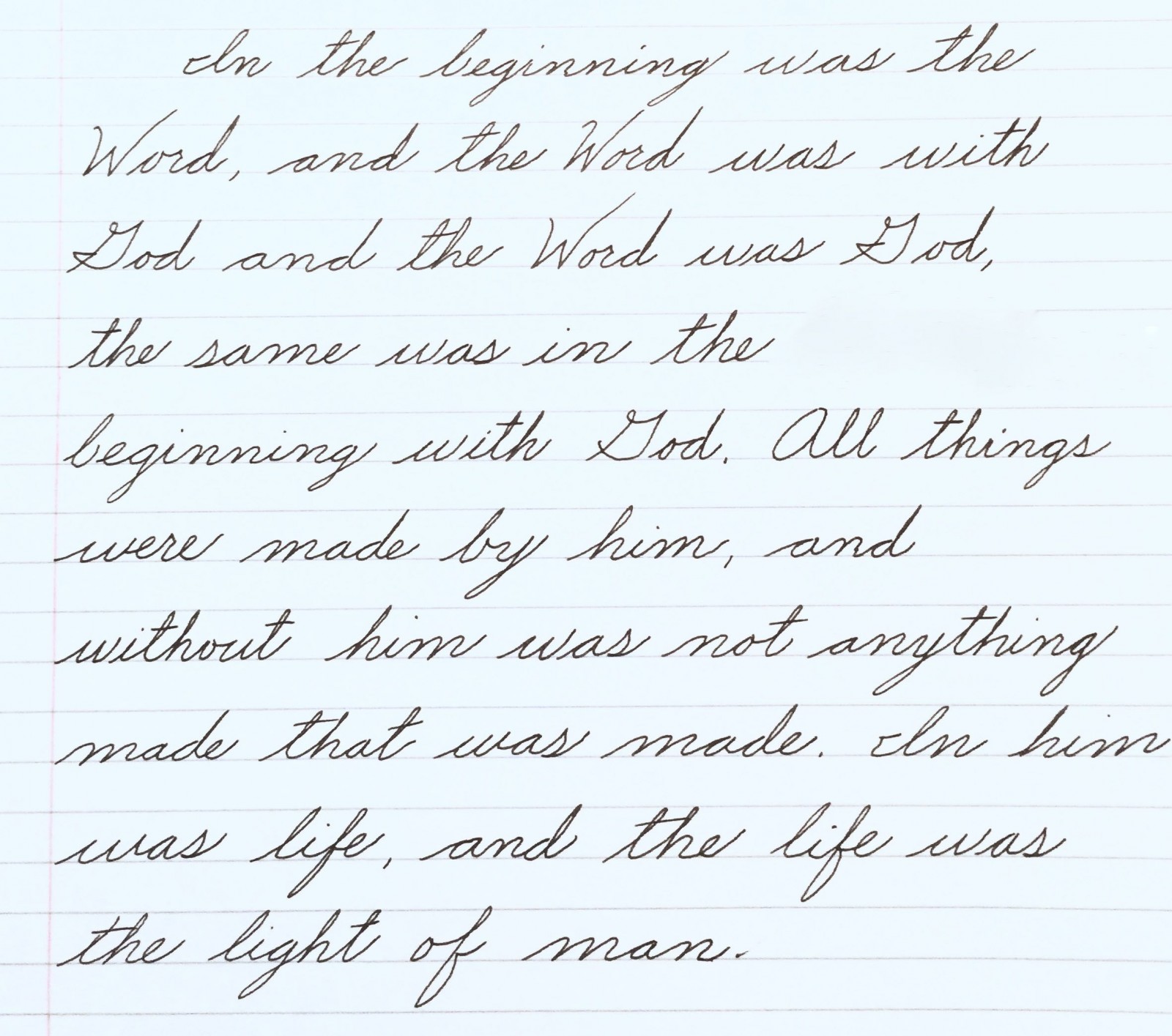
The minimal set of doodles I mentioned is a simplification of the Palmer method, which can itself be thought of as a simplification of the Spencerian method. If one wants to get into penmanship seriously, there are many wonderful rabbit warrens to descend into.
If one is unable to form legible letters at all, in my experience that tends to be more of a fine motor eye-hand coordination thing than anything else, in which case almost any well-chosen set of doodle drills will help significantly.
[edit] also - welcome to HN! I just noticed the green font for your username. I suspect you'll have lots to contribute to this place.
> I think this is something of a debate on "is it good to get some exercise?" vs "is walking or swimming or weight lifting a better exercise?"
This is an astute comparison, and I think you're completely right. One who devotes time and effort into practice (nearly any practice) of handwriting will improve.
However I would liken it more to something such as: "will Olympic weightlifting make me a better soccer player than sprinting, ball control, and team coordination drills will?". It's not a generic A or B, as we're trying to achieve an intended result.
More aptly, "given I want to achieve C, is A or B a better approach".
It's a surprisingly big field. Largely divided into:
  1. More artistic, commissioned works
  2. Wedding calligraphy, envelope addressing
  3. Teaching
I principally taught. Was too much of a perfectionist, and would devote more time than was economically viable to commissioned works. Though my art is on a couple wine labels in Napa.
Calligraphers/penman show up in surprising places. The White House employs 3 calligraphers for writing menus, invitations to formal events, etc.
Most English language handwriting has an up-and-to-the-right tilt. Architects will frequently adopt a precisely vertical style but it tends to feel cold and impersonal (or perhaps just unfamiliar as most writing does have a bit of slant to it). I suspect it's a bit like the serif vs sans serif debate. People generally prefer the look of sans serif fonts but they read farther into and retain contents better when the font has serifs (first measured in the 1950's and first discussed broadly in Ogilvy On Advertising, the book that most of Mad Men season one's plot points were based on). Straight up and down seems like it would be best, but for whatever reason hundreds of years of practice have retained that small angle as the preferred style.
It's due to the way penmanship was written. Consider the arm position [0] of proper penmanship. The page is at an angle to the left, such that it is similar to the angle of your forearm on the page. Pivoting at the elbow allows you to swing your arm from the left side of the page to the right. The forward slant allows you to always be moving "forwards" as you write across the page.
I hope that was clear. Please feel free to ask clarifying questions if not.
I agree that the slant is intentional, but it's not clear to me that the slant comes as a result of the preferred arm position (it seems equally likely the arm position was chosen because it results in the desired slant).
As you might be aware, arm position and use in serious calligraphy is a far more thoughtfully and intentionally designed process than I ever would have imagined. A major component of Spencerian technique involves resting the right forearm on the left palm (I think I have that right, I'm not actually one who does Spencerian writing) in order to use the flesh of the forearm as a linear bearing driven by the shoulder muscles and constrained by the left palm as a means of achieving a more repeatable and predictable translation motion than can be achieved with simple proprioception based motor control.
It is deliberate for most Latin cursive scripts. I believe it is common wisdom that ovals are easier to write consistently and quickly than circles. Though I suspect this perhaps has more to do with older pens and styluses than a universal.
Edit: come to think about it, it's probably a universal, since you see angling in Arabic and Chinese scripts' calligraphic styles as well.
We used to get homework of these in elementary school. I always thought it sucked, and did them poorly, and my penmanship now is awful unless I write very slowly. Fortunately very, very rarely I need to write by hand.
> In penmanship class, we learned a standard cursive font. I think it’s the standard cursive font, in fact.
He's wrong that there's a standard cursive. Different countries and different centuries have used a variety of different cursives. Most Americans who were taught cursive in school learned either Zaner-Bloser or D'Nealian, which both derive from Palmer. Both of them are terrible. They have indistinct letter shapes that degrade horribly when written quickly.
Cursive Italic handwriting is much more legible, if slightly slower. There are popular systems including Getty-Dubay Italic and Barchowsky Fluent Handwriting. Both of those are fine, and should be strongly preferred to 19th-20th century cursive.
In re: different countries: students who study Russian (or, I assume, other languages that use a similar alphabet) typically learn to write Russian in cursive. The letter forms overlap with English/American cursive, but not perfectly, and of course there are OTHER letters, too, that we lack.
(Russian cursive is also notoriously hard to read for non-native speakers owing to a few idiosyncrasies: some letters are entirely different written vs. in print, and the letter forms can lead to ambiguity -- certain letter combinations are effectively identical.)
A near-universal phenomenon among people I've spoken with who took Russian in college is the unconscious blending of the two letter sets. Students, myself included, would routinely find themselves using Russian letters in English script while writing without realizing it, and sometimes even reading it later without realizing the presence of Russian letters.
I knew it was happening to me, but it wasn't until I loaned my political science notes -- ostensibly in English! -- to a non-Russian-student pal that the prevalence of the swaps were really clear. "Uh, I absolutely cannot read this."
Ooops.
Anyway, it's tangential to this topic, but I thought it was interesting enough to share.
This is the first link I found with illustrations of the Russian cursive alphabet:
It’s very likely that English cursive is insufficient to really write the English words - since English pretends to only have 26 letters but so many do double or more duty - sometimes distinguished by diphthongs or other mechanisms but often just assumed you’ll know which pronunciation is right.
I wonder if the Russian cursive slips in because it has sounds that are closer.
What fascinated me when learning both Russian and English cursive is that Russian cursive makes writing in Russian much much faster, whereas English cursive (the one taught in school) just slows you down and is absolutely counterintuitive.. Also, I am yet to meet a person who is not confused by the cursive English G..
This is a good comment. I do have a contrary opinion however as I generally recommend a spencerian derivative over an italic one to new learners these days. One could say simple Spencerian derivatives are like Rust with a steep learning curve to inculcate the core shapes into muscle memory but have lesser overhead during runtime owing to their dependence on muscle memory. Italic derivatives otoh more like Go, easier to pick up initially, but relative to penmanship variants have a higher runtime overhead. This is a silly analogy, but drawing from my experience teaching penmanship and calligraphy to people of different age groups is what I’ve seen to be true, mostly in younger age ranges. Older people usually do better with italic variations. A good reason, I recommend spencerian/penmanship derivatives is that they let one write more efficiently with higher precision during flow moments as letting muscle memory do the work helps with learning the task at hand.
A small nitpick, Zanerbloser doesn’t derive from palmer script, but they both absolutely do belong to the same family.
Great point about muscle memory, I found it fascinating to learn Spencerian as it kind of distills the essence of writing to a surprisingly low number of forms (7 or 8 I think?), a kind of local optimum for Latin-based cursive. The hardest thing for me to learn about it, with which I still struggle, is keeping the arm posture correct and using the upper, rather than lower, part of the arm for control.
I also found it really interesting to discover that the prescribed 52 degree writing angle for Spencerian is almost exactly what you get matching the diagonal on an 8.5" by 11" piece of paper (I'm surprised that's not more widely known!). Thus, rather than a difficult and seemingly arbitrary requirement, it's a super easy way of attaining consistency by simply rotating the page so its diagonal goes straight away from the writer. (If you're using US Letter paper, anyway)
> The hardest thing for me to learn about it, with which I still struggle, is keeping the arm posture correct.
It’s great that you recognize this handicap as dealing with it sooner rather than later is a good; bad posture is indeed harder to correct later as we know. The first measure you can take is course correcting yourself over shorter intervals i.e.Move The Paper towards yourself with no shame, even during the length of a line, as often as need be. Even Louis Madarasz did it, so don’t hesitate. But I think your fix becomes a habit, it becomes a non-issue later.
> ... the proscribed 52 degree writing angle for Spencerian is almost exactly what you get matching the diagonal on an 8.5" by 11" piece of paper
If this is true, you just blew my mind, thanks for sharing the discovery.
Asking because I think I've got about as much benefit as I'm going to from having used a fountain pen exclusively for the last five or so years, so I'm looking at this point to learn a proper script. It sounds like you're considerably more familiar and may know some good places to start, and I'm hoping to get the benefit of your experience.
Not the OP, but I learned by reading and practicing alongside Spencerian Key to Practical Penmanship[0], by Platt and Henry Spencer themselves. It goes into an astonishing amount of detail; while there are probably newer adaptations I think you'd be hard-pressed to find a more comprehensive treatment.
This is good. Good penmanship and the pursuit of it is a very enjoyable and rewarding practice. Since you mentioned you experience with fountain pens and a desire to learn a spencerian derivative, I want to give you a heads up that fountain pen experience doesn't necessarily translate but you still have an edge of course.
As far as recommendation goes, I think you should see if you would be content with learning something like the afore-mentioned D'Nealian method, which involves a lot
of printing and shape reproduction, and stick to it. You can get far using a fountain with this.
However if you have the desire to reach for something more, I would recommend looking into a good "Business Writing" hand. There should a introductory book on a decent business hand produced by Ziller Inks on the Apple book store. I'd get that, it was pretty affordable last time I checked.
The business hand is a beginner friendly entry into the spencerian family and let's you carry your progress into more refined spencerian hands when you are ready for them later. Download a copy of the book "C.C.Canan - Collection of Penmanship" to see the kind of spencerian hands you could aspire towards.If you chose this path, it's a long journey so it depends on your personality like most hobbies.
Penmanship is a weird hobby, it looks both simple and intimidating at the same time. If you feel like you could use some personal advice, leave a comment and I'll reach out to contact info on your profile. I'm not an expert(I've seen what experts do and boy am I not one) but generally enjoy sharing penmanship learning advice so I don't mind a consultation or two.
This Spencerian example looks like what I learned in U.S. (Northern Utah) schools in the 80's. It doesn't say what it's called other than "Early American Spencerian".
That one is a little bit simplified, and as such is very close to something like D'Nealian which is what I learned in school. Technically in Spencerian the letters "d", "t", and "p" have the same basic stem height and are somewhat shorter than other full-height lower case characters. Basically instead of two heights for lower case letters, you get three.
But adapted into business script AFAIU the simplification into two heights, and the shrinking of the "p" stem, is pretty common. I'm definitely not used to making "p" taller than "q" and I am not always consistent about it.
A few years ago I made a conscious effort to improve my handwriting and got a few fountain pens, to me transitioning from D'Nealian to a Spencerian variant was pretty easy and I think the latter is faster, more legible, and more comfortable to write. Although the differences are more significant IMHO if using a fountain pen.
I'd toyed with fountain pens on and off for twenty years. In 2019, I dug an old Waterman Expert out of my closet, watched some videos for how to use bottled ink and converters and off I went into the hobby.
I still use traditional late 20th century American cursive (D'Nealian, I think), but all the practice with fountain pens has made my handwriting more legible than it's been in a long time.
Cursive came about because writing with quill and dip pens required you keep the nib on the paper for as long as possible, lest it dry out, or the ink drop to the page. Fountain pens aren't as bad in this regard, but still do better when the ink is flowing than just waving about in the air.
I happily take work notes all day long with fountain pens (today I have a Pilot Custom 74 inked up). I wouldn't want to give them up.
Likewise! And if you've yet to try a Vanishing Point or a Decimo, you've got a pleasant surprise in store, I think - I've found them nearly perfect for work notes in particular thanks to their speed and ease of one-handed operation.
(The Vanishing Point was admittedly a little too big and heavy for comfort, but a Decimo has the same nib and mechanism in a lighter, narrower body. Looks a lot more elegant, too, with the smoother rounding of the shoulder.)
The Decimo is a great form factor, it's also just about the most inconspicuous fountain pen possible so you won't get weird looks from people who've never seen a fountain pen before. That said I have one as well as a Custom 74, both in EF, and somehow I like the 74 a lot more in that size. The Decimo nib seems finer and is noticeably softer (18k vs 14k), and I'd prefer it with a medium nib for maximum smoothness. I think it also dries out a little bit, something that I've never had with the Custom 74.
On the other end of the spectrum I have to recommend the Lamy Safari and Kaweco Sport for their utilitarian design and timeless aesthetics.
The award for utilitarian and timeless has to go to the Lamy 2000.
The Safari is very good as a starter (though I'm partial to the Pilot Metropolitan or TWSBI Eco for starters). I don't have experience with the Kaweco Sport, though I hear only good things.
> Zaner-Bloser or D'Nealian, which both derive from Palmer.
This is not accurate. Zaner predates Palmer.
> Both of them are terrible. They have indistinct letter shapes that degrade horribly when written quickly.
I would more attribute this to...
  1. Unskilled modern penman
  2. An eye that's unaccustomed to reading old script
... rather than something intrinsic to the style. Business penmanship was, after all, created to be fast & legible. Historical pieces of penmanship are most often legible, particularly when written by skilled penmen.
Source: was professional penman, specifically studying 1860-1920 American penmanship.
I'm almost certain I was taught Palmer in Christian school when I was a kid. I still hate how certain letters look but it's hard to change how I write now. 34 I've been at odds with the letter "r".
I've been really leaning into handwriting - and good penmanship in general as a fun creative activity. I started writing all my notes/journal entries/etc in cursive during covid just for something to do and I've become very enamored of the process. Often I find myself wanting to write just to do it (I imagine if I was in to needlepoint, this is the time I'd do needlepoint). I end up writing a lot of journal entries and letters to friends (it usually starts with "I want to write" and my own thoughts and doings are an easy subject) which has a nice personal and social effect. I acquired some fancy pens and sewed myself a fancy leather journal that are a pleasure to write with and that have really accelerated and sustained the habit.
I wouldn't make any claims that writing has somehow made me magically smarter or better at anything else, I just find it fun to do (and I believe that pleasure is vastly more important than "productivity" so that's a win for me). It seems probable that my composition skills are better (or at least different in some hard-to-define way) due to the slower speed and non-editability of handwritten text. I rarely find myself at a loss for what sentence to write next when I'm handwriting because my thoughts are already buffered up since it takes them a bit longer to get onto the page.
Another angle for me is that I recently picked up a chronic disease which has changed my energy levels a lot and many old hobbies are no longer feasible as often as they used to be. I can write even when I feel like there's a mountain of tires on fire inside my head.
I was taught cursive when all kids were still being taught it, and I also switched back to block letters when we all stopped using paper. The act of writing cursive is so fluid, like written parkour, that I think when we finally master it, it bonds with the flow of our thoughts. When I write in block letters I get impatient and frustrated; my thinking writing energy is scraped out in chunks. It's like violence against the wrists. I never feel like I'm writing down my thoughts, and I can almost sense my train of thought disappearing while I'm still capturing the earlies pieces of it. Cursive lets that energy flow continuously, guided into shapes rather than forced.
Covid 19 is going to have introduced a generation with the worst handwriting we've seen so far. By worst I mean both incorrect and illegible, and I'm basing this observations of my daughters who were in 1st and 4th grade during the first lockdown. Admittedly, they already had what I would call "poor" handwriting.
I have no problem with the idea that legible is the primary criterium for handwriting. Correctness as I and my parents and grandparents learned is really just a matter of self-respect, I think. Correctness was already on the way out by the time I came along anyway. There was a uniformity to my mother's and grandmothers' handwritings that was not present among my peers and me in school.
The only experience that I have that says someone must continue to learn cursive is that there are lots of historically important (or at least interesting) documents that are difficult to read even for me, and my kids would have a harder time still. Reading is not the same as writing of course, so merely practice reading these types of things is probably enough. I guess it's similar to Fraktur, which is difficult to read if you've never seen it, but not that bad with just a little practice.
> Correctness as I and my parents and grandparents learned is really just a matter of self-respect, I think.
Fucking weird angle on that imo. It's a skill with broad application but low impact for most people. The actual techniques for good handwriting aren't taught in school anymore, so people will have to decide to value it, seek it out, and practice it themselves. You might think they should, but if they disagree it doesn't indicate that they lack self-respect.
An almost infinite number of skills fit into this honestly. Kitchen knife work, drawing, whistle or sing a tune, phonetic alphabet, advanced mental arithmetic, basic carpentry, sewing, plant care, orienteering, bread baking, small engine repair, knot tying, etc etc etc etc.
Anyone can learn a bunch of these to varying degrees and they'll be frequently valuable through life, and potentially contribute significantly to identity and yes self respect. Which specific ones someone ends up with is pretty much meaningless though. I mean this kindly but there's nothing special about penmanship just because you value it.
Oddly enough I used to write my '0' like an 'O', until I started writing down a lot of chemical structures with numbered atoms. I had to distinguish between the 0 label and the 'O' of an oxygen. I've now adopted the 0 as the way to do it :)
edit: Ok, so HN font as displayed does not show the bar across the 0, even though the editor does ...
I’m not sure how good rendering support is, but you can try explicitly specifying in Unicode that you want a zero with a "combining long solidus overlay":
0̸
(May render as 0 ̸, but should look like a single slashed zero. Wikipedia seems to think this is the way to get a slashed zero in Unicode: https://en.wikipedia.org/wiki/Slashed_zero)
I also had to adapt my handwriting - halfway through my math degree, my inability to tell symbols apart genuinely started to become a problem. I ended up having to use a horizontal bar on 'z' to tell it apart from '2', and added a loop on the tail of my 'y's to keep them from looking like a wayward 'x', both of which persisted into my normal handwriting.
(And I still swear that my differential equations professor wrote problems that used mu, 'u', 'v', and nu at the same time as a prank on people with bad handwriting.)
I picked up the wild ass french numeral 1 from living there in my youth. I still think it's more ambiguous than the english variants but I had so much trouble with people misinterpreting mine I switched and have never been able to shake it.
If you look up examples online they seem fairly reasonable. But in actual daily handwriting they are very extreme. It looks more like a stylized capital A than a number honestly.
Oh I see, from looking at some examples it's the one without the bar on the bottom? I use the the more French/European '1' to distinguish from a lowercase 'l' (so that C1 does not look like Cl = chlorine).
Yeah the way I originally learned to do it is with no bottom bar and a short, 45º, straight serif. The french way has a lloooooong curving serif, at least as long as the downstroke. Or at least I think of it as french since that's where I ran into it. Maybe that's the norm in europe?
I (an American) picked up the European 1 and 7 in college but gave them up when I left school because they confuse people. I still use them when I'm doing math or doing anything where numbers and letters might be confused.
One of the most spectacular examples of penmanship I ever saw was sitting in a meeting with a lady who could effortlessly write phrases and paragraphs in italics... cursive italics ! It was perfect in every possible measurement. (And no this wasn't decades ago, this is 21st century).
But I digress! I did also want to state that I disagree with the author's statement "Nobody writes it anymore".
Clearly the author has not met many doctors or lawyers or spent much time in Europe.
Cursive is very much still in use by all three of the above.
Italicized cursive was what was taught in Swedish primary schools while it was still part of standard education (meaning at least through the whole 1980s), and I suspect it was the same in many other European countries.
They taught millennials to write in cursive. I only stopped because some of my teachers couldn't read it. It took work to write in print as effortlessly.
It's not like there aren't American outcries about how schooling changing decade to decade. But like everything, it's just an outcry from people who worry about the most minor of things that change.
Just my experience, but as a millennial growing up in the US, when I was in say 3rd grade or so we had a short unit on cursive and then I never used it again. When it came time to start signing things as an adult I had forgotten almost all of it. Years later someone commented that I signed the first letter of my last name in lowercase, oops...
Another tidbit someone may find interesting, going through elementary school in the early 90s I was forced to write right handed, despite being a natural lefty. This was due to the teachers religious leanings. I grew up in a major metro area as well. I can write with both hands now, but prefer right handed writing so the spirals of notebooks don't push up against my hand. Anytime I pick up a new hobby I have a weird decision to make about what hand I want to use. Still haven't figured out if I bowl left or right handed!
Penmanship and calligraphy, I think, are important to develop manual dexterity and hand-eye coordination & give you a way to express your individuality. The author talks about the standard font in cursive, but I learned many ways to make the letters F, X, M and more, that I felt made my writing unique among others.
I also don't think we've totally moved away from wet signatures, so they do have practical use as well.
Most non-architectural hand-writers write the letter “P” with a single stroke: draw a small loop and extend the side downward to form the stem.
I've got no architectural training, but I make my p's in two strokes (and my n's, for that matter, too).
I do this too, but trying to change it. I learned as a figure-eight, then switched to two-circles in grad school (for some reason), but now learning Morse code and copying 8's takes too long if you don't write them as one motion.
"Nobody writes it anymore. Nobody can read it, anyway."
I think the author is mistaking their self for everyone.
I have rows of my bookshelf dedicated to all my journals. Written by hand. In cursive (for the most part, some technical journals I used standard print for diagrams and annotations).
I use a reMarkable2 as well for ephemeral notes, bullet journalling, and reading/sharing documents from my computer. I like being able to hand-write a note and email it as plain text to myself. Process it with a script and boom, new draft post. While I sit at my desk, no computer in sight. Bonus, character recognition of my cursive writing is pretty accurate.
It’s poetic license - like saying that nobody reads or writes Latin anymore; there are small groups that still can and do; but it is no longer assumed that every college graduate can.
This focuses on writing that will be legible to others. More often I want notes that I can read without ambiguity and in a form that I can write about as fast as I can type.
Not mentioned in the convo so far is shorthand commonly used by legal secretaries and journalists. Mastering this is akin to switching from Qwerty to Colemak rather than just trying to improve your qwerty.
For anyone who's considering investing more in hand-written notes, look into various shorthand notations. I like Pitman but there are others depending on handedness, pen preferences, etc.
I'm still learning, but I now use it interspersed with my cursive script and find I can read my shorthand more easily than my cursive.
(Either way: invent your own symbols for words/phrases you write a lot. Text shorthand, foreign languages, and math symbols all find their way into my notes. U for you, y for and, o for or, ∀ for all/each, etc.)
The author was born in the 90s, and was in elementary and middle school in the 2000s, when keyboarding was already seen as a primary skill. His take that "nobody writes cursive anymore" is true, given that for him, "everyone" is under the age of 30. Those of us who grew up prior to personal computers and phone touchscreens being ubiquitous can scream all we want "I learned cursive and I still write it!", but it doesn't change all that much. Some of us learned and it and can't do it any longer. Some of learned it and still do it, for whatever personal or professional reason.
Here's the hotter take:
Skills like handwriting are (hold on to your hankerchiefs graphologists!) pseudo-sciences. They are vestiges of elitist education systems, whereby a bunch of rich, but likely average-intelligence, students who paid for elite education, hired private instructors to help them become members of the "learned class". It doesn't take any special intelligence to teach or to learn, and can be used as a signal to others that you "belong" to the upper class.
Fast forward to the 90s, in rural North Carolina, to a grossly underfunded school system that can't afford specialized training for teachers or students. What do we get? Over insistence on out-dated markers of education: cursive, Cotillion, woodshop for boys and home ec for girls. What don't we get? Computer science, math beyond algebra and geometry, science beyond basic earth science, and US history that stops at WWII! 1600 students with excellent penmanship, who know how to waltz, but none of us is even aware that computers can be programmed or that people get paid money to do it.
And to the commenters claiming graphology is a thing or that it is in any way useful in sorting candidates for job opportunities (I'm looking at you France), you are just as wrong as the author who claims "I don't use cursive, so nobody uses it either".
NB: This is not an attack on the hobbyists, or on the aesthetics of cursive in general. Well-written cursive is marvelous. I just think we had too much emphasis on it it school, and likely it was due to our schools not having the wherewithall to teach us anything else of value.
Cursive may well functionally fill the role of social class shibboleth in certain circumstances and specific social environments, but that is very secondary to its highly practical primary function: you can write _much faster_ in cursive than by any other means.
There were no typewriters or computers through almost all of human history. Writing was it. This skill had, and to a large degree even today still has, enormous practical and economic value.
The utility of this ability to efficiently produce text artifacts is vastly higher when one can do so in a manner that is readily legible to others, which requires that one use an approximation of standardized, well-known glyphs. The closer you can produce them, the more differentially legible your written output is to others. It's not merely a coded signal for your elite status.
Even today when many can take notes on a keyboard, writing notes by hand has a well studied secondary practical effect of improving retention and comprehension, as well as being available any time a pencil and paper are at hand. These still work when dropped, when they get wet, when the power is out, or when you forgot to charge them.
I learned math and programming but I wish I'd also taken wood shop (and metal shop, and other practical courses.)
Making actual stuff with your hands and using physical tools is immensely satisfying and empowering. I really crave it after spending all of my time staring at a screen and typing on a keyboard.
Other practical skills like personal finance, home improvement and maintenance, and cooking can pay dividends for the rest of your life.
I wish I'd had more time for many courses (also including music, art, drama, etc.) that weren't part of the "college prep" track.
100000% agree. I would have loved to get more practical stuff in high school, and less fluff. Woodworking is a lifetime skill, and contributed to my understanding of spatial organization, practical math, fractions, and precision. Plus now I can make stuff.
Cooking as well. I worked in kitchens for 7 years during and after college, and wouldn't trade that knowledge for the world.
I only mentioned woodworking and home ec since they were gender-assigned by the school, not because they were less useful.
I learned how to operate tools safely in woodshop and it's one of the more valuable skills I picked up from my school days. I've forgotten most of my Spanish, almost all of the math, but I remember how to keep my fingers.
> And to the commenters claiming graphology is a thing or that it is in any way useful in sorting candidates for job opportunities
It is useful, just not in a way that many people find acceptable. It is a marker of a particular sort of "elite" education. Your comment that this surfaces a "bunch of rich, but likely average-intelligence" people is true, but it misses the point. It's not meant to reveal intelligence, but whether a person is "one of us" — the right sort, a safe pair a hands, a sound fellow, etc. The decision-makers care much less about intelligence than whether they can be trusted to "do the right thing," which is whatever maintains elites in their position—exactly what these people have been brought up to do by their parents and educated to do by elite institutions.
I was arguing that, in Europe, and France specifically, it's a way to see whether or not a potential candidate is "French" enough. It's expounded as a psychological tool (orthographists and graphologists are paid to psychoanalyze you based on written documents that you MUST submit), but in the end, it leads to a gray area of racism and classism.
That's cool. This type of thing just sparks something in my brain. I learned cursive because it was beat into me. As soon as I could abandon it I did, and for good reason too. My cursive was terrible and dyslexic, and block text was much easier to write and to read.
The other stuff I wrote is secondary to your post, and just a hot take. Thanks for the stimulating article though!
Fun (or maybe not-so-fun) fact: my 15-year-old nephew recently had to sign a document for some volunteer work, and he didn't know how. Apparently, schools no longer teach cursive, not even enough for kids to learn how to sign their own names for legal documents. The secretary was just like, "Yeah, we get that a lot; he can just print his name instead, that's fine."
I've always had shitty handwriting, and when I was in first grade, my teacher told my mom, "Don't worry about it; when he grows up, he'll probably be typing everything anyway." Turns out that was far more accurate and generalizable than we knew.
Given my age, I learned cursive in school, and spent my college years taking handwritten notes. My cursive was pretty terrible, much like my father's. However, he spent years working as a draftsman, and then as an estimator (before the days of personal computers), so his printing was very similar to the form described in the linked article. So, I taught myself to write in the same form. I still handwrite a lot (journalling, drafts of papers), because I find it easier to "think out loud" with a pencil in my hand.
It's funny how some people think their signature must be legible, or the wonder if they have to include their middle initial just because the printed version of their name on some document does. I believe a signature can be just about any symbol (although hopefully more complex than the "X" which is legally acceptable) which the signer can reliably re-create.
"The traditional function of a signature is to permanently affix to a document a person's uniquely personal, undeniable self-identification as physical evidence of that person's personal witness and certification of the content of all, or a specified part, of the document."[0]
Part of the reason I'm so cynical about the teaching profession is that I had a string of two or three elementary teachers who insisted that cursive was the only acceptable method of handwriting in educational settings. Immediately after—and for every single other teacher or professor—no one cared whether the letters were connected or block-printed so long as they were legible.
The other reason was the far-longer string of "you had better shape up now because if you don't get your act together, you'll never pass next year" and then continually passing next year with flying colors.
I think it would make me more cynical about teaching if teachers all agreed. Teachers have different opinions that evolve over time because they're trying to figure out the best way to teach. Static unanimity could would only happen if it was pursued for its own sake, to make the profession more comfortable and to avoid questions of skill and credibility.
I have ditched cursive for block printing, but it is an annoyance because I'm much slower that way. Even though I sit at a keyboard ten hours a day, better handwriting ability would be a noticeable asset for me. Still, I can't blame the teachers who taught me in elementary school, because none of them could make the individual choice to teach me a different cursive system, just like I can't make the individual choice to start writing code in a different language at my company.
It's weird that a signature is expected to be in cursive in so many places anyway. It's not like cursive is some unforgeable method whereas as printed writing looks exactly the same no matter who writes it.
Hell, nobody even cares what it says, so my "signature" is just a scribble that is somewhat consistent.
> I've always had shitty handwriting, and when I was in first grade, my teacher told my mom, "Don't worry about it; when he grows up, he'll probably be typing everything anyway." Turns out that was far more accurate and generalizable than we knew.
My third grade teacher told my mom not to worry about my (awful) handwriting, "he'll have a secretary." Which probably makes me a bit older than you. I retroactively blame my 1st grade teacher who forbid me from writing my name in cursive; it was a 1/2/3 combo class, and she said she had a hard time figuring out if work was mine or the other person with my first name who was in second or third grade and expected to write in cursive. It might have been better for me to just write my last initial or full last name. Oh well.
I just bought a house, and signing all the mortgage docs, they told me I had to sign my name exactly as it appears on the document: First Middle Last. My signature, the one that is most personal, recognizable, and ubiquitous to me, is a quick scribble that kind of includes the first letter of my first name, then some flairs of loops and things. Having to laboriously write out my full name in script was a giant pain in the ass. I could not repeat the same signature twice. In many cases I couldn't remember how to write the capital cursive letter for my middle and last name.
TL;DR: I am 38 and completely sympathize with your nephew. I can't sign my name either.
Semi related aside - it was a good post day today.
I've been after a book called "Flip The Script" for ~10 years, but being out of print the prices are crazy. It's recently been reprinted, arrived today, and it's absolutely wonderful - https://www.handselecta.com/handselecta-flipthescript
As it says on the back "Graffiti is one of the last strongholds of highly refined penmanship." Anyway, beautiful book, highly recommended.
I studied architectural engineering and hand to take a handwriting course. It is the exact opposite of cursive, youre never supposed to let your pen(cil) connect letters, not even parts of the letter (as the post describes how to write a P). you always lift up the pen and start a new point of connection because it gives you more control of the output. it was an interesting class and changed the way that I write (all caps that basically look like the image in that book) and also anyone I teach to write.
> Most non-architectural hand-writers write the letter “P” with a single stroke: draw a small loop and extend the side downward to form the stem. An architectural hand-writer writes the letter “P” using two independent strokes: draw a small circle, lift the pen, and then draw a vertical line tangent to the left-side of that circle, extending downward.
Am I the only one who draws the downstroke first, then back up and draw the loop (without raising the pen)?
No, I do that too. But having seen how it comes out when I'm writing quickly to capture a thought, I can certainly respect the intent of the architectural method. Might try it out just for fun, even if my days of block-printing everything for the sake of it are long behind me.
Cursive is still taught with ferocity in Dutch primary schools. When done well it's pretty, enables rapid writing and note taking, and at least part of learning to write that way is to learn how to read it. Since everyone older than you will still write that way, it's useful to be able to read it.
I have always written cursive (in Indian schools in the 70's, teachers yelled at you if you wrote block), and with a fountain pen, no less. One of my English teachers threw away my favorite ballpoint pen and gave me her fountain pen to write notes that day in school. My grandfather, who was a school teacher, insisted that we write copy of at least 1 page everyday in a 4-line ruled handwriting practice notebook.
I still write all my notes in cursive with a fountain pen. According to graphology, handwriting is brain-writing and improves as you write more.
> Most non-architectural hand-writers write the letter “P” with a single stroke: draw a small loop and extend the side downward to form the stem. An architectural hand-writer writes the letter “P” using two independent strokes: draw a small circle, lift the pen, and then draw a vertical line tangent to the left-side of that circle, extending downward. The resulting glyph is neat, deliberate, and replicable.
What about those of us who draw the stem first, and then the loop ?
I have essentially abandoned normalized cursive in writing. My letters often connect but it's nothing a elementary martinet would recognize as Palmer or whatever.
That said, I do write by hand (with a fountain pen! it's more fun, and slows me down a little which improves legibility) every day. I plan my day and take notes longhand, and often journal in the evening. I've done this all my working life, because writing seems to connect to my brain in a way that just typing doesn't, and I've increased in the pandemic because the more years I spend at the keyboard (I'm 52) the worse my handwriting seems to get. Doing it more seems like a good way to try and reverse that trend.
Couple of my favorite handwriting activities are writing in architectural font letters, and some bastard "gothic" I made up. With architectural fonts, the shapes slant diagonally a bit, so letter like P the half-circle points about 20 degrees up which makes it easer to separate it from the next letter and hence more legible.
The gothic font (along the lines what you get image searching "fraktur" or "gothic font") is good for some cards or signs or something, it's a bit slow to write, but because of the corners being so discontinuous it has a very distinct look to it. It doesn't really need a calligraphy pen either.
I was taught to write in cursive in France, a quick google seems to show it has it's own style.
But I always remember, I moved back to the UK when I was 8, my literacy skills were far higher than my peers in my new primary school. My new teacher did not like my writing, said it was too small, took away my pen and told me start writing with a pencil.
I was pretty good at cursive (so I thought), I still use it on the rare times I write but sometimes feel I need to print letters in case someone has to actually try and read it, so I pretty much just use cursive for my own notes, and it is messy as hell now. I forgot how to do all the nice capital letters they had too.
I only write by hand, when I need to quickly note down something for myself. For that purpose cursive is by *orders of magnitude* better than "typesetting by hand".
I hated learning cursive as a child, and as soon as I could get away with it, switched to writing printed non-cursive letters. BUT, I'm glad I did learn it, as just an alternate way of writing, and if I ever have a child/ren will probably try to teach them if it's not being taught in their school (which it doesn't sound like is common these days).
I don't recall that I hated cursive, but by the late 1960s (no consumer electronic keyboards anywhere) I switched to printing for all my middle-school homework. I also started omitting uppercase letters most of the time, especially at the beginning of sentences. I dont' recall any of my public school teachers trying to force me back to cursive, surprisingly. Nowadays, all-lower-case printed proper names of various advertised products is quite common, which was not the case at all fifty years ago.
Whatever i had before was essentially illegible. I think the act of learning something by choice, as opposed to having it forced on me through public school, allowed me to embrace that artistic aspect of it and see handwriting as something other than purely utilitarian.
"I never write cursive these days. Nobody writes it anymore. Nobody can read it, anyway. And I honestly couldn’t write it neatly anymore even if I tried. Cursive is obsolete."
This is a rediculous inference - I don't do it, therefore nobody does it and it's obsolete.
I for one, write in cursive every day, taking notes in a notebook/journal, and carry a fountain pen to do so. It's just such a nicer experience than writing in biro, which I refuse to do except when it's utterly unavoidable. I can appreciate I might be an outlier, but handwriting in fountain pen is a superior experience to even using an iPad, and this way I don't have to "print" my notes, they already exist in hard copy, and are resistant to bit-rot (save a deluge). I think writing by hand also engages a different part of me to the one that is engaged by typing on a computer. I'd recommend it to anyone.
“Nobody [does thing] anymore” is a common euphemism for “very few people [do thing] now, compared to in the past”. The author is correct about this with respect to cursive, at least in the US. I think you know this as well, as you acknowledge your outlier status.
I "practiced" penmanship every day for 9 years in primary school, but my handwriting is still the sad squiggly sort stereotypically associated with doctors. It really didn't change much from age 12 and onwards.



Draw two horizontal lines about half an inch apart and in the space between them doodle one of:
+ continuous clockwise stream of overlapping circles (imagine you flattened a slinky)
+ continuous counterclockwise version of the above
+ continuous line mountains/valleys (draw an N that becomes an M that keeps going and has tons of peaks)
Repeat.
The first time trying it, most people will find it freakishly difficult to do smoothly and consistently. That's because your fine-motor eye/hand control circuits aren't tuned for these motions which are are the basis functions for all western language penmanship. If you start doodling these figures when you're bored on zoom, your penmanship will magically improve, not because you learned penmanship but because you enabled your fingers to do what your brain is telling them to do.
This will also help you have better penmanship on a whiteboard, but in-office whiteboard writing involves more large muscles as well, so it doesn't hurt to also doodle on a whiteboard this way once you have the fine-motor controls tuned up (the fine-motor remains the most important, even on a whiteboard, so starting with pen and paper doodling will get you where you want to go fastest for either format).