Wow. I'd seen renders of the proposed magnet geometry, and it looked like a nightmare to build. They actually built it successfully. It was built by welding curved parts together, not 3D printing the thing in metal. It uses a superconducting magnet, which means having to wind coils from somewhat brittle niobium-titanium alloy. These are strangely-shaped non-planar coils which operate at liquid helium temperatures a few centimeters from 100 million degree plasma.
Here's an industrial view of the construction project.[1] Considerable new manufacturing technology had to be developed to build this. One minor component is a diamond window 120mm across and 1.8mm thick, soldered into a stainless steel frame with copper-silver-titanium solder.
Cost €370M. Look at the construction pictures and you can see why.
I wonder how the Skunk Works fusion project is coming along. They have an even stranger geometry. The only word out of Lockheed is that there's been enough progress to justify spending more of Lockheed's money on the project.
The attached PDF is wonderful. Is there any other cluster of companies in the world capable of such high-precision mechanical and electrical engineering outside of northern Europe?
> Wow. I'd seen renders of the proposed magnet geometry, and it looked like a nightmare to build.
Not an expert, but ... imagine trying to successfully build a stellarator as irregular and sinuous as this in the 1960s! You can see why they didn't try.
This is a stellarator which is the same idea as a tokamak: Confine hydrogen with magnets and get fusion.
The magnetic field in a stellarator is crazy complicated, and was impossible to model and design before computers. With computers they were able to design it, but were unsure if they could build it.
This is a test showing that yes, they can actually build it.
In theory stellarators are simpler to get right than tokamaks, but only if you can actually design, and then make one.
It's also worth pointing out that this isn't doing any nuclear fusion; it's a test bed to verify the stellarator's particle confinement and efficiency at heating plasma [1].
    Achieving these objectives does not require producing
    an energy-yielding fusion plasma. This is because the
    properties of an ignited plasma can largely be
    transferred by the ITER tokamak to stellarators.
    Wendelstein 7-X can therefore dispense with the use
    of the radioactive fusion fuel, tritium, thereby
    greatly reducing costs.
This is why it's so much cheaper than ITER to build; they're building a part of a nuclear fusion reactor.
If you squish hydrogen atoms together hard enough, and hot enough, they release energy.
But it needs to be really really hot - so hot that anything you made it out of would melt.
So what do you do?
You use a magnet. The magnet squishes the really hot hydrogen without actually touching it.
But if you squish one side, the hydrogen will want to go out of the other side. So you have to squish all sides exactly the same amount.
It turns out, it's impossible to make a magnet in the shape of a ball that squishes on all sides equally.
But, it is possible to make one in the shape of a doughnut! That's a tokamak. They are complicated because you also have to use the hydrogen inside the tokamak to help make the magnet work and keep the hydrogen inside.
Another shape that works is a kind of twisted doughnut, this is called a stellarator, if you do that, you don't need to also use the hydrogen inside as a magnet, and this makes it easier. But the twisted shape means it's harder to build because you have to put the magnets in exactly the right place.
The name "tokamak" comes from a sentence in Russian describing the machine, and the name "stellarator" comes from a word that means "sun".
Can you explain how the Hairy Ball Theorem applies to the spherical magnetic field? My first intuition is that the magnetic field would not be a tangent field because you'd want all of the force lines to point inwards to the center of the sphere. However, based on what you said, it sounds like my intuition is wrong.
To phrase it another way, could you explain why the magnetic field is tangent to the sphere and not normal to it?
The force magnetic fields apply is always perpendicular to the field: F ~ v × B (right hand rule, and all that). So if you want F to point inward, the one component of B that doesn't matter is its radial component---ie. the tangent component is all that counts. But it's not clear to me that you can't compensate for the restrictions of the hairy ball theorem by having a nonuniform velocity distribution. Of course, there's no "hairy torus" theorem (because it's not true!) and this immediately suggests the tokamak design.
It's also not possible to take a sphere and have the radial magnetic field point inward everywhere (or outward everywhere), because Maxwell's equations prohibit magnetic monopoles.
Charged particles will spiral along magnetic field lines. Thus, you want to have the field lines only be parallel to the confinement surface, so that the particles will migrate around the surface while doing their smaller-scale spiraling, instead of migrating outwards along field lines that exit the confinement.
I'd guess that it has something to do with eddy currents induced within the contained plasma. The HBT probably implies that these can't be perfectly symmetrical, and if they aren't symmetrical the whole thing will fall apart.
great eli5. I attended a lecture by one of the Wendelstein-7X engineers a month ago, and the main reason why they would construct such a thing (took 10 years), from what I figured, was that a tokamak is operated in short pulses, whereas the stellarator runs smoothly.
Wiki: However, stellarators, unlike tokamaks, do not require a toroidal current, so that the expense and complexity of current drive and/or the loss of availability and periodic stresses of pulsed operation can be avoided, and there is no risk of toroidal current disruptions. It might be possible to use these additional degrees of design freedom to optimize a stellarator in ways that are not possible with tokamaks.
With the donut, the problem is similar to trying to inflate a balloon that has a weak point in it. Blowing causes the weak point to inflate instead of the balloon.
Plasmas are electrically charged and have their own magnetic field. Trying to squeeze down on the plasma inside the donut shape to cause fusion causes the plasma's own magnetic strength to increase and counter the field being applied to it.
The stellarator works with the plasma's magnetic field instead of against it by spiraling it around in circles.
You can. That's what a Farnsworth fusor does (there are other related designs, but that's the original, and the kind you can build in your garage).
But for complicated reasons, it just isn't efficient enough to actually produce net power output. Of course, neither is any other design right now, but magnetic confinement appears to be the more promising path forward.
Thanks for the explanation. I looked up some of those designs.
Now I'm really puzzled why no one has tried a more naive approach. I'm picturing a hollow metal sphere with a high positive charge with positive ions inside of it. Wouldn't it push them all together and with a high enough charge get them hot enough to fuse?
Counterintuitively, this setup would have zero force inside the sphere. It turns out that being closer to charge on one side of the sphere is always exactly balanced out by the more distant side's greater total charge.
Nope. They are both part of the same thing - the joint electromagnetic field - and they transform into each other in different reference frames, but in a given reference frame, the electric field and magnetic field components behave quite differently.
Fission is getting energy by having heavy atoms break up into lighter ones, fusion is getting energy by having light atoms, well, fuse together.
Fusion reaction has pros over fission in that a fusion reaction produces a lot more energy than a fission - and that it can't 'melt down' - unlike fission it doesn't have to be kept in check. If Homer Simpson messes up at the fusion plant, the reaction will just stop. Why? Because for fusion to happen, the atoms (hydrogens) need to overcome their electrostatic repulsion of eachother - the Coulomb barrier generated by the protons in the nuclei (at fusion temps the atoms have all become ionized - electrons have shot off from the atoms, so you have electrons and positively charged nuclei flying around - aka a charged gas aka a plasma).
Anyway that coulomb force has the same dependence on distance as gravity (1/r^2) - but unlike gravity - is a repulsive force. If you can force the atoms close enough together (by putting them under high temperature and pressure) then they will be close enough that the nuclei of the atoms will be pulled together by a stronger attractive force - the nuclear force - which only works at a very short range. As mentioned, you have to get the atoms going really fast and really close together for this to happen (put the gas under high temp and pressure, which incidentally will ionize the gas atoms into electrons and positively charged ions).
The fact that it is now 'electric' is the key to both approaches (tokamak and stellarator) at containing the plasma. These are just two approaches at Magnetically Confined Fusion, which operates on the simple principle that charged particles (both electrons and the ions that you are trying to fuse w other ions) travel along magnetic field lines. They spin in tight little circles around magnetic field lines, the stronger the magnetic field, the tighter the circle. Tokamak, which is simpler than a stellarator, is basically a solenoid https://en.m.wikipedia.org/wiki/Solenoid that wraps around into a donut shape. Just as the magnetic field lines in a solenoid go along the length of the solenoid, the magnetic field lines in a tokamak will go around the donut (toroidal field). Just imagine that the tokamak magnets are really powerful so the magnetic field lines (not really lines) are really strong - then your ions will gyrate around and bump into other ions that are gyrating around B-lines. There are problems though.
It's been a while since I studied but basically, in addition to ions and electrons very fast giration around the magnetic field 'line' and it's slower movement along the field line (around the donut) - it also 'drifts' https://en.m.wikipedia.org/wiki/Guiding_center - this is the slowest movement. There are a few mechanisms that cause this drift, but to the great misfortune of mankind, these drifts are 'out' - the ions drift away from the plasma core, and towards the wall of the tokamak.
To stop this drift from happening, you need the toroidal (around the donut) B field lines to also twist, so they look like a twizzler that has been wrapped around on itself. In a tokamak this is generally done by running a current through the plasma around the donut. Plasmas are highly conductive, so you can do this. It is like a big coil of wire. Just like the coils on a solenoid generate a straight B field through the center of a solenoid, and the coils of a tokamak (donut shaped solenoid) generate a donut shaped B field, running a current through the donut shaped plasma will generate a B field from the ceiling to the floor thru the donut hole (the poloidal field). The poloidal and toroidal fields vector add to make your twirly twizzler shaped field that prevents drifts. This running a current thru the plasma is how you 'twist' the field in tokamaks.
Stellerators, on the other hand, generate the field with complex (very) magnetic configuration (look up images of WX-7). There is no need to run current thru the plasma, and this in theory, and I think now in practice, with WX-7, leads to a more stable plasma. This stability issue is very important. Scientists have known about drifts since year 0 of fusion research, but there are many instabilities that cause the plasma to break down.
As mentioned in the article - there is a triple product that basically describes the success of the plasma - plasma density, plasma temperature and confinement time. This is more or less equivalent to 'are we getting more energy out than we are putting in' and I believe the advantage of stellerator would be confinement time. Hopefully these brainiacs can get it happening.
Same as all current power plants - heat energy to a working fluid to spin turbine but I don't know details. Seems like you would need a much bigger device than today's to fit that in - need to be a lot bigger anyway as their effectiveness scales with size.
The Wendelstein 7-X is already water-cooled --- it has too be, or it would melt. (It has a 10 MW heating system to create a hot plasma like what would be in a fusion reactor, and then the cooling system has to remove 10MW of heat). So I think you could hook that up to a turbine already.
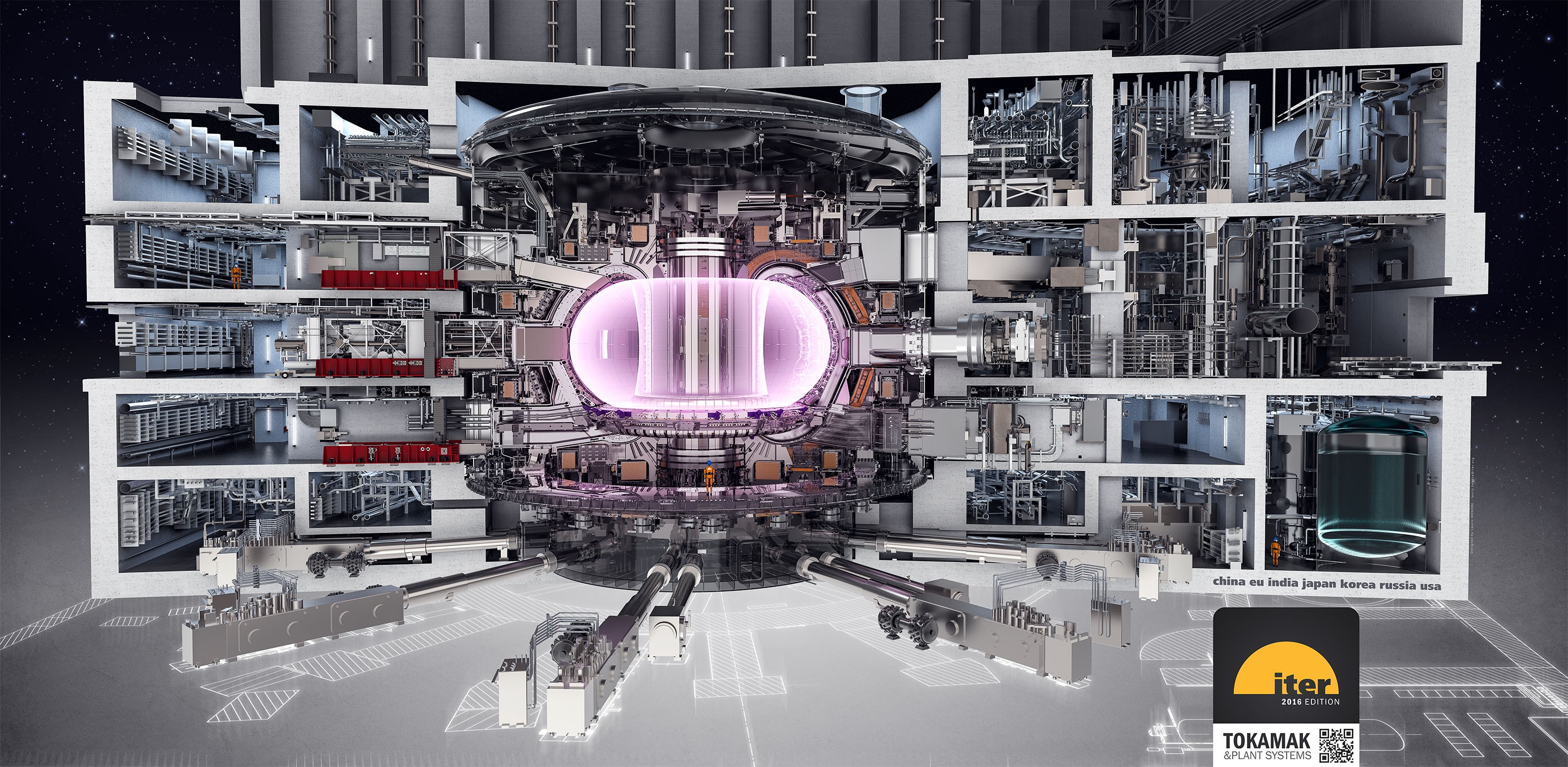
However, it is too small to break even. A smaller device will loose plasma faster (bigger surface area/volume), so too make it produce enough energy it needs to be big. See this picture of the planned ITER, note the human figure for scale:
I mean... I know that testing complex software projects is a pain in the ass. But... this? I mean... how do you even begin to plan where all the wires and other elements go and then test that it's a sound design?
I'm guessing they do a lot of simulations and such, but what if something fails? how much do you have to backtrack to fix a potential bug?
It just boggles the mind. I had no idea these things were so complex. Thanks for the links.
Edit: This video explains the elements quite in an understandable way [0]
That is very complex, and a large part of the design process is to make sure it actually is testable.
The article actually describes the result of some of the system testing of the device. They have now measured the magnetic field and found that it reproduced what they predicted it should be.
First project in a while where I feel my tax money is used well (my guess is the overall cost will end up being around 1.5 billion).
The engineering simply makes my jaw drop...sick achievement, congratulations to everyone involved. Surprised that it isn't pushed more in the media here. I think it's really hard to communicate the achievement to the masses but this needs to be on the news way more than it is (and presented better...somehow)
Is it true that this reactor doesn't use the latest REBCO superconductors? I watched a talk where they claim they can make reactors 10x smaller now, because they increased the strength of the magnetic field (can go up to 10-20T, instead of 3T). And the superconducting tape is cheap, much more flexible and only needs to be cooled to 100K instead of 4K.
If that's true and I'm not mistaken, the MIT ARC reactor would be much better posed to win the race than Wendelstein 7-X, especially that W7X doesn't aim to generate surplus energy. A commenter above was wondering at the expensive diamond window they had to use. This project is going to be too expensive and with dated technology. We could do it cheaper now.
The design for ITER was finalized in 2001, amended in 2007. Construction for W7-X started 2003. W7-X is now built, fully functional and operational. At several points during its construction, the construction process for its required parts had to be invented first.
That's 15+ years of research, breakthroughs and inventions in plasma confinement physics and engineering that have had to happen first.
As a noncommercial research reactor, W7-X will continue to be useful for many years to come. For material testing alone I would imagine access to reactor capable of producing a stable, continuous fusion reaction is invaluable.
The ARC is a design proposal from 2015. As such they have access and can utilize all the achievements, results and processes from W7-X, ITER and other material science advances of the last 15 years. If their proposal was not better than already built specimens, it would be a bad proposal. To declare it a race against the research foundation they built upon seems ignorant at best.
In 10-20 years, when the ARC is built, a new design proposal will emerge, based on even newer advances in material science and the lessons learned from building the ARC. And it again will be better than the then current, assembled reactors. That is how it is supposed to be.
But, the catch is that ARC reactor is smaller, cheaper, faster to build and could possibly be developed by industry, which would speed up the research cycle.
The projects goal is not to build a reactor but to study plasma physics. I'd guess the diamond window is surely industrial diamonds.
Fun fact as well: There are inner plates for shielding which are screwed into place. The question is: So you have a shield to protect from very high temperatures but also a screw on the same side. How do you protect the screw? You put a diamond coating over it. :)
Also, of course we could do it cheaper now. The project began around 20 years ago and had much luck, because there were many occassions were the techhnology needed to build the Wendelstein was just invented.
They started 2003 with the construction. Of course it can be built cheaper and more efficient know, but in 10 years you could again write the same comment about dated technology and cost. In that sense, the project is using up-to-date technology as there is no other similar stellarator running with newer technology.
> This project is going to
You seem to imply it's still in construction. It's finished already, in fact they finished testing it a year ago.
Stellarator is a beautiful word. I think it's my word of the year.
  stellarator |ˈstɛləreɪtə|
  noun - Physics
  a toroidal apparatus for producing
  controlled fusion reactions in hot plasma,
  where all the controlling magnetic fields
  inside it are produced by external windings.
  ORIGIN
  1950s: from stellar (with reference to the
  fusion processes in stars), on the pattern
  of generator.
ELI5 explanation: Because of something called the "hairy ball theorem" [0], which says you can't comb hairy balls (but you can comb hairy donuts), scientists are making a hairy, combed, billion-dollar metal donut [1] to squish hydrogen atoms evenly on all sides. Once you turn on the machine, the squished hydrogen atoms release energy!
This news today is saying that the hairy, combed, billion-dollar metal donut is the right shape, which is very important because nobody ever made a donut like this before, and if it was the wrong shape you couldn't comb it and that means the hydrogen would escape and you couldn't make any energy.
An important thing about the 7-X is that it's not about the fusion (squishing), because fusion is fundamentally a very simple process. It's all about the combing (plasma physics), which is very difficult and the reason we don't have squishing-plants yet.
For anyone reading who don't get just how simple it is, there are literally hundreds and possibly thousands of people who have built their own DIY fusion reactors at home. Many high schoolers, some of them as young as age 14.
I was at the 2016 APS Department of Plasma Physics Meeting a month or so ago. I work in Laser Plasma, so I have only a surface understanding of the magnetic confinement stuff, but I did attend a keynote by this group, and my impression after the talk was that they were approaching a respectable result but hit a snag. Looks like they couldn't get this out before DPP but fine enough, they can confirm it today, so cheers to them.
And Plan C is ARC/SPARC out of MIT which I like because it is taking more of a startup approach and addresses issues such as financial return on investment, maintenance etc.
Yeah, but Lockheed could just be running a scam to fleece the US govt out of millions in research grants and tax credits. Obviously it's a huge bet that could pay out $lol if it succeeds, but I suspect it's more of an accounting trick than serious R&D.
They're not running a scam, but they don't have the results to be in more then the research curiousity stage. Keep in mind too, the W-7 isn't designed to be net energy positive either whereas ITER is.
I expect there are significant tax credits available for investing in that kind of research. In the UK there certainly are. You can characterise an awful lot of software development as R&D and write the cost off as research and claim a tax credit, which can be very substantial. The last place I worked was running this "scam" and offset it's dev budget by millions of pounds a year.
From what I've seen, most fusion researchers are skeptical. Lockheed hasn't revealed much detail, and their people aren't leaders in the field.
They also have a long way to go; when they made their big announcement they were running on about 100 watts of power. By comparison, MIT's C-Mod uses as much power, briefly, as the entire city of Cambridge.
Lockheed claims that fast iteration will make for fast progress, but they're not the only fusion startup taking that approach. Others include General Fusion, Helion, and Tri Alpha. And Tri Alpha, at least, gets a lot of respect for openly sharing experimental data in papers and conferences.
Exactly, they are going down as my plan A. I've got very little confidence in the likes of ITER because, while they are doing amazing work, they are getting fusion-never funding.
Current need not be generated inductively, it can arise naturally ("bootstrap current"). There have already been experiments with as much as 85% of the current coming from this mechanism. As far as I know, there's no reason to absolutely rule out a bootrap fraction close to unity.
If you have information that does rule this out, I would like to hear it, since I hear this claim repeated often.
Edit: there's also lower-hybrid current drive. This combined with boostrap means that ITER may be able to operate at steady-state.
Is the strange geometry just one possible arrangement (current best optimisation) or is there something more specific about it? To an outside observer the apparent lack of symmetry etc is surprising.
It has 5 fold symmetry. It's broadly a pentagonal shape (viewed from above) made up of the same piece repeated five times. It's actually rather simple and beautiful (to my eyes). I'd not have been surprised if the model they ran spat out some ridiculous random-looking shape that happens to fit some local minima. As it is, it's a fairly reasonable-looking twisted ribbon like shape.
The shape has been optimized by simulation. A twisted magnetic field is needed to keep particle orbits confined. Tokamaks generate this twist with a current around a symmetric torus, stellerators do so by relaxing the symmetry.
> In a stellarator, nested toroidal magnetic surfaces are created from external magnetic coils
What does that mean? What is a 'magnetic surface'?
> Each magnetic field line meanders around on its magnetic surface; it never leaves it. In general, if one follows a field line from one point on a magnetic surface, one never comes back to the same exact location. Instead, one covers the surface, coming infinitely close to any point of the surface.
Does 'magnetic surface' just mean this, the manifold generated by following a field line?
In that case, is it really meaningful to call these 'nested'? If what they're saying is that at any point in the field, following the field will trace out a surface, then there aren't actually discrete surfaces here, and it's not entirely meaningful to call them nested. It's like talking about the contour lines on a hill being nested, when what you really mean is that the hill has a smooth gradient.
A "magnetic" (or "flux") surface is one in which particle orbits remain confined. The only way they move from surface to surface is via colliding with other particles, or by being carried away by turbulent fields.
I've never heard that "nested" need only refer to a finite number. It's a way to illustrate, with words, how such surfaces relate to a 3d torus. I don't see anything wrong with this.
The nestedness is about the topology of the surfaces, it means that most of the surfaces are concentric around a single point. The alternative is that there are lots of little islands, so if you plot the 2d cross section there will be rings that are next to each other, instead of one being inside the other. In the extreme case you can get "stochastic" patterns, where there are infinitely many islands in a fractal pattern. See the e.g. figures here:
What is the process to generate the physical design for this (or for the Tokamak)? Is it a sort of reverse-statics equation solver, where you define the objective (confined field lines, etc.)? There has to be several layers of solving involved, though, since you first determine the forces needed, and then determine the physical hardware needed to create those forces (as well as other systems like material-inlet). I imagine the article and its citations actually contain this information, but might take a while to read through.
Nicely done! To me at the W7-X is at least as impressive as the LHC. I particularly like the ways they measure the magnetic topology by shooting electron beams through a neutral gas. That had me wondering if you could build a 3-D vector display that way. Sort your plasma lamp but with figures inside rather than randomness.
It all looks very impressive, but why all the funky curves?
I thought the idea is to create a magnetic field to contain a plasma. Could that not be done with a torus of circular cross-section? Instead we see a very complex undulating torus, what's the reason for that?
A simple toroidal magnet creates a complicated field, while this complicated magnet creates a much simpler and more benign field.
AFAIK, in Tokamaks you need to permanently increase the plasma current to keep it stable, which puts an upper bound on the time you can sustain the plasma (you can't increase the current forever).
In a Stellarator, by contrast, you can keep the current constant, and thus have plasma durations measured in hours instead of minutes.
When you use a true doughnut stuff drifts toward the outside of the doughnut. You have to up the current constantly to keep it from drifting toward the outside of the doughnut.
If you make a doughnut twizzler it doesn't happen.
Think about it like a supercharger on a car. They consume power to do their job, but they gain you more than they consume so the net result is more power delivered to the crankshaft.
A Top Fuel dragster's supercharger takes around 600 horsepower to drive at full bore, but that enables an engine that's loosely derived from (read: shares core dimensions with) a ~350HP production car to produce more power than a freight train.
Sometimes you've got to spend power to make power.
That would allow you to keep a quantity of plasma confined for a longer period of time than a short solenoid, but doesn't help you keep the plasma density/pressure up high enough for sustained fusion.
This is a very confusing title. 1:100,000 is not a magnitude of a magnetic field. It refers to the approximate deviation from the desired magnetic topology that the stellerator experiment was targeting.



Here's an industrial view of the construction project.[1] Considerable new manufacturing technology had to be developed to build this. One minor component is a diamond window 120mm across and 1.8mm thick, soldered into a stainless steel frame with copper-silver-titanium solder.
Cost €370M. Look at the construction pictures and you can see why.
I wonder how the Skunk Works fusion project is coming along. They have an even stranger geometry. The only word out of Lockheed is that there's been enough progress to justify spending more of Lockheed's money on the project.
[1] https://www.ipp.mpg.de/987655/w7x_and_industry_en.pdf