> If you're using something like ECS or serverless, AWS gains nothing by optimizing the servers to make your code run faster - their hard work results in less billed infrastructure hours.
If ECS is faster, then you're more satisfied with AWS and less likely to migrate. You're also open to additional services that might bring up the spend (e.g. ECS Container Insights or X-Ray)
We did some benchmarks and ECS was definitely quite a bit more expensive for a given capacity than just running docker on our own EC2 instances. It also bears pointing out that a lot of applications (either in-house or off-the-shelf) expect a persistent mutable config directory or sqlite database.
We used EFS to solve that issue, but it was very awkward, expensive and slow, its certainly not meant for that.
Not a hijacking, but also maybe a reason not to give all Sikhs a pass on airport security.
> The bombing of Air India Flight 182 is the worst terrorist attack in Canadian history and was the world's deadliest act of aviation terrorism until the September 11 attacks in 2001. It remains the deadliest aviation incident in the history of Air India, and the deadliest no-survivor hull loss of a single Boeing 747
I can understand concerns about moving thousands of acre-feet of water into the desert for cooling, or pumping your aquifer dry for the same thing. But moving water from the Great Lakes a few miles inland? How much water evaporates out of the Great Lakes every day, and what is the percentage increase when used for cooling?
I don't recall the exact specifics, but I do remember a while ago there was some outrage that Nestle was bottling some really large sounding amount of water (think ~millions of gallons a day?) from a Great Lake. The math behind how much was being used as a % of lake volume was negligible (it would take ~3,500,000 years to "drain" Michigan at that rate).
In my mind this is partly due to people not understanding large numbers, and also not understanding just how much water is actually in the Great Lakes. It's a huge amount - Lake Michigan has 1,288,000,000,000,000 gallons in it. Every human on earth could use close to 10gal of water per day for the next 50 years before Lake Michigan would be "dry", assuming it was never replenished. And that's just Lake Michigan. (Obviously environmental systems are more complicated than the simple division I did, and individual water usage isn't simply 10gal a day - it's just to demonstrate a point).
Now, someone else pointed out that the tragedy of the commons is a sort of death by a thousand cuts. And if anyone who shows up is allowed to draw millions of gallons a day, that can add up and certainly have negative effects. It's just important to actually understand the scale of the numbers involved, and to not let legitimate environmental concerns be cross-contaminated with just anti-tech-of-the-year sentiment, or political motivations, or whatever else might cloud the waters (pun unintended).
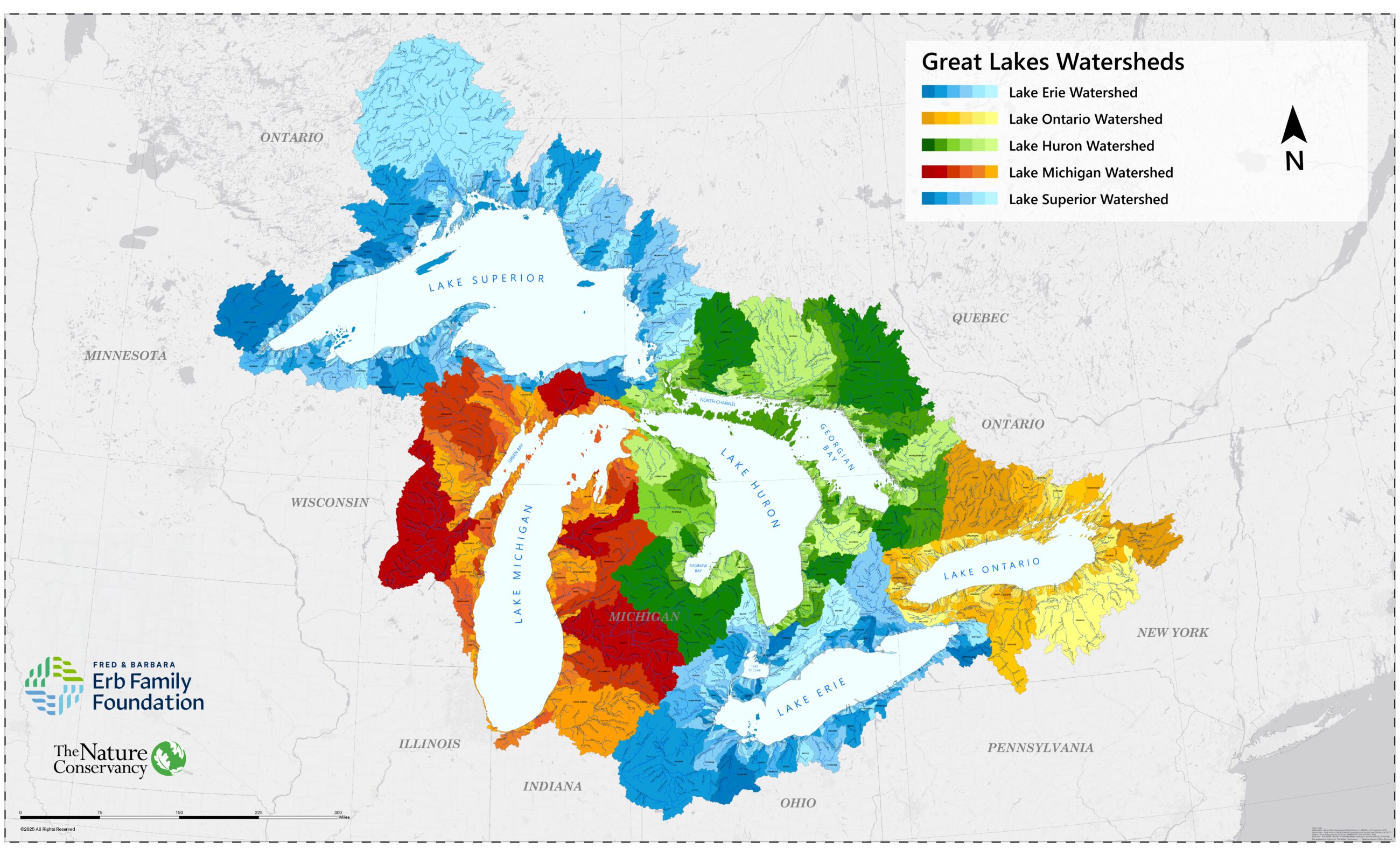
It's which side of the drainage basin is the water moved to? When the water is flushed back into the system, does it drain back into the Great Lakes? or down to the Gulf of Mexico?
On the southern shore of Lake Michigan, that "few miles" changes the watershed that its part of.
As for diversions that go to evaporative cooling, that's a big question for the data center itself and there are many designs. https://www.nrel.gov/computational-science/data-center-cooli... has some cutting edge designs, but they're more expensive to use for pumping waste heat elsewhere.
While the Great Lakes are coming off of wet years ( https://water.usace.army.mil/office/lre/docs/waterleveldata/... ) that shouldn't be used as long term prediction of what will be available in another 10 years lest it becomes another Colorado river problem. Currently, the water levels for Lake Michigan are lower than average and not predicted to return to average in the model range. https://water.usace.army.mil/office/lre/docs/mboglwl/MBOGLWL... . You'll note that this isn't at the minimums from the 1960s... and the Great Lakes Compact was signed in 2008.
But where do we stop with all of this endless expansion? Do the great lakes have to go through an Aral Sea type of situation before we decide it's time to stop? It's not like these AI ghouls are shy about wanting infinite expansion and an ever-growing number of data centers to feed their word generators, do we really think that if we just let them have the water now they're not going to abuse that and that they won't start draining the lakes for all the water they can manage? I'm not so optimistic, myself.
Water levels have been down for years as-is. It may not seem like much now, but I think it's important to avoid a "tragedy of the commons" scenario in the future.
Can you make more substantive comments besides saying "wrong!" ? I don't disagree with your claim but it's extremely low effort and adds nothing to the conversation.
PNG is so violent that you don't even have to be accused of witchcraft to have something bad happen to you.
I worked at an NGO in the region and made several duty travel trips to PNG. The office building I was working in had a platoon of security guards and metal detectors in the lobbies of every floor. A local employee kept an M-16 and ammunition locked in the server room. We had to have security escorts to travel anywhere outside of downtown Port Moresby. Coworkers shared stories of being carjacked like you or I might relate losing a phone.
I spent a lot of time working in Brazil between 2004-2015 and in the first five years or so of that, it was very similar to what you describe (though not the onsite weaponry in offices). Most expats lived in secure walled compounds and execs usually used bulletproof transportation. And this was in Sao Paulo state, not even an out of the way part of the country.
I vouched for this comment, which got flagged dead. It’s got an accusatory tone, which is not great. But it also has accurate substance.
It’s true that westerners visiting nations like PNG for work are often cloistered behind elaborate security. This is in part because the organization has legal responsibility for sending those workers, and the deterrent security measures are way less expensive than the legal and PR headache of an incident. In addition, well-funded and highly organized foreign businesses attract local ire in ways that random individuals do not.
In any one of those countries at any given time there are also foreigners passing through on travel or less organized work (e.g. academia) who experience the country without that thick security layer… and are perfectly fine.
May be because they have less money. Almost any westerner is much richer than the locals, so makes a good target in a way that most South Americans do not.
This is true of a lot of foreign countries where people somewhat exaggerate the security issues, but really isn't of PNG. It's the kind of place where it's not just the foreigners who need a thick security layer to travel, there are plenty of places in the country where no official government representatives could safely travel to without basically bringing the army.
> If you don't bring more fungible labor into the US, the jobs will be offshored.
Offshoring is not always a substitute for an employee chained to the job by a visa. I'm sure you can get a million and one anecdotes here on HN about the perils of working across timezones, cultures, and legal systems.
FWIW, the employees in question are at least in the 90th percentile of US salaries if not 99th percentile (L5 is ~ $250K, L6 is ~ $399K, and L7 is north of $500K)
In regards to fairness, many times these cuts are based what group you are in, rather than performance. You wonder, hypothetically, would the L5s and above all agree to accepting a 20% pay cut in exchange for not having layoffs. It strange that one person keeps the job paying $500K, while the other unlucky one will have trouble getting a new $150K job due to the terrible job market.
Walmart is particularly bad for this: The employees do the picking and they have giant carts that monopolize the aisle. You're stuck waiting for them to scan and bag 8-10 popular items before you can get in there and grab the one thing you need.
> I'd like to point out that IBM still dominates the large, billion-dollars worth mainframe market
Companies continue to pay the IBM tax, but the way IBM writes support contracts incentivizes customers to work very hard at moving workloads to Windows/UNIX. IBM is choosing "Better to reign in [mainframe], then serve in [commodity compute]."


If ECS is faster, then you're more satisfied with AWS and less likely to migrate. You're also open to additional services that might bring up the spend (e.g. ECS Container Insights or X-Ray)
Source: Former Amazon employee
reply