If someone wanted to read more into the theory(s) you highlighted do you have any recommendations on where to start?
I ask because I have not heard either of those ideas put that way of the real illusion being undeniable and needing to shatter that real illusion by raising consciousness, or the idea of "Walter Benjamin said, we must bring about a real catastrophe"
Any recommendations are welcome.
Context no background in German Idealism just some cursory understanding of Marxism and Nietzche.
My favorite, and what I still think is the best Benjamin essay, is On the Concept of History[0], but that one is a bit tough as a first essay, perhaps a better starting place (and where most people start with him) is Art in the Age of Mechanical Reproduction[1]. There's a pretty big gap between those two essays, not intellectually but theoretically, as in it will take you a while, probably, before you understand how they're related.
In general, if you want an actual "start" to studying any modern philosophy, you've got to go with Kant's Critique of Pure Reason (go with the NK Smith or Guyer-Woods translations, though I prefer the former). Then you can start reading forward, Hegel's Phenomenology of Spirit, then, of course, Marx's Capital, vol 1. Then from there, I think you would do well to read Nietzsche's Geneaology of Morals and/or Thus Spoke Zarathustra, and after that really you should read Freud, at the very least the Interpretation of Dreams, and Heidegger, either the Origin of the Work of Art or The Question Concerning Technology. And from there, you can basically just read whatever you want and you'll understand it.
My only further advice is to study all those texts first, before trying anything else, otherwise you'll end up like the people in this comments section.
Thanks for the recommendations I really appreciate it. I have read a lot of philosophy piecemeal but nothing that gave quite the comprehensive connections that you described in either of your comments.
The most important thing is the Critique of Pure Reason, everything else follows from that text. Other than that, everything else here is just an outline, but if you do read all those books, I think you'll be naturally inclined to continue studying on your own in a suitable direction.
Its not just the rich and powerful, its the knowledgeable experts and powerbrokers that facilitate and actually build out the power structure that enables the rich to take advantage of these opportunities.
As long as one of the most lucrative and prestigious routes to success for exceptionally talented people lie in the power structures that require the compromise of society, the rich will have abundant opportunity to harvest the wealth that lies in damaging the world we live in and make money on the "solutions".
Your completely correct if you mean the norm since the 80's when antitrust enforcement was abandoned. Her stances completely align with the standing anti-laws and regulations that have existed for over 80 years. The anti-trust bar and big business have been trying to redefine what anti-trust is for the past 30-40 years which is what got us into this mess of giant firms and too big to fail economics.
The perspective that bringing back regulatory action is outside the norm shows just how skewed economic thinking has been in the US.
It's not just "regulatory action" that the FTC under Khan is embarking on - it's outright hostility and refusal to even work with companies she personally doesn't like.
There is a difference between enforcing laws and then just trying to burn down everything you touch. Khan is embarking on the latter quest (see the way she tried to handle the Within Unlimited acquisition.)
It would be different if the FTC actually attempted to engage in good faith. As someone that has seen them in action recently, they do not.
While I totally agree with the defining of a subject first, I am curious about some of your implicit assumptions inherent in your statement/question.
While everything works on the same rules we definitely have not arrived at the completion of a list of those rules especially when it comes how biologic systems take advantage those rules to build systems. Its inherent in systems that they allow for increased complexity beyond what the base components allow. Its not a stretch to theorize that increased complexity and the opaque nature of physical interactions might allow space for Free Will or independence of consciousness in certain circumstances.
I definitely lack the words to be super eloquent on this front, but I boil it down to a computer comparison. No matter how complex a computer we make it will take inputs and compute outputs. I now of no evidence of a level of complexity at which this is no longer true. I think the idea of free will is enticing, I'd love to look at a situation in which I prevailed and say "yes, I overcame everything to make that happen." But I think the only supported conclusion is that I made the decision and action I made due to a complex, lifelong history of things that happened internally (biology) and externally to me.
Comparatively, I think free will is essentially asking that a computer take inputs and it's programming and shrug that all off to come up with a completely novel output.
It is true that a computer will take inputs and compute outputs, and that is all it ever can do. However, this statement does not quite end up explaining Space Invaders. There's a couple of steps in between that might have been glossed over slightly. [1]
A computer is entirely capable of generating novel (enough) output. Elsewhere I point to the trivial-seeming python function math.random(). Good luck predicting what that will do!
In reality, it turns out that math.random() and the theory behind PRNGs is not so trivial at all, and is actually quite interesting to dive in to. [2]
Your argument boils down to assuming there is true randomness in the universe. You need hardware level rng with a natural source of entropy to generate non-predictable random numbers, but even then you're just at the point where maybe we could predict the randomness if we could go low enough.
We can't, so at the moment it looks as though the universe might have true randomness (I'm very sceptical of this).
But even then, so what? Does that mean free will is just decisions with some true universal randomness thrown in? How does that give you free will if it is just random? And then we're back to, what does free will even mean.
Well, funnily enough rand() isn’t all that random, but that’s beyond the point. I don’t think randomness is a good argument for free will, that’s just nature. Does a flipping coin have free will? An electron before it decoheres?
Well, randomness is definitely novel output though.
PRNGs are not-quite-random, they're actually chaotic functions.
Which is actually a bit closer to how I think free will functions if you look at it empirically from the outside. (At least: if you were to use your <free will> to try to generate 'random' numbers; which will also not be perfectly random!)
Of course, it does sort of depend on your definition of <free will>.
Oh shoot, I see why I made the error, but on checking more sources to back me up, it turns out only some PRNGs are considered chaotic, and the most used ones are not necessarily viewed with that lens in literature. Eh, it would have been easier. In future I'll have to switch to a different set of algorithms to make my argument,.
For me the crux of it is where's the boundary of 'self'. Regardless of how it came to be, we can define a bounded self (whether bio or software) that runs freely taking energy (but not decision input) from outside. Then we can say that that self produces outputs that have internal sources as being 'free'.
To me it basically comes down to infinite butterfly effects where the knowledge of past/current states of the environment can't be effectively used to predict the output of the self.
Another fun way to imagine it is to say 'I' is the complex gut microbiome that's interchanged and evolving and it's the 'source' of decisions more than anything else. It would also solve the problem of how the human population keeps increasing but souls are discrete and countable--even with reincarnation the number of creatures varies greatly. With microbiomes they can be cultivated and/or subdivided, and mixed. Of course this doesn't work out, but it's easy to see there are things that we haven't considered yet to be ruled out.
But that assumes that with the same inputs, the outputs are always the same. As far as I know this hasn't been proven for quantum mechanics. I'm just a layman but in my understanding you can only predict a probability of the result.
That's why with exactly the same inputs, the output can actually differ. Whether or not that's free will is another discussion, but the "we are a very complex yet in theory predicable computer" argument doesn't hold.
If you're willing to accept inputs that are only almost exactly the same, there's already a class of deterministic systems that can provide you with wildly different outputs.
Moreover, in such systems, the output might be impossible to predict based on the input (other than by running the system).
I'm just saying, you don't need to reach for quantum mechanics here, living organisms (and computers) are quite capable of being unpredictable even without it.
While ads are not the main driver of revenue at Apple they did develop a ad service at the same time they implemented the new "privacy" features on iOS.
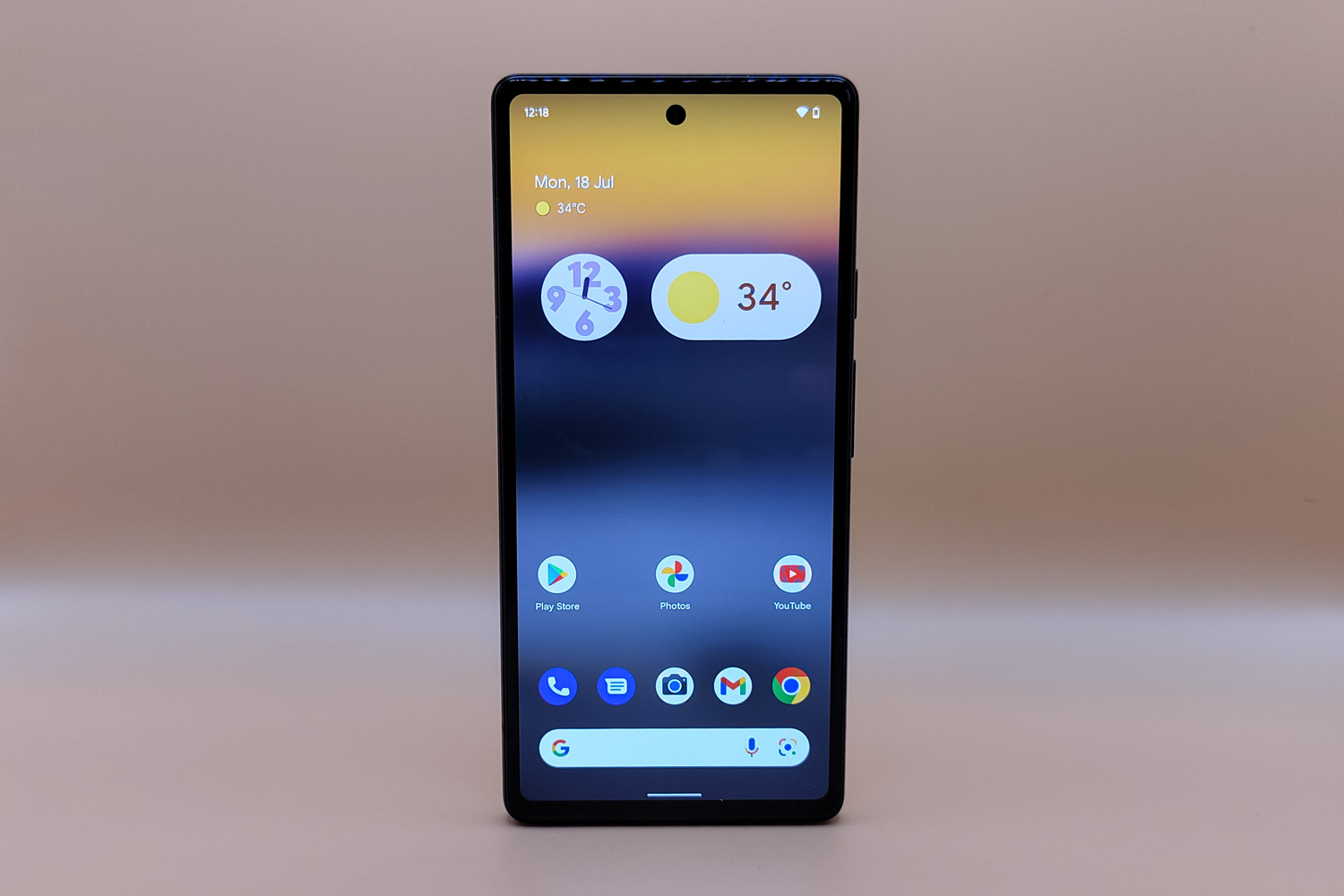
I have a pixe6 and the OEM launcher has a date at the top you can't remove or change and a google chrome search bar at the bottom that you cant remove.
You have to install a 3rd party launcher to remove them.
https://www.stuff.tv/wp-content/uploads/sites/2/2022/07/Goog...
Well, OK. The Google launcher app has... a Google search bar. But again that's just an app, and you can change it. And have been able to for years and years. What's the actual complaint here? I mean, the original complaint was that you can't install your own apps on the home screen. So how is it wrong that the mechanism to do so is to... install your own app?
To be glib: The contention was that you can't change this stuff. And your response is "That's right, you can't change it! You have to CHANGE it to change it!". So... just change it?
"I can't even customise the home screen as much ( Literally cannot remove a link to Chrome and other google apps )."
I was simply clarifying the point the OP brought up. You literally cannot remove that search bar from the homescreen
https://support.google.com/pixelphone/thread/133065648/is-th...
And my point stands, with the Pixel launcher you cant change either of the features mentioned.
And an aside: Interesting how you made me and the OP sound deranged because we don't want to install a 3rd party service to customize the use of our phones. Great Convo
> And an aside: Interesting how you made me and the OP sound deranged because we don't want to install a 3rd party service to customize the use of our phones.
Fair enough, but I was trying to phrase it as a gentle joke.
I mean... you're trying to "customize" them to make them use "3rd party services"! That's the whole point! That's what you want! You want something not-Google, and you're mad that the mechanism to do so is to... not use the Google app.
I mean, you get that that's hilarious, right? Do you get likewise angry (maybe you'd say "deranged") that Microsoft has a Bing search bar on the desktop, or non-removable OneDrive integration in the file browser? That Apple sets you up with an account by default when you unbox your iPhone?
In point of fact, and being completely serious here: of all the major-vendor client platforms out there, Google Android is by far the most customizable in the sense of "removing the vendor's own app integration". Go try to swap your browser on iOS. I really don't understand why you're so upset.
Again I didn't mention any angst over the restriction I was simply reinforcing the OPs point that those items are not negotiable.
And I really don't see how the points you brought up are comparable. The bing search bar is removable and the iOS sign in is required for functionality.
The issue at play here are features that have nothing to do with functionality and are locked in eating up a large space on a limited space device.
This is just poor design from a UX perspective but great placement from a user habit and marketing perspective.
Its great that you degraded our comments/concerns as "hilarious" and that we are "angry" when the OP was simply sharing a subjective experience, with one part that is factually correct.
Thanks for the extra context from the credit holders. It seems that this is completely overlooked in the solutions proposed to solve the housing crisis. Seems like there is an argument to be made that we need new policies to change this calculation at either the state or federal level.
Wouldn't public private partnership funding help with this?